Botanical species
Limonium narbonense
Mill.
Swamp sea-lavender
Description
Morphological description
Perennial herbaceous plant 30 to 70 cm tall, characterized by a bushy habit with glabrous, robust, and cylindrical flowering stems, which can be spreading, arcuate, or erect-patent. These stems are densely branched in the upper part, giving rise to highly branched corymbose inflorescences.
The root system is short and compact, anchoring the plant in brackish and wet soils typical of coastal environments.
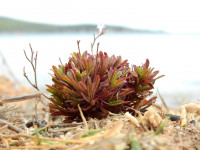
The leaves are arranged in a basal rosette, are petiolate, and range from extremely elliptical to oblong-ovate up to lanceolate-spatulate. They have a fleshy texture, are pinninerved with well-visible lateral veins. Leaf length varies from 15 to 30 cm. The margin is entire and sinuate, often mucronate, while the shape is acute and the blade has a smooth surface. The leaves persist also during flowering.
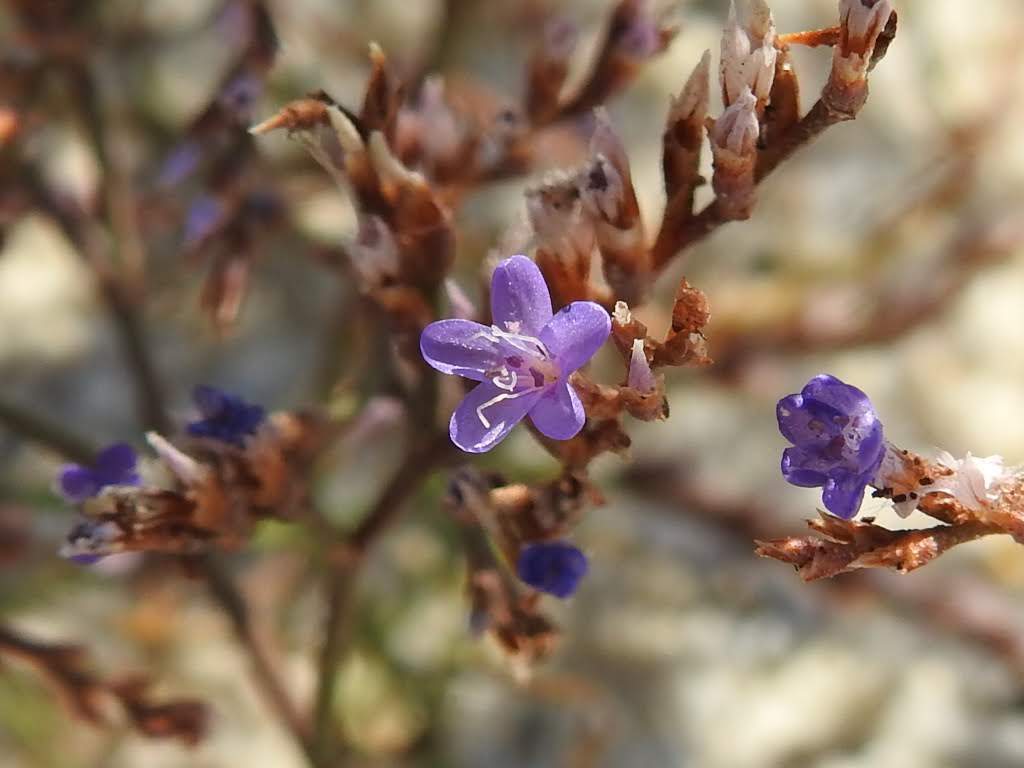
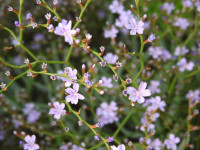
The inflorescence is a highly branched corymbose panicle, composed of dense unilateral spikelets without leaves, each bearing two flowers. The spikelets are arranged in spikes about 6 by 1 cm. The flowers are pink-lilac (or lilac) in color, small in size with a diameter ranging between 5.5 and 6.5 mm. Each flower has five petals and calyces about 5 mm long, with a velvety tube on the ribs and triangular lobes. The bracts, triangular acute or slightly acuminate in shape with a membranous margin, envelop the calyces and are fleshy in the central part. The corollas are generally longer than the calyx by one quarter or one third.
The fruits are minute brown achenes, which mature in autumn.
Habitat and distribution
A typical species of Mediterranean coastal environments, Swamp sea-lavender prefers brackish and marine habitats, such as salt pans, salt marshes, piallasse, and barenic meadows, i.e., areas of clayey or silty soil subject to periodic flooding by tides and characterized by high salinity.
Its distribution is centered on the Mediterranean coasts, with extensions northwards and eastwards, also including areas adjacent to the Vite region. In Italy it is present particularly along the Adriatic coasts, where it is also reported in protected environments such as the salt pans of Cervia.
It grows mainly at low altitude, in flat areas or just above sea level, on clayey or silty soils with high salinity. The preferred exposure is open, typical of coastal areas exposed to sun and sea wind.
Flowering period
Flowering occurs from June to September, with some geographic variability linked to latitude and local environmental conditions. During this period the plant displays its characteristic pink-lilac inflorescences, which constitute a distinctive and visually striking element of brackish coastal habitats.
Ecology and pollination
Swamp sea-lavender is mainly pollinated by pollinating insects attracted by the flowers colored in shades of lilac and by their scent. The structure of the inflorescence, with dense spikes of small flowers, facilitates access for pollinating insects.
The plant reproduces by seed, with achenes maturing in autumn and probably dispersed by abiotic agents, such as wind or water, considering the marine habitat and coastal characteristics. Dispersal by water is suggested by its presence in environments subject to flooding and tides.
Curiosities and traditional uses
In several European countries this species is known as a kind of "sea lavender" or "sea heather." In England it is called "Common Sea-Lavender," in France "Lavande de Mer" or "Saladelle," while in Germany it is known as "Echter Strand-Flieder" (true beach lilac).
The pink-lilac colored inflorescences are highly valued for their long-lasting preservation and were traditionally collected to decorate homes. A widespread memory in Italian coastal areas, such as the salt pans of Cervia after the war, is that of large lilac-violet patches covering the embankments, a natural invitation to gather bunches of these flowers.
In Italy, due to indiscriminate collection and habitat rarity, also caused by reclamation works and coastal protection, Swamp sea-lavender has been included among protected species in some regions, such as Emilia-Romagna.
No significant medicinal or food uses of this species are documented, nor particular references in folklore beyond the ornamental and symbolic value linked to the coastal landscape.
Etymology
The genus name Limonium derives from the Latin limonium, a term that indicated a wild plant of wet meadows, cited since antiquity by Pliny. The specific name narbonense refers to the city of Narbonne in France, probably indicating the place of origin or first description of the species.
The Italian common name "Swamp sea-lavender" precisely recalls this geographic origin, while the vernacular names in other European languages emphasize the association with the marine and coastal environment, comparing it to plants such as lavender or heather.
Sources
- Acta Plantarum - Flora delle regioni italiane (actaplantarum.org)
- Acta Plantarum - Scheda di Mirna Medri
- Tela Botanica / H. Coste, Flore descriptive et illustrée de la France
Characteristics
Scheda botanica
| Famiglia | Plumbaginaceae |
|---|---|
| Fioritura | giugno – settembre |
| Forma biologica | Rosulate |
| Habitat | with purple flowers, Perennial plant, plant with a spreading bushy habit |
Domande frequenti
- Quando fiorisce Swamp sea-lavender?
- Swamp sea-lavender fiorisce giugno – settembre.
- Che tipo di pianta è Swamp sea-lavender?
- Swamp sea-lavender è una Hemicryptophytes (Rosulate) secondo la classificazione di Raunkiaer.
- A quale famiglia appartiene Swamp sea-lavender?
- Swamp sea-lavender appartiene alla famiglia botanica Plumbaginaceae.
Where I found it (18 sightings)
Classification
- Kingdom
- Plantae
- Family
- Plumbaginaceae
- Full name
- Limonium narbonense Mill.
- Synonyms
- Limonium angustifolium (Tausch) Turrill, Limonium serotinum (Rchb.) Pignatti, Limonium vulgare Mill. subsp. serotinum (Rchb.) Gams
- Life form
- Hemicryptophytes rosulate
Similar species
Search for species with similar characteristicsFurther reading
Noticed an error in the identification? Write to me
Other species of the same family
Plumbaginaceae
Explore
Other species of Plumbaginaceae