Botanical species
Limonium ilvae
Pignatti
Limonio dell'Elba
Description
Morphological description
Perennial herbaceous plant belonging to the family Plumbaginaceae, with a bushy and compact habit, typically psammophilous and endemic to the island of Elba. It presents basal rosettes of persistent, evergreen leaves arranged at ground level. The leaves are characterized by a leathery texture, suitable for withstanding coastal and sandy exposure conditions.
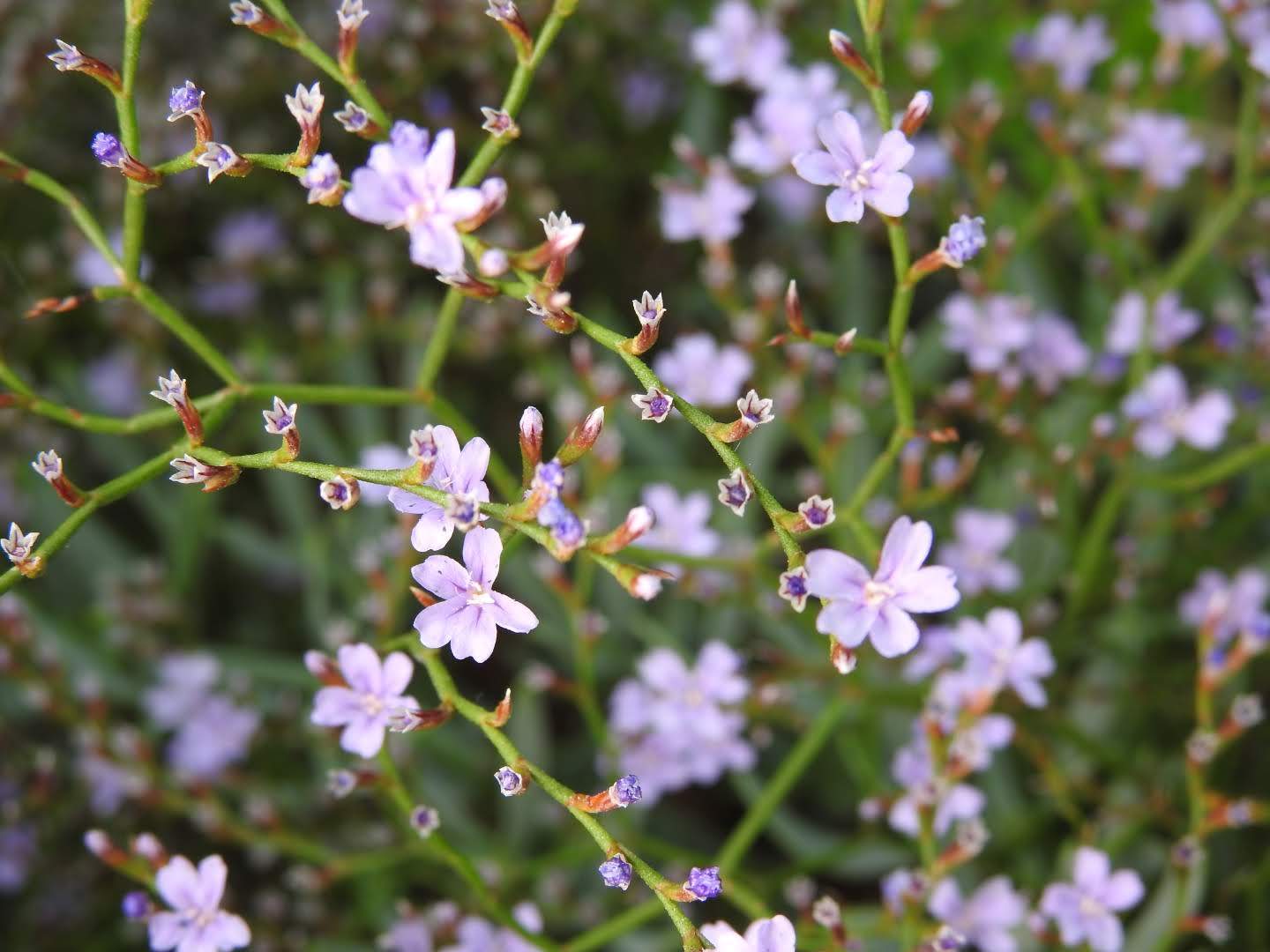
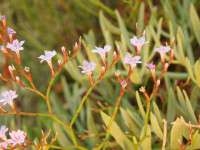
The stem is jointed and arched, with abundant sterile branches contributing to the formation of dense shrubs. The inflorescences consist of arcuate-patent spikes, 3 to 5 cm long, each bearing 3-4 spikelets arranged along about 1 cm of the axis. The spikelets generally contain one or two flowers.
The flowers are deep violet in color, with five well-distinct petals, and have a subsessile calyx 4.5 to 4.7 mm long (in some populations from Procchio and Marciana Marina slightly larger calyces are observed, between 5 and 5.5 mm). The inner bracts are 3-3.5 mm long, while the outer ones measure 0.8-1 mm. The overall habit of the inflorescences, together with the vivid color of the flowers, gives the plant an ornamental appearance, typical of coastal species adapted to windy and salty conditions.
The fruit is not described in the available sources; however, as in many Plumbaginaceae, it is presumably a small and light achene, suitable for dispersal in coastal environments.
The root system is presumably well developed and adapted to stabilize the plant in sandy substrates, favoring anchorage and efficient absorption of water and nutrients under conditions of low availability.
Habitat and distribution
It is an endemic species of the island of Elba, where it mainly grows in coastal environments, on sandy and psammophilous substrates, typical of beaches and coastal dunes. The distribution is therefore very limited and restricted, with populations mainly known in the areas of Procchio and Marciana Marina.
It prefers sunny exposures and marine conditions, tolerating salty winds and poor, draining, sandy soils well. Its presence is strictly linked to these coastal habitats, characterized by strong exposure and Mediterranean climatic conditions, with dry summers and mild winters.
It is not reported beyond Elba, nor in other areas of the Mediterranean, confirming its status as an endemic species of conservation interest.
Flowering period
Flowering extends from May to July, corresponding to late spring and early Mediterranean summer. No significant variations in the flowering period are known among the different populations, given the restricted range and fairly uniform climatic conditions on the island of Elba.
Ecology and pollination
The violet flowers are probably pollinated by pollinating insects attracted by the color and shape of the flowers. The morphological characteristics suggest an entomogamous pollination strategy, common among coastal Plumbaginaceae. The presence of single or double flowers in the spikelets may facilitate greater attraction for pollinating insects.
Seed dispersal, although not thoroughly documented, is presumed to occur mainly by wind action and perhaps, to a lesser extent, by water or animal transport, in line with the habits of species living in coastal and sandy habitats.
Curiosities and traditional uses
No specific traditional or medicinal uses are known for this species, probably due to its rare distribution and endemism restricted to the island of Elba. Its main importance lies in its ecological and conservation value, being an indicator of intact and relatively undisturbed coastal habitats.
The common name “Limonio dell’Elba” precisely reflects its close association with this island, emphasizing its geographical exclusivity.
Etymology
The scientific name "Limonium" derives from the Greek "leimonion," a diminutive of "leimon" meaning "meadow" or "pasture," probably referring to the open and sunny habitats typical of many species in the genus.
The specific name "ilvae" is a direct reference to the island of Elba, whose ancient Latin name is "Ilva," highlighting the species’ endemism to this location.
The Italian common name “Limonio dell’Elba” is therefore a literal translation associating the genus Limonium with its area of occurrence, facilitating identification and communication with the general public.
Sources
- Prof. S. Pignatti, "Flora d'Italia"
Characteristics
Scheda botanica
| Famiglia | Plumbaginaceae |
|---|---|
| Fioritura | maggio – luglio |
| Forma biologica | Rosulate |
| Habitat | with purple flowers, psammophilous plant, endemic plant |
Domande frequenti
- Quando fiorisce Limonio dell'Elba?
- Limonio dell'Elba fiorisce maggio – luglio.
- Che tipo di pianta è Limonio dell'Elba?
- Limonio dell'Elba è una Hemicryptophytes (Rosulate) secondo la classificazione di Raunkiaer.
- A quale famiglia appartiene Limonio dell'Elba?
- Limonio dell'Elba appartiene alla famiglia botanica Plumbaginaceae.
Where I found it (10 sightings)
Classification
- Kingdom
- Plantae
- Family
- Plumbaginaceae
- Full name
- Limonium ilvae Pignatti
- Life form
- Hemicryptophytes rosulate
Similar species
Search for species with similar characteristicsNoticed an error in the identification? Write to me
Other species of the same family
Plumbaginaceae
Explore
Other species of Plumbaginaceae