Botanical family
Cyperaceae
Description
Botanical characteristics
The Cyperaceae are a family of herbaceous monocotyledonous plants, predominantly graminoid, with a tufted habit. The stems are often triangular in cross-section, without obvious nodes, and the leaves are alternate, linear or linear-lanceolate in shape, with sheathing bases that wrap around the stem; the leaf blade is generally coriaceous. These plants are usually perennial or annual and are mainly found in wet environments.
The flowers of Cyperaceae are inconspicuous and generally unisexual, although in some genera they can be hermaphroditic. They do not possess a perianth (i.e., tepals or petaloid sepals), but are surrounded by herbaceous bracts known as glumes, which protect and replace them. The floral structure is often interpreted as a hermaphroditic inflorescence, simulating a 4-cyclic flower (pseudanthium), formed by an apical female flower with 3(2) carpels and a unilocular ovary, flanked by one or more male flowers with 3(1) stamens. The style is single and ends in 2-3 stigmas. The flowers are gathered in solitary spikes or in compound inflorescences such as anthela, panicle, capitulum, raceme or spike.
The typical fruit is a nutlet (a coriaceous indehiscent achene), often enclosed in a sheath called utricle. Morphologically, Cyperaceae differ from Graminaceae by the triquetrous shape of the stems and the absence of nodes, as well as by the different flower structure, which in Graminaceae are hermaphroditic with a reduced perianth and a fixed number of stamens and tepals. Cyperaceae are mostly anemophilous plants, i.e., wind-pollinated.
Distribution and diversity
The Cyperaceae family is cosmopolitan, with a predominant distribution in temperate, tropical and subtropical zones, especially in wet habitats such as ponds, marshes, riverbanks and swampy soils. Their presence is particularly abundant in wet environments, where they often constitute dominant plant communities.
The family includes about 90 genera and numerous species, many of which are morphologically similar and difficult to distinguish without careful botanical analysis. This high number of species makes Cyperaceae one of the richest families in species among monocotyledons.
Main genera and representative species
Among the most important genera of Cyperaceae, we find:
-
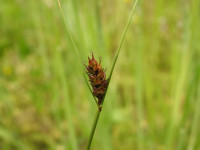
Carex: the genus richest in species, commonly known as sedges. These plants are also widespread in Italy, especially in wet and marshy areas. Carex species are often tufted and easily recognizable by their characteristic floral spikes.
-
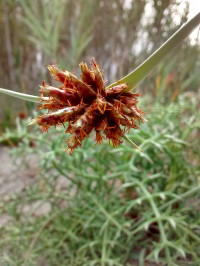
Cyperus: includes species such as papyrus (Cyperus papyrus), known for its historical use in paper manufacturing. This genus is widespread in wet and tropical environments and is also represented in Europe by some minor species.
-
Eleocharis: genus that includes aquatic or marsh species with thin stems and reduced leaves, commonly found in ponds and marshy areas.
-
Scirpus and Schoenoplectus: genera with species from marshy environments, often with robust stems and spike inflorescences.
In Italy, besides several species of Carex, species belonging to the genera Scirpus, Eleocharis and Cyperus are also found, populating wetlands, lakes and ponds.
Etymology
The family name derives from the genus Cyperus, which in turn has ancient origins in the Greek language (κύπερος, kýperos), which indicated plants similar to sedges or marsh plants. The term was scientifically adopted to define this group of graminoid marsh plants.
Curiosities and uses
Cyperaceae play an important ecological role in wetlands, contributing to soil stabilization, water purification and providing habitat for numerous aquatic and terrestrial organisms. Some species, such as papyrus, have historically been used by humans for the production of materials such as paper and textiles.
In some cultures, certain Cyperaceae species are used for ornamental or artisanal purposes, especially for their resistance and the fibrous structure of the stems. However, in many contexts Cyperaceae can become weeds in lawns or irrigated crops, due to their adaptability to wet soils.
Sources
- Wikipedia (it)
Species of the family
2 species catalogued
Explore
Other botanical families