Botanical species
Viola odorata
L.
Sweet Violet
Description
Morphological description
Perennial herbaceous plant, acaulescent in habit, generally 5 to 15 cm tall, with a root system consisting of a long, thick, creeping rhizome that produces numerous stolons, both subterranean and aerial, thin and rooting at the nodes. These stolons are sterile during the first year, while they become flowering in the second year of life. The plant has fine and widespread pubescence.
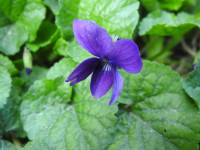
The leaves are all basal, arranged in a rosette, with petioles up to about 5 cm long and equipped with downward-facing hairs. The leaf blade is broadly ovate-cordate or reniform, with crenulate margins and a deep basal sinus; the shape is rounded, with the maximum width located about halfway up the leaf. The leaves are dark green tending to bluish. The stipules flanking the petiole are broadly oval or lanceolate, 4-5 mm long, with short glandular fringes less than 1 mm.
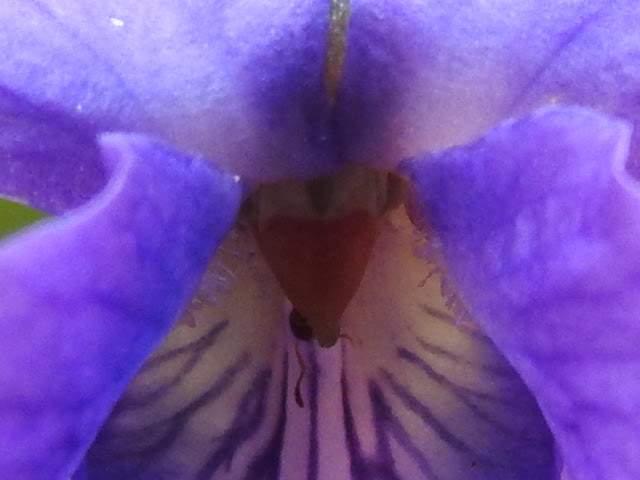
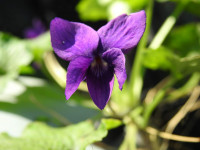
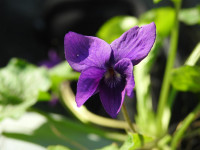
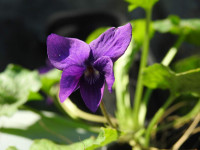
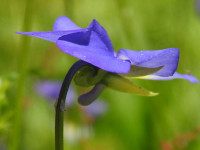
The flowers are solitary, borne on peduncles inserted on the leaf rosette, as long as or slightly shorter than the leaves. The corolla is composed of five petals, of which the lateral ones are folded downward and close to the larger lower petal. The corolla has a diameter of about 1.5-2 cm, with a typical dark violet color, intensely fragrant, but it can present less common color variants of pink or white. The spur is straight, about 6 mm long, the same color as the corolla. The sepals are oval, obtuse and provided with short cilia.
The fruit is a subglobose capsule, pubescent with short hairs and dense fuzz, with three valves, which opens to release relatively large and light-colored (ochroleucous) seeds. The fruiting peduncles are prostrate, that is, they bend downward.
The plant is evergreen and aromatically scented, a characteristic that makes it easily recognizable even outside the flowering period.
Habitat and distribution
The species is widely distributed throughout the Italian territory, from the plains up to about 1200 meters altitude, present both in continental and insular regions. Its range also extends throughout southern and Mediterranean Europe, with occurrences in some regions of central and western Europe, up to the Middle East and northern Africa.
It grows in various habitats but prefers grassy places, uncultivated areas, forest edges, hedges and roadside borders, often in shady or semi-shady environments. It likes well-drained soils, both calcareous and neutral, and is commonly found in meadows, open woods and thickets. It is also frequent in anthropized areas, where it often naturalizes or is cultivated in gardens and parks.
Flowering period
Flowering occurs mainly between February and April, with possible variations depending on local climatic conditions. In some areas it can extend until May. The fruiting period immediately follows flowering, with seed dispersal from April to June.
Ecology and pollination
The plant is mainly pollinated by pollinating insects attracted by the intense and sweet scent of the flowers, particularly bees and butterflies. The zygomorphic structure and bright color of the flowers favor visits by pollinating insects. The presence of cleistogamous flowers (closed and self-fertilizing) also allows reproduction even in the absence of pollinators.
Seed dispersal occurs through the capsule which, once opened, releases the seeds onto the ground around the mother plant. Stolons allow rapid clonal vegetative expansion, facilitating territory colonization.
Curiosities and traditional uses
Sweet Violet has been known for centuries for its medicinal properties and food uses. The leaves, flowers and rhizomes are used in herbal medicine: the leaves in decoction have a mild laxative effect, while the flowers, often used in infusions and syrups, are appreciated for their anti-inflammatory and purifying properties, effective against bronchitis, cough, pleurisy and catarrh. The roots are used for expectorant decoctions and as laxatives.
In culinary use, the flowers are edible and used to decorate desserts and salads or to prepare scented beverages. The plant is also cultivated for its ornamental value and characteristic fragrance.
In popular folklore, Sweet Violet is associated with legends and symbolism related to purity, modesty and secret love, often mentioned in classical literature and Italian poetic tradition.
Etymology
The genus name, Viola, derives from the Latin "viola" or "violetta", a term already used in antiquity to indicate these plants, with roots tracing back to ancient Greek. According to a legend, the nymph Io, transformed into a cow, would have given rise to the violet as a form of pasture, hence the name.
The specific epithet odorata derives from the Latin adjective odoratus, meaning "fragrant", referring to the characteristic intense and sweet scent of the flowers.
The Italian common name "viola mammola" refers to the rounded and soft shape of the flowers, "mammola" being a dialect term indicating the softness and roundness typical of this species.
Sources
- Prof. S. Pignatti, "Flora d'Italia"
- Acta Plantarum - Flora delle regioni italiane (scheda di Silvano Radivo)
- Tela Botanica / H. Coste, "Flore descriptive et illustrée de la France"
- World Flora Online (WFO)
Characteristics
Scheda botanica
| Famiglia | Violaceae |
|---|---|
| Fioritura | febbraio – aprile |
| Forma biologica | Rosulate |
| Habitat | with purple flowers, fragrant plant, Perennial plant |
Domande frequenti
- Quando fiorisce Sweet Violet?
- Sweet Violet fiorisce febbraio – aprile.
- Che tipo di pianta è Sweet Violet?
- Sweet Violet è una Hemicryptophytes (Rosulate) secondo la classificazione di Raunkiaer.
- A quale famiglia appartiene Sweet Violet?
- Sweet Violet appartiene alla famiglia botanica Violaceae.
Where I found it (17 sightings)
Classification
- Kingdom
- Plantae
- Family
- Violaceae
- Full name
- Viola odorata L.
- Life form
- Hemicryptophytes rosulate
Similar species
Search for species with similar characteristicsFurther reading
Noticed an error in the identification? Write to me
Other species of the same family
Violaceae
Explore
Other species of Violaceae