Botanical species
Vincetoxicum hirundinaria
Medik.
White Swallow-Wort

Description
Morphological description
Perennial herbaceous plant, White Swallow-Wort has a habit that can vary from erect to prostrate or climbing, with stems reaching a height between 30 and 100 cm. The base of the stem is lignified, longitudinally striated and characterized by the presence of two lines of hairs; the surface of the stem is hirsute and tomentose, with an angular section. Sometimes the stem may appear slightly twisted, wrapped to the left.
The leaves are opposite, with a decussate arrangement, lanceolate and acuminate, with sizes varying between 3-5 cm in width and 5-9 cm in length. The upper side is a shiny dark green, while the underside is lighter and shows a well-evident reticulate venation. The basal leaves may be more cordate, while the upper ones become oval-lanceolate with a rounded base. The petiole is short, about 1 cm.
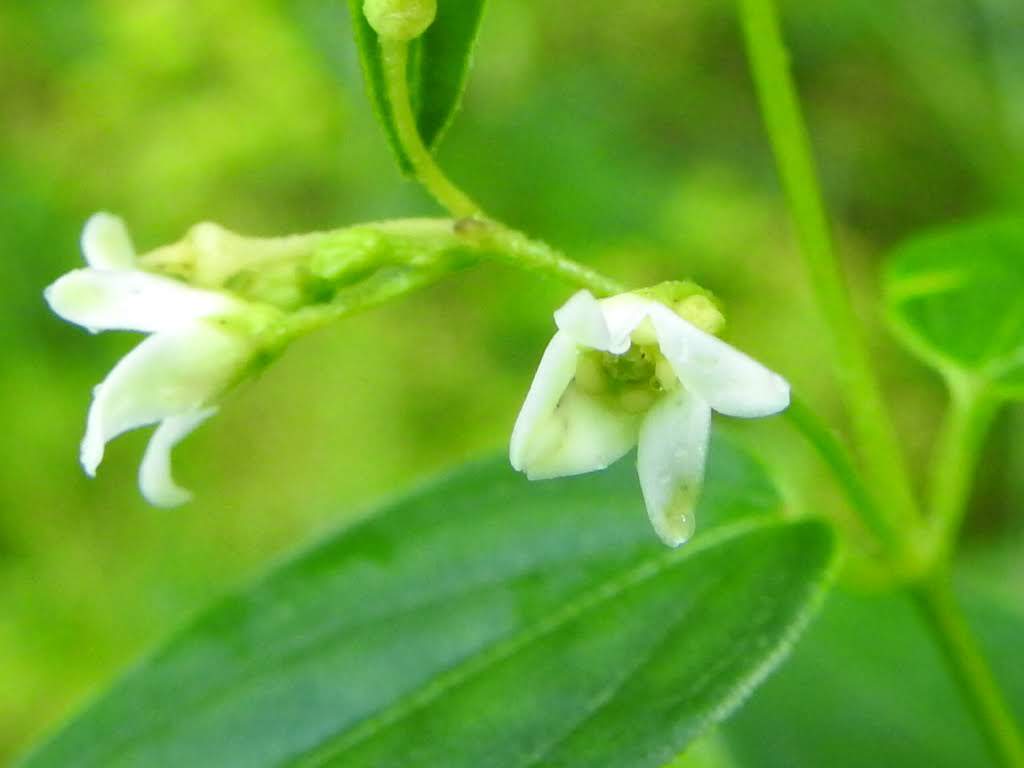
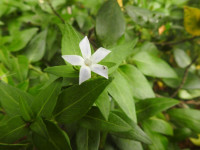
The flowers, small (about 8 mm in diameter), are creamy white and arranged in scapose corymbose cymes (i.e. with an elongated floral axis often leafless) in the axils of the upper leaves. The flower peduncles measure 5-6 mm. The corolla is formed by 5 lanceolate lobes, about 4 mm long, connected to each other for half their length by a transparent membrane. The stamens are yellow-greenish and protrude from the corolla. The calyx has 5 linear teeth, about 1.5 mm long.
The fruit is a fusiform follicle, 4-5 cm long, acuminate and supported by a reflexed peduncle. Inside it contains numerous ovoid, compressed, brownish seeds, equipped with characteristic white and soft hairs that facilitate dispersal by wind.
The root system includes a creeping rhizome that allows the plant to overwinter and colonize the soil.
Habitat and distribution
White Swallow-Wort is mainly widespread in temperate European regions, with a presence extending from Western Europe to Japan, thus typically Eurasian. In Italy it grows in sparse woodland environments, sunny shrubby cliffs, preferring calcareous and stony soils. The plant adapts to warm and dry exposures, showing some xerophily, and is commonly found from the hill belt up to 1,700 m altitude. It often frequents garrigues, rocks, thickets and places with well-drained substrates.
In the Mediterranean area it is especially present in temperate climate zones, and in Italy it is well represented in the central-northern regions, also adapting to slightly arid conditions.
Flowering period
Flowering extends from May to September, with main peaks between June and August. The period may vary slightly depending on latitude and altitude, occurring earlier in warmer areas or later in mountainous environments.
Ecology and pollination
The flowers of White Swallow-Wort, characterized by white and delicate corollas, are mainly pollinated by pollinating insects attracted by the color and morphology of the flowers. The corymbose and scapose structure facilitates access for pollinating insects. The fruits, follicles containing winged seeds and equipped with soft hairs, rely on the wind for dispersal, allowing the plant to colonize new environments.
An interesting ecological aspect concerns the relationship with the fungus Cronartium flaccidum, agent of blister rust of two-needle pines. This fungus uses White Swallow-Wort as an intermediate host in its life cycle, establishing a closely connected link between the herbaceous plant and the surrounding forest environment.
Curiosities and traditional uses
The genus name derives from the Latin “vinco” (to conquer) and “toxicum” (poison), alluding to ancient beliefs that the plant could be a remedy against poisons and poisonings. The specific name “hirundinaria” refers to the root of the plant, which resembles the shape of a swallow’s tail, from “hirundo” meaning swallow.
White Swallow-Wort is known for its toxicity: it contains glycosides such as vincetoxin and alkaloids with effects similar to aconitine, capable of causing excessive salivation, vomiting, diarrhea, abdominal pain, cramps and paralysis. For this reason, it is considered a poisonous and inedible species.
Historically, the plant has been used in folk medicine as a diuretic, depurative and sudorific, and in the past it was believed to act as an antidote against snake bites. However, such uses are now discouraged due to toxicological risks.
Etymology
The scientific name Vincetoxicum combines the Latin “vinco” (to conquer) and “toxicum” (poison), referring to its presumed ability to neutralize poisons, despite being poisonous itself. The specific epithet “hirundinaria” derives from “hirundo”, swallow, and refers to the characteristic shape of the root similar to a swallow’s tail.
The Italian common name “White Swallow-Wort” directly recalls the toxic property of the plant and its traditional identification as a plant linked to the theme of poison and its neutralization.
Sources
- Acta Plantarum - Flora delle regioni italiane (actaplantarum.org)
- Acta Plantarum - Flora delle regioni italiane (scheda di Marinella Zepigi)
- Tela Botanica / H. Coste, "Flore descriptive et illustrée de la France"
- World Flora Online (WFO)
Characteristics
Scheda botanica
| Famiglia | Apocynaceae |
|---|---|
| Fioritura | maggio – agosto |
| Forma biologica | Scapose |
| Habitat | with white flowers, toxic plant, plant with a prostrate-ascending habit |
| Tossicità | Tossica — non consumare |
Domande frequenti
- Quando fiorisce White Swallow-Wort?
- White Swallow-Wort fiorisce maggio – agosto.
- È tossica White Swallow-Wort?
- White Swallow-Wort è una pianta tossica o velenosa. Non consumare nessuna sua parte senza aver consultato un esperto.
- Che tipo di pianta è White Swallow-Wort?
- White Swallow-Wort è una Hemicryptophytes (Scapose) secondo la classificazione di Raunkiaer.
- A quale famiglia appartiene White Swallow-Wort?
- White Swallow-Wort appartiene alla famiglia botanica Apocynaceae.
Where I found it (5 sightings)
Classification
- Kingdom
- Plantae
- Family
- Apocynaceae
- Full name
- Vincetoxicum hirundinaria Medik.
- Life form
- Hemicryptophytes scapose
Similar species
Search for species with similar characteristicsFurther reading
Noticed an error in the identification? Write to me
Other species of the same family
Apocynaceae
Explore
Other species of Apocynaceae