Botanical species
Vinca minor
L.
Lesser Periwinkle
Description
Morphological description
Evergreen perennial herbaceous plant, with a creeping and rhizomatous habit, capable of spreading on the ground up to over one meter in length. The sterile stems lie along the soil, rooting at the nodes, while the fertile stems, shorter and erect, bear solitary flowers at the axils of the upper leaves. The surface of the stems is glabrous and tough.
The leaves are arranged oppositely along the stem, elliptic-lanceolate in shape, leathery and glossy on the upper side, dark green in color, while the lower side is lighter, matte, with well-defined and prominent reticulate veins. The leaf margin is entire and the blade generally measures between 10-35 mm in length and 10-16 mm in width. The petiole is short, from 1 to 5 mm.
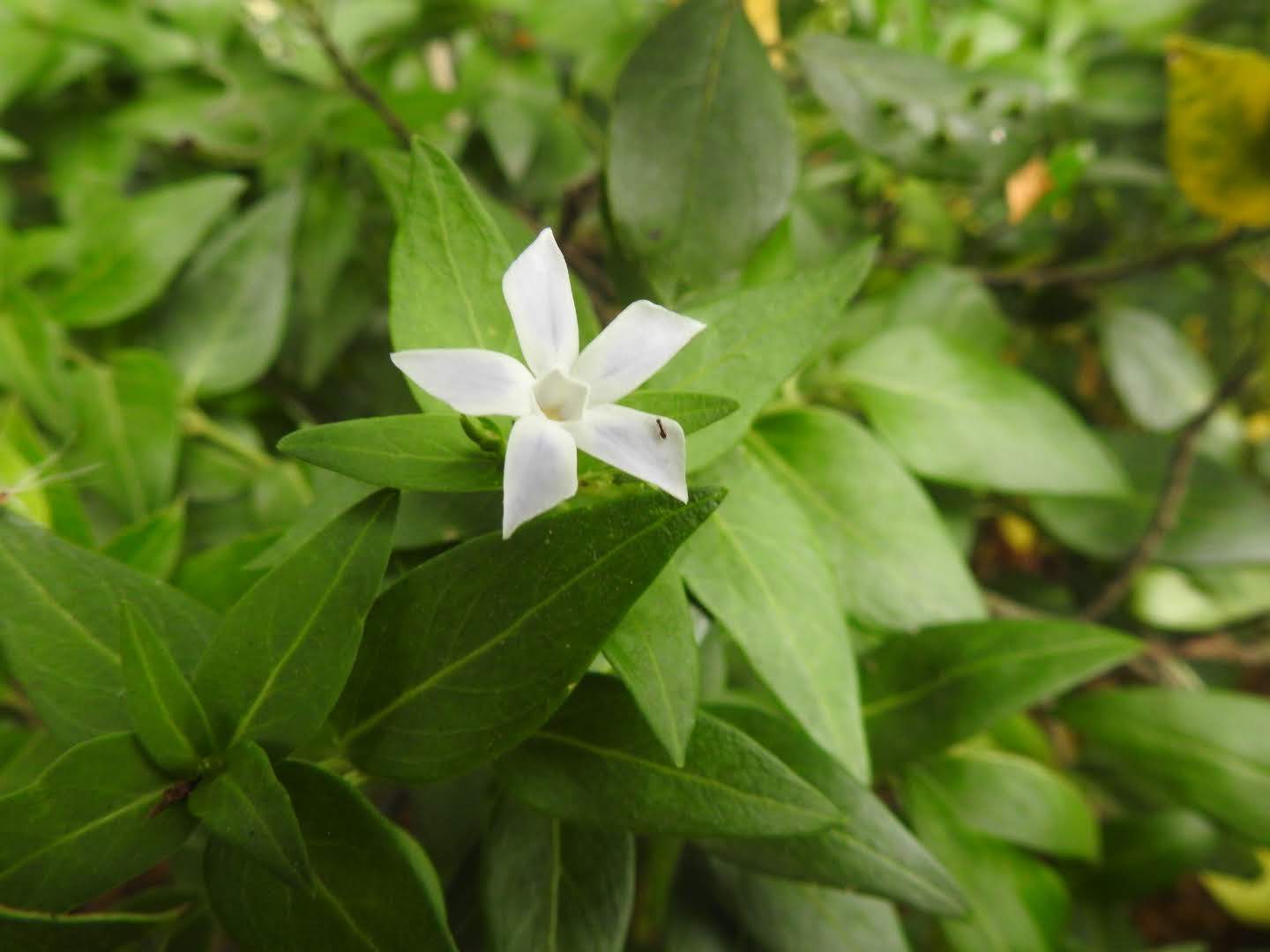
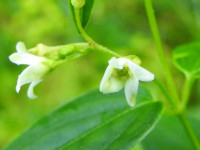
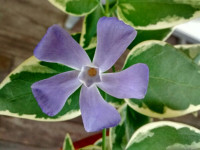
The flowers are solitary, inserted singly in an axillary position, supported by a peduncle 9 to 30 mm long, often longer than the corolla. The calyx consists of five lanceolate, glabrous lobes, about 3-4 mm long, divided for about two thirds, with an entire margin and sometimes a small basal tooth on each side. The corolla is gamopetalous, tubular in shape with a tube about 1 cm long, and opens into five spatulate, obovate-spatulate lobes, slightly asymmetric and truncate at the apex. The flower diameter ranges from 2.5 to 3.5 cm. The predominant color is bluish-violet, with variations that may include lighter shades or, more rarely, white or pink.
The androecium is included in the corolla tube: the five stamens have filaments curved at the base, each bearing a tuft of hairs; the anthers are yellowish, flattened, pubescent on the back and with an apex curved toward the stigma. The ovary is superior, bicarpellary and glabrous; the style is filiform and yellowish with a green stigma shorter than the anthers, adorned with tufts of white hairs around the stigmatic opening.
The fruit consists of two divergent follicles, cylindrical and acuminate, about 1.5 cm long, containing glabrous, oval, grooved black seeds.
The root system is rhizomatous, formed by a dense network of thin roots that promotes anchorage to the soil and erosion control on slopes.
Habitat and distribution
A typical species of the understory of broadleaf forests, especially oak woods, it prefers moist, humus-rich and well-drained soils. It commonly grows in wooded and shrubby environments, on fresh and shady substrates, up to about 1,300 meters altitude.
Its natural distribution includes central and southern Europe, the Caucasus and the Mediterranean area, with widespread presence in Italy and many European regions. In Italy it is common in broadleaf forests, preferring semi-shady exposures and fresh or moist soils.
Flowering period
Flowering extends from February to April, with slight geographical variations linked to altitude and local climate. In some Mediterranean areas, flowering may begin as early as late winter, while in cooler or mountainous zones it can continue until May.
Ecology and pollination
Lesser Periwinkle reproduces mainly through entomogamous pollination: the flowers, with tubular corolla and violet or blue coloration, attract various pollinating insects, including bees, butterflies and bumblebees, which facilitate pollen transfer. The androecium and gynoecium are included in the corolla tube, a feature that favors specialized pollination by insects equipped with mouthparts adapted to probe the tube.
Seed dispersal occurs through the follicles containing black and grooved seeds; however, the species also spreads effectively vegetatively through creeping rhizomes that allow colonization of large areas, forming dense colonies.
Curiosities and traditional uses
Lesser Periwinkle has traditionally been used in herbal medicine and folk medicine, although it is a toxic species due to the presence of alkaloids such as vincristine and vincamine. The latter is an active principle used pharmacologically as a vasodilator and cerebral stimulant.
The leaves are known for their diuretic, astringent, digestive and hypotensive properties. For external use, the plant has anti-inflammatory applications and has been used in baths and poultices for the treatment of dermatoses, boils and eczema, with moderate cosmetic efficacy on delicate and irritated skin.
Historically, periwinkle has been a symbol of purity, fidelity and affectionate memory. Its flowers and evergreen leaves were used to compose wedding garlands and funeral crowns. In popular tradition, Lesser Periwinkle was believed to bring good luck to newlyweds and represent the tenacity of remembrance.
Despite its uses, the plant should be handled with care: ingestion can cause symptoms such as nausea, vomiting, fever and, in severe cases, neurological disorders. In the past, these properties were exploited to prepare magical love potions.
In ornamental horticulture, Lesser Periwinkle is highly valued for ground cover in gardens and parks, thanks to its ability to form dense green carpets and its flowers with delicate bluish-violet colors, with cultivated varieties also available in white or purplish flowers.
Etymology
The genus name derives from the Latin vincire, meaning "to bind," referring to the long creeping shoots formerly used to weave garlands worn on the head. The specific name minor indicates the smaller size compared to the related species Vinca major, the greater periwinkle.
The Italian common name "pervinca minore" reflects this size distinction, highlighting the smaller size and smaller flowers compared to the greater periwinkle.
Sources
- Prof. S. Pignatti, "Flora d'Italia"
- Acta Plantarum - Flora delle regioni italiane (scheda di Marinella Zepigi)
- Tela Botanica / H. Coste, "Flore descriptive et illustrée de la France"
- World Flora Online (WFO)
Characteristics
Scheda botanica
| Famiglia | Apocynaceae |
|---|---|
| Fioritura | febbraio – aprile |
| Forma biologica | Creeping |
| Habitat | creeping plant, with purple flowers, Perennial plant |
Domande frequenti
- Quando fiorisce Lesser Periwinkle?
- Lesser Periwinkle fiorisce febbraio – aprile.
- Che tipo di pianta è Lesser Periwinkle?
- Lesser Periwinkle è una Chamaephyte (Creeping) secondo la classificazione di Raunkiaer.
- A quale famiglia appartiene Lesser Periwinkle?
- Lesser Periwinkle appartiene alla famiglia botanica Apocynaceae.
Where I found it (4 sightings)
Classification
- Kingdom
- Plantae
- Family
- Apocynaceae
- Full name
- Vinca minor L.
- Life form
- Chamaephyte creeping
Similar species
Search for species with similar characteristicsFurther reading
Noticed an error in the identification? Write to me
Other species of the same family
Apocynaceae
Explore
Other species of Apocynaceae