Botanical species
Vinca major
L.
Greater Periwinkle
Description
Morphological description
Perennial, evergreen herbaceous plant, characterized by both erect and creeping habit. It can reach a height of 40-80 cm in the erect stems, while the long stolons or creeping shoots can extend up to about 100 cm, rooting at the tips and forming a dense vegetative carpet. The stem is woody at the base and herbaceous in the upper part.
The leaves are opposite, ovate or ovate-acuminate, with variable sizes generally between 3-6 cm in length and 2-4 cm in width. They have a herbaceous and slightly coriaceous texture, with finely ciliate margins (i.e., bordered by small hairs) and often an acuminate apex. The leaf surface is glossy, dark green, glabrous or with slight pubescence along the margins, and the base is generally rounded or slightly cordate. The petiole is short, about 5 to 15 mm.
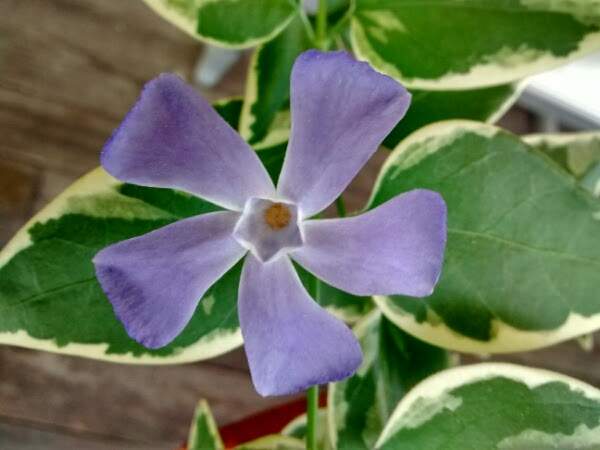
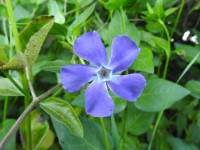
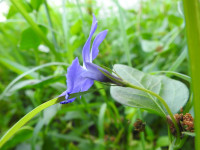
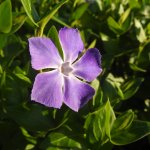
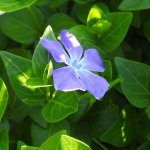
The flowers are solitary, hermaphroditic and actinomorphic, blue-violet or violet in color, with a corolla 4-5 cm in diameter. The corolla is gamopetalous, funnel-shaped (hypocrateriform), with five oblique, spreading lobes, truncate at the apex and with a characteristic white ring at the base (throat). The corolla tube is 1.2-1.6 cm long. The calyx consists of 5 linear lobes, 1-1.8 cm long, acuminate and ciliate along the edges, persistent and almost the same length as the corolla tube. The flowers are inserted singly at the axil of the upper leaves, supported by peduncles 2-5 cm long, generally shorter than the leaves themselves.
The fruit consists of two fusiform follicles, divergent, 2-4 cm long, glabrous and dehiscent along the ventral suture. The seeds are ellipsoid, brown, without a tuft of hairs.
The root system is rhizomatous, with stolons that allow the plant to expand rapidly and root in new points, facilitating the formation of dense and stable vegetative carpets.
Habitat and distribution
The species is mainly widespread in Mediterranean regions, with a range extending from southern Europe to Asia Minor and North Africa. In Italy it is present throughout the territory, but it is considered native especially in central-southern Italy. In northern regions it is often found as a cultivated plant and subsequently naturalized, rarely found far from inhabited centers.
It typically grows in woods, hedges, parks, banks along watercourses and in shaded or semi-shaded environments, preferring fresh and well-drained soils. It tolerates exposures from partial shade to shade, with a preference for humid or moderately humid habitats. It also adapts to variable substrates, from fertile soils to poorer soils, but avoids excessively dry or too exposed conditions. It is generally found from low altitudes up to about 1500-1850 m above sea level.
Flowering period
Flowering extends from late winter to late spring, with the main months being March, April and May. In some Mediterranean or more temperate areas it can start as early as late February and continue until June. The production of solitary and well-visible flowers is abundant especially in the erect parts of the plant.
Ecology and pollination
Greater Periwinkle is mainly pollinated by insects (entomogamous), which are attracted by the vivid blue-violet color and the open shape of the flowers. The structure of the corolla, with a relatively long tube and a white ring at the throat, facilitates access to nectar by bees, bumblebees and other pollinating insects.
The plant reproduces both sexually, through seeds contained in the follicles, and vegetatively through rhizomatous stolons that root quickly, allowing rapid expansion and colonization of the ground. Seed dispersal occurs mainly locally, with possible contribution from small animals or water along streams.
Curiosities and traditional uses
Greater Periwinkle has long been recognized for its medicinal properties, although all parts of the plant are toxic due to the presence of alkaloids such as vincristine and vinblastine. Traditionally it has been used for its diuretic, astringent, digestive and hypotensive properties. For external use it is known for its anti-inflammatory capabilities.
In popular herbal medicine, the leaves were used to treat disorders such as chronic catarrh, diarrhea, enteritis, hemorrhoids and leucorrhea, always with caution given its toxicity. Modern medicinal use is mainly based on alkaloid derivatives for the production of antitumor drugs.
From an ethnobotanical point of view, the long creeping shoots were used to weave garlands and bindings, from which the genus name probably derives. The common name “pervinca” refers to its ability to withstand winter with evergreen leaves, symbolizing vitality and vegetative continuity.
The genus Vinca belongs to the family Apocynaceae, whose name derives from Greek and means “against the dog,” referring to the presumed toxicity of the latex plants of this group to dogs. The specific name “major” indicates the larger size of the plant compared to the related species Vinca minor.
Etymology
The genus name, Vinca, derives from the Latin vincire, meaning “to bind,” alluding to the traditional use of its flexible branches to weave garlands and bindings. Another possible origin is from the Latin vincere, “to conquer, to fight,” referring to the plant’s resistance to winter thanks to its evergreen leaves.
The specific epithet major means “greater” or “larger,” emphasizing the larger size of this species compared to the more common Vinca minor, from which it also differs by larger flowers and leaves.
The Italian common name “pervinca maggiore” directly reflects this size difference and the familiarity of the plant in the Mediterranean landscape.
Sources
- Prof. P.V. Arrigoni, "Flora analitica della Toscana", "Flora dell'Isola di Sardegna"
- Acta Plantarum - Flora delle regioni italiane (scheda di Anja Michelucci)
- Tela Botanica / H. Coste, "Flore descriptive et illustrée de la France"
- World Flora Online (WFO)
Characteristics
Scheda botanica
| Famiglia | Apocynaceae |
|---|---|
| Fioritura | marzo – maggio |
| Forma biologica | Creeping |
| Habitat | with purple flowers, Perennial plant, with blue-purple flowers |
Domande frequenti
- Quando fiorisce Greater Periwinkle?
- Greater Periwinkle fiorisce marzo – maggio.
- Che tipo di pianta è Greater Periwinkle?
- Greater Periwinkle è una Chamaephyte (Creeping) secondo la classificazione di Raunkiaer.
- A quale famiglia appartiene Greater Periwinkle?
- Greater Periwinkle appartiene alla famiglia botanica Apocynaceae.
Where I found it (4 sightings)
Classification
- Kingdom
- Plantae
- Family
- Apocynaceae
- Full name
- Vinca major L.
- Life form
- Chamaephyte creeping
Similar species
Search for species with similar characteristicsFurther reading
Noticed an error in the identification? Write to me
Other species of the same family
Apocynaceae
Explore
Other species of Apocynaceae