Botanical species
Typha angustifolia
L.
Lesser Bulrush
Description
Morphological description
Perennial marsh herbaceous plant, with an erect habit and height that can reach up to 3 meters. The stem is robust, cylindrical, not glaucous, with a thickness between 2 and 3 mm near the inflorescence, while the flowering shoots have a thickness of 5-12 mm in the central part. The plant has a simple and rhizomatous rhizome, which emits roots and adventitious stems, allowing extensive development and the formation of compact populations.
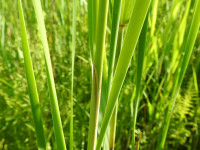
The leaves are distichous, with a lanceolate (ensiform) blade, flat, dark green in color, 3 to 12 mm wide (on average 3-6 mm), longer than the inflorescence. Their texture is herbaceous. The margin of the leaf sheath is membranous and has membranous auricles at the apex, which often disintegrate at the end of the season. Mucilaginous glands are present in the transition zone between sheath and blade and are brown in color, while they are absent on the blade itself and, usually, also in the center of the sheath near the apex.
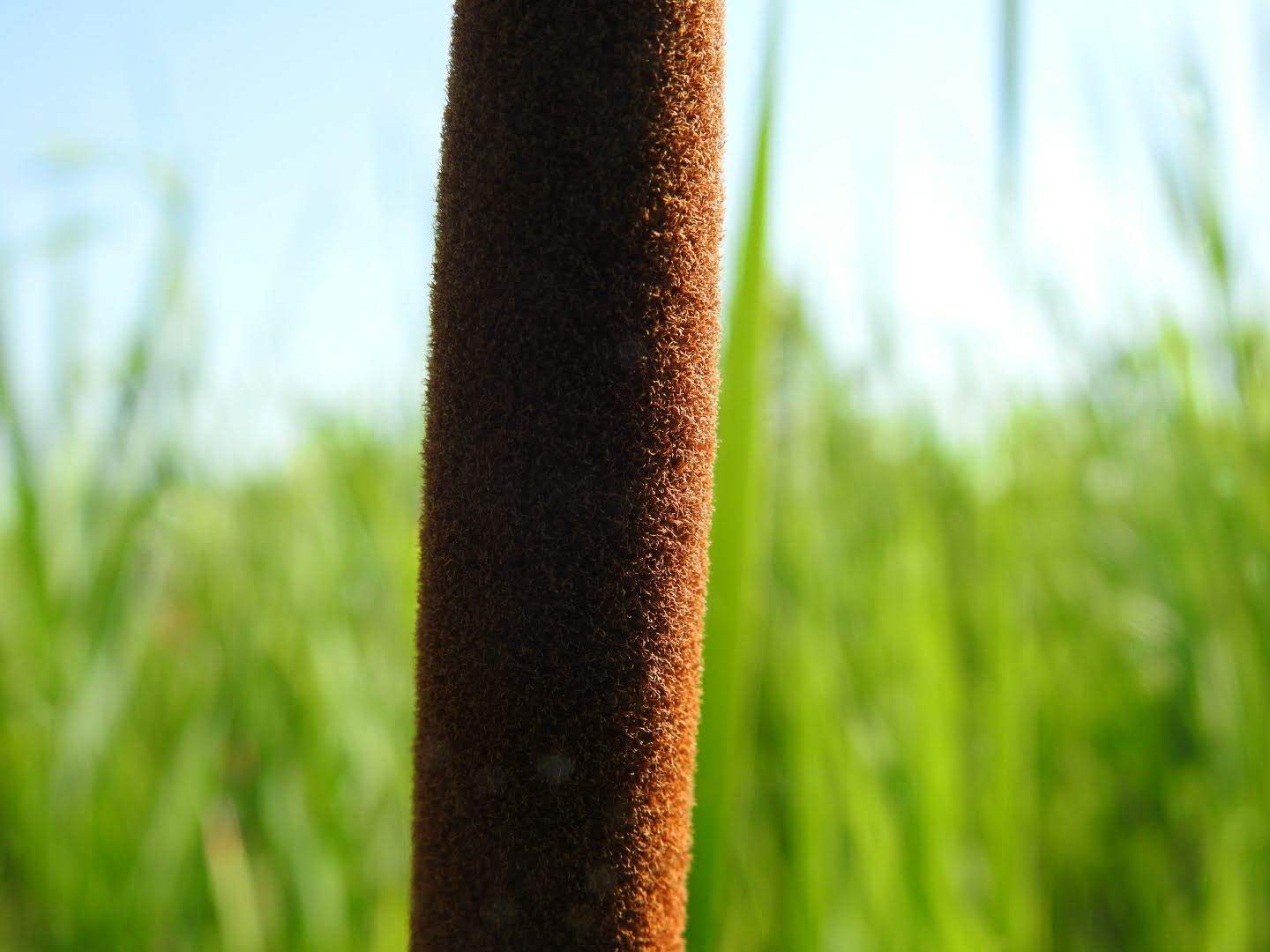
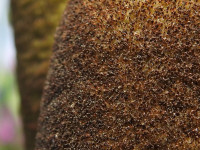
The inflorescence is located at the apex of the stem and consists of two monoecious spikes separated by a naked axis 1 to 12 cm long. The lower spike, longer (8-20 cm), bears female flowers, while the upper, slightly shorter, hosts the male flowers. The inflorescence has a cylindrical shape, with a diameter of 1-2.5 cm. The female flowers are covered by opaque spatulate scales of dark brown color, with brown hairs and an achlamydeous perianth formed by thin bristles, which give the infructescence a cottony appearance. The male flowers have oblong anthers 1.5-2 mm long with yellow thecae and dark brownish apices, and linear hairs or scales. The ovary is fusiform, 1-1.5 mm long, with numerous hairs arranged in whorls; the stigma is linear or lanceolate, brownish at maturity.
The fruit is a fusiform achene, about 1 mm long, with a pericarp not adhering to the seed and equipped with hairs that facilitate dispersal by anemochory (wind dispersal), forming a sort of parachute.
Habitat and distribution
A typical species of marshy and riparian environments, it grows along ponds, swamps, ditches, and stagnant or slow waters with depths up to about 1 meter. It prefers mesotrophic, neutral-acidic waters, and is common in coastal habitats and wet areas of plains and hills, with documented presence in many regions of Italy and the Mediterranean area. Its presence also extends to cold and temperate-cold zones of Europe, Asia, and North America, with a circumboreal distribution. In Italy it is widespread especially in wet areas of the north, center, and south, often associated with species such as Scirpus and Phragmites.
The substrate on which it thrives is typically muddy and rich in organic matter, exposed to full sun or in partially shaded areas. The species adapts well to conditions of constant moisture and shallow water depths.
Flowering period
Flowering mainly occurs in June and July, with possible slight variations depending on altitude and local climatic conditions. Generally, in more temperate and coastal areas, flowering may start earlier or last longer.
Ecology and pollination
Typha angustifolia is an anemophilous species: pollination is carried out by the wind, which transports pollen produced by the male flowers to the female ones. The flowers are surrounded by a sheath of thin bristles that facilitate the dispersion of pollen and subsequently of seeds. The dispersal of propagules also occurs through the wind (anemochory), thanks to numerous ciliated hairs that form a kind of parachute for the seeds, facilitating their dispersal over long distances.
The plant is heterophyllous, with leaves of different shapes and functions, and forms dense populations thanks to the expansion of rhizomes, which allow it to rapidly colonize wet habitats. This ability, combined with resistance to even polluted conditions, makes the species potentially invasive in certain environments.
Curiosities and traditional uses
Historically, the leathery and waterproof leaves of this species were used for making mats, baskets, chairs, and for stuffing flasks and demijohns. In coastal areas, the leaves were also used to build huts and small boats, while young shoots were consumed as food.
Dried rhizomes were ground to obtain a flour similar to wheat flour, used in times of necessity. Furthermore, the pressed fluff was used to stuff mattresses, a use that refers to the etymology of the generic name linked to the use of leaves as stuffing.
Today the female inflorescences, with their characteristic cottony appearance, are appreciated in floriculture as a decorative element for dried floral arrangements.
From an ecological point of view, the species is used in modern phytodepuration systems thanks to its ability to resist various types of pollution, including chemical.
It should be noted that the species is considered allergenic.
Etymology
The generic name Typha derives from the Greek τύφη (týphe), a term used by Theophrastus to indicate plants with elongated leaves used for stuffing, identified with this species or similar ones. It is probably connected both with the Latin tuber and the English tuft, tracing back to an Indo-European root tewh- meaning “to swell, enlarge.”
The specific name angustifolia means “narrow-leaved,” from the Latin angustus (narrow) and folium (leaf), a clear reference to the narrow and lanceolate shape of the leaves that characterizes this species compared to others in the genus.
In Italian the plant is commonly called Lesser Bulrush, a name that highlights precisely the particular shape of its leaves, narrower and thinner than those of related species such as Typha latifolia. In English, this corresponds to the common name Lesser Bulrush.
Sources
- Acta Plantarum - Flora delle regioni italiane (scheda di Roberta Alberti)
- World Flora Online (WFO)
Characteristics
Scheda botanica
| Famiglia | Typhaceae |
|---|---|
| Fioritura | giugno – luglio |
| Forma biologica | Rhizomatous |
Domande frequenti
- Quando fiorisce Lesser Bulrush?
- Lesser Bulrush fiorisce giugno – luglio.
- Che tipo di pianta è Lesser Bulrush?
- Lesser Bulrush è una Geophytes (Rhizomatous) secondo la classificazione di Raunkiaer.
- A quale famiglia appartiene Lesser Bulrush?
- Lesser Bulrush appartiene alla famiglia botanica Typhaceae.
Where I found it (5 sightings)
Classification
- Kingdom
- Plantae
- Family
- Typhaceae
- Full name
- Typha angustifolia L.
- Life form
- Geophytes rhizomatous
Similar species
Search for species with similar characteristicsNoticed an error in the identification? Write to me
Other species of the same family
Typhaceae
Explore
Other species of Typhaceae