Botanical species
Typha latifolia
L.
Bulrush
Description
Morphological description
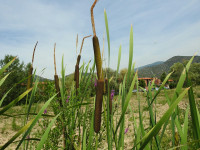
Perennial herbaceous plant that can reach considerable heights, up to 2.5-3 meters, characterized by an erect and robust habit. The stem is simple, cylindrical, glabrous, with a thickness of 3-7 mm in the proximal part near the inflorescence. The root system consists of horizontal and elongated rhizomes, from which stems and adventitious roots originate every year, giving the plant a marked rhizomatous capacity and soil colonization ability.
The leaves are broad, linear and flat, bluish-green in color with a glaucous coating, long and narrow but wider than those of related species, with a width ranging between 8 and 25 mm (in some cases up to 29 mm). The leaves are parallel-veined, sheathing the stem, with an acute apex and membranous or transparent margins. The upper leaves can reach and surpass the inflorescence.
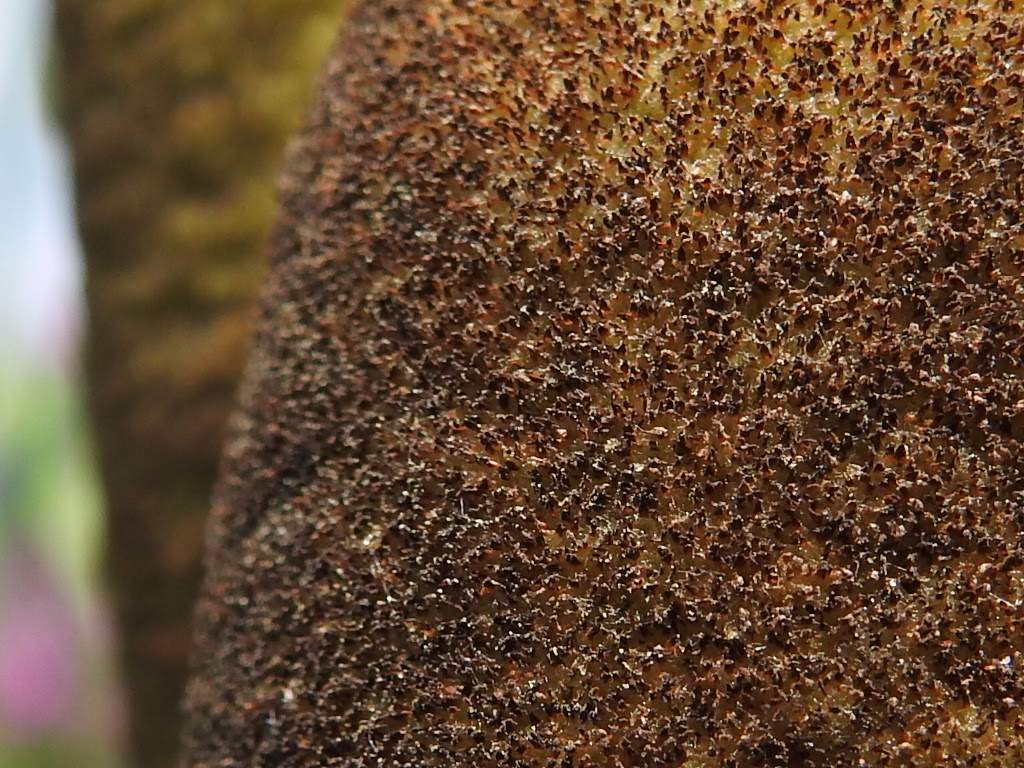
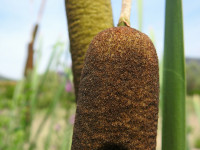
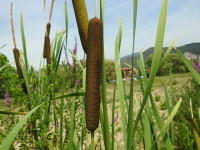
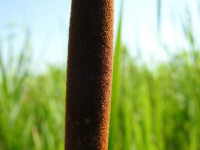
The inflorescence is characteristic and easily recognizable: it consists of two monoecious spikes (spadices) superimposed and contiguous or nearly so, placed at the apex of the stem. The lower female spike is 15 to 25 cm long, cylindrical, dark brown or dark brown in color, with an apparently scaly surface due to the brown stigmas emerging among the fine hairs of the perianth. The male spike, located just above, is narrower, whitish or straw-colored, conical and as long as or slightly shorter than the female spike. The male flowers are very small, with basifixed anthers of 2-3 mm, while the female flowers are tiny and closely pressed to the stem, lacking bracteoles. The female stigmas are spatulate, long and protruding beyond the hairs of the perianth.
The fruit is a fusiform achene, about 1-1.5 mm long, with a pericarp not adhering to the seed and dehiscent at maturity. Dissemination occurs thanks to the fine and transparent hairs of the pseudoperianth which form a “parachute” facilitating the anemochorous dispersion of the seeds.
Habitat and distribution
Bulrush prefers wet environments, typical of marshy areas and stagnant or slow-flowing fresh waters, such as swamps, ponds, lake shores, ditches and canals. It can grow from the plains up to 2000 meters altitude, adapting to different climates and predominantly muddy or silty soils, generally exposed to sunlight or partially shaded.
In Italy it is widespread in all regions, from the plains to the lower mountainous areas. More generally, the species is cosmopolitan, present in Europe, Asia, Africa and North America. In the Mediterranean it is common in coastal and inland wet areas.
Flowering period
Flowering extends from June to August, with a possible extension until September in some areas. Seed maturation and subsequent dispersal continue from autumn until the following spring, ensuring a long window for reproduction and colonization of new habitats.
Ecology and pollination
Bulrush is a monoecious plant with male and female flowers separated but on the same plant. Pollination is mainly anemophilous, i.e. wind-borne, facilitated by the structure of the spikes and the production of pollen in tetrads. Seed dispersal also occurs via wind (anemochory), with very light seeds equipped with hairs that act as a parachute.
The species plays a primary ecological role in wetland ecosystems: it provides habitat and refuge for many animal species, helps stabilize sediments and has a remarkable capacity to absorb and purify pollutants, including chemical compounds, making it useful in phytoremediation systems.
Curiosities and traditional uses
Historically Bulrush has been widely used by humans for various practical purposes. The leathery leaves were woven to make mats, baskets, and to cover flasks and demijohns. In some cultures they were also used for building light boats.
The rhizomes, once dried, were ground to obtain a flour that could replace cereal flour. Young shoots were consumed as food, while the soft pappi produced by the female spikes were used as stuffing for mattresses and pillows.
Today Bulrush inflorescences, especially the brown female spike, are highly appreciated in floriculture and decoration for dried floral arrangements. The species is also of interest for its potential use in phytoremediation, thanks to its ability to withstand various types of pollution.
Etymology
The genus name Typha derives from the Greek “τύφη” (týphē), a term used by Theophrastus to indicate plants with elongated leaves, used for stuffing. This name may have Indo-European roots meaning “to swell” or “to stuff”, also connected to the Latin tuber and English tuft.
The specific epithet latifolia means “broad-leaved”, referring to the leaves being wider than those of related species. The Italian common name “tifa” or “lisca maggiore” recalls the elongated and rigid shape of the leaves, similar to splints or sticks.
Sources
- Acta Plantarum - Flora delle regioni italiane (scheda di Anja Michelucci)
- Tela Botanica / H. Coste, Flore descriptive et illustrée de la France
- World Flora Online (WFO)
Characteristics
Scheda botanica
| Famiglia | Typhaceae |
|---|---|
| Fioritura | giugno – agosto |
| Forma biologica | Rhizomatous |
Domande frequenti
- Quando fiorisce Bulrush?
- Bulrush fiorisce giugno – agosto.
- Che tipo di pianta è Bulrush?
- Bulrush è una Geophytes (Rhizomatous) secondo la classificazione di Raunkiaer.
- A quale famiglia appartiene Bulrush?
- Bulrush appartiene alla famiglia botanica Typhaceae.
Where I found it (4 sightings)
Classification
- Kingdom
- Plantae
- Family
- Typhaceae
- Full name
- Typha latifolia L.
- Synonyms
- Massula latifolia (L.) Dulac
- Life form
- Geophytes rhizomatous
Similar species
Search for species with similar characteristicsFurther reading
Noticed an error in the identification? Write to me
Other species of the same family
Typhaceae
Explore
Other species of Typhaceae