Botanical species
Smilax aspera
L.
Common Smilax
Description
Morphological description
Perennial, evergreen plant belonging to the family Smilacaceae, it has a suffrutescent and lianoid habit, with flexible and branched stems that can reach from 1 up to 4-15 meters in length. The stems are angular, quadrangular or angular in cross-section, glabrous and equipped with numerous curved and pointed spines, characteristics that give it a prickly and defensive appearance. These climbing stems use stipular tendrils, located at the base of the leaf petioles, to anchor and climb on other plants or structures.
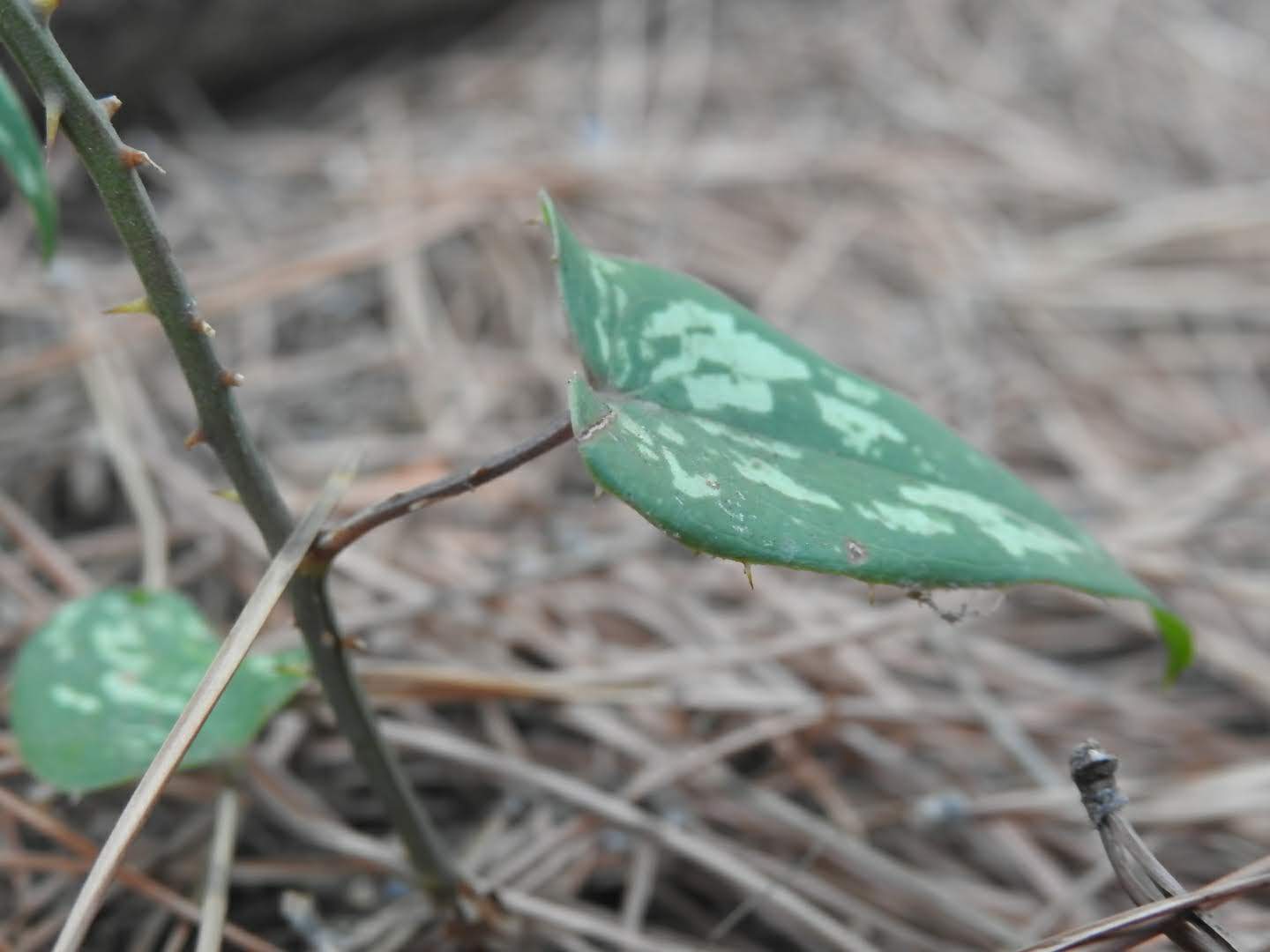
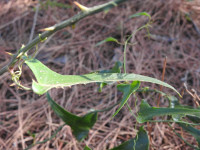
The leaves are alternate, coriaceous and glossy, of variable shape but generally oval, cordate or lance-shaped (astate), with serrated or slightly spiny margins. The blade, 5 to 15 cm long and 3-11 cm wide, has a prominent central vein with 5-9 main parallel veins, sometimes also spiny on the lower side. The leaves have a petiole 2-3 cm long, which bears at the base two thin tendrils used for climbing. Sometimes the leaves show whitish spots on the surface, a distinctive trait of the species.
The flowers are small, unisexual and fragrant, gathered in corymb inflorescences or in terminal and axillary panicles 10-15 cm long, with 5-30 white or whitish-greenish flowers arranged on a zigzag axis. Each flower has a dialypetalous perianth formed by 6 linear-lanceolate tepals 4-6 mm long, with an obtuse or rounded apex. Male flowers have 6 free stamens with anthers about 1 mm, while female flowers lack fertile stamens and have 6 scarious staminodes and a sessile trilobed stigma. The species is dioecious, with plants bearing either male or female flowers.
The fruit is a spherical berry, initially green, which changes in autumn from yellowish to red, then becoming almost black at maturity. The diameter varies between 4 and 10 mm. Inside there are 1-3 ovoid, smooth seeds, brown-reddish in color, surrounded by a light areola. Flowers and fruits can be observed simultaneously on the same plant due to the long persistence of the fruits.
The root system consists of a horizontal, long and highly branched rhizome, which allows the plant to survive and regenerate annually. This rhizome gives the species the ability to rapidly expand in the undergrowth or thickets.
Habitat and distribution
The species is typical of Mediterranean regions, with a distribution extending from the Mediterranean basin to India, passing through subtropical Africa. In Italy it is mainly found in central-southern and insular regions, with more sporadic and isolated occurrences in Lombardy, Veneto and Friuli Venezia Giulia, where it often appears as a naturalized plant.
It grows mainly in forest environments, holm oak woods, Mediterranean scrublands, garrigues and hedges, up to 1200 meters altitude. It prefers well-drained soils, often calcareous or volcanic, and sunny or partially shaded exposures. The species is thermophilic, adapting well to warm and relatively dry climates, and is frequently associated with evergreen species such as Phillyrea latifolia, Pistacia lentiscus, Myrtus communis and Rhamnus alaternus.
Flowering period
Flowering extends from September to November, with slight geographical variations that may slightly anticipate or delay this interval. In the warmer Mediterranean climates, flowering generally begins at the end of summer, while in cooler areas it can extend until early late autumn.
Ecology and pollination
The plant is dioecious and mainly relies on entomogamous pollination, i.e., mediated by pollinating insects attracted by the scent and pale color of the flowers. This mechanism ensures effective cross-fertilization. Seed dispersal occurs through birds that feed on the mature berries, contributing to the colonization of new habitats. The simultaneous presence of flowers and fruits on the same plant facilitates reproduction and species survival.
Curiosities and traditional uses
Smilax has been known for centuries for its medicinal properties. The root contains active principles such as smilacin, sarsasaponin and sarsasapic acid, which confer purifying, diuretic and sudorific effects to the plant. These principles were traditionally used in infusions and decoctions to treat colds, rheumatism and some skin diseases.
The young shoots are edible and were consumed as wild asparagus, while the berries are considered toxic and inedible. In Mediterranean folklore, the presence of this spiny climbing plant is evidence of the subtropical origin of the evergreen sclerophyllous forests of the Mediterranean basin, along with other species such as Rubia peregrina and Clematis flammula.
Etymology
The genus name Smilax derives from the ancient Greek smilax or smilakos, a term used by ancient authors to indicate various climbing plants. Interpretations vary and are discordant: for Dioscorides it was a climbing legume, while Plato associated it with the yew and Theophrastus with an oak. In Latin classics such as Pliny and Ovid, the term indicated climbing and spiny plants.
The specific epithet asper means "rough", "scabrous" or "prickly" in Latin, a clear reference to the spiny nature of the stems and leaves of the plant.
The common Italian name "salsapariglia" derives from the Spanish translation sarsaparilla, which in turn refers to the characteristic of this spiny climbing plant, known for its medicinal properties.
Sources
- Acta Plantarum - Flora delle regioni italiane (scheda di Anja Michelucci)
- Tela Botanica / H. Coste, "Flore descriptive et illustrée de la France"
- World Flora Online (WFO)
Characteristics
Where I found it (7 sightings)
Classification
- Kingdom
- Plantae
- Family
- Smilacaceae
- Full name
- Smilax aspera L.
- Life form
- Fanerofite nano-fanerofite
Similar species
Search for species with similar characteristicsFurther reading
Noticed an error in the identification? Write to me
Explore
Other species of Smilacaceae