Botanical species
Lythrum salicaria
L.
Purple Loosestrife
Description
Morphological description
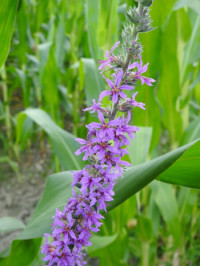
Perennial herbaceous plant, rhizomatous, with erect stems reaching a height between 40 and 120 cm, robust and reddish at the base. The stem is characterized by a quadrangular section, slightly pubescent in the upper part and can be simple or branched. The leaves are opposite or arranged in whorls of three in the basal part, while in the apical part they can become alternate. They are sessile, lanceolate or elliptical, with entire margins, and have a heart-shaped or rounded base. The texture is herbaceous, with well-marked veins especially on the underside.
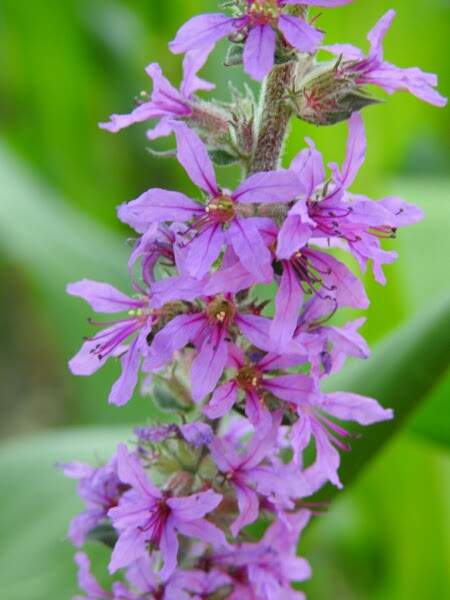
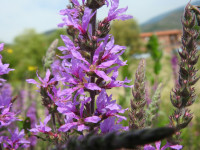
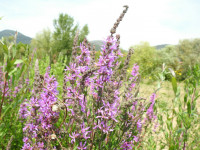
The flowers are gathered in long terminal spikes, often interrupted at the base, which can reach up to 40 cm in length. They are purplish-violet in color, with six lanceolate petals, about 6-10 mm long, and arranged in axillary clusters that simulate whorls. The calyx is gamosepalous, pubescent, with a cylindrical tube 5-8 mm long and 12 evident veins; the calyx teeth are triangular and alternate with linear epicalyx segments, about twice as long as the sepals. The stamens are twelve, of which at least six protrude beyond the corolla. The fruit is a bilocular ovoid capsule, 3-6 mm long, dehiscent, containing numerous triangular brown-yellowish seeds enclosed by a persistent calyx.
The root system is rhizomatous, allowing the plant to survive and regenerate even in variable moisture conditions.
Habitat and distribution
The species is widespread throughout Italy and the Mediterranean basin, also present in many other regions of Europe, western and northern Asia, as well as in some areas of Africa and North America. It prefers wet environments such as river and lake banks, marshes, ponds, ditches, and brackish zones, growing on moist and often muddy soils. It is found from the plains up to mountain altitudes of about 1,200 m, with sporadic reports up to 2,100 m a.s.l. The plant prefers sunny or partially shaded exposures, in conditions of high soil moisture.
Flowering period
Flowering generally extends from June to September, with possible slight geographical variations depending on altitude and local climate. In some regions, the peak flowering may be concentrated in the central summer months.
Ecology and pollination
The plant adapts to aquatic and wet environments where it plays an important ecological role. The flowers, with vivid colors ranging from purple to violet, attract various pollinating insects, mainly bees and butterflies, which promote pollination. The arrangement of flowers in terminal spikes and axillary clusters increases visibility and accessibility for pollinators. Seed dispersal occurs through the dehiscence of capsules that release numerous small and light seeds, facilitating colonization of new wet habitats.
Curiosities and traditional uses
Historically, the plant has had various uses in medical and popular contexts. The generic name refers to the color of blood, as it was believed effective against hemorrhages and as an astringent. It contains active principles such as anthocyanosides, gallic tannins, flavonoids, and phenolic acids, which confer astringent, antibacterial, diuretic, and antihemorrhagic properties. Traditionally it has been used to treat inflammations of the gastrointestinal mucosa, diarrhea, dysentery, and to regulate menstrual flow. For external use, infusions of leaves and flowers were used to cleanse wounds, sores, and dermatitis, as well as to treat hemorrhoids and varicose veins.
In the past, the root, rich in tannins, was used for leather tanning, while a dye was extracted from the flowers used in pastry and to dye natural fibers such as cotton and wool. Young shoots were consumed in salads or used as a tea substitute. At one time, a spirit was also distilled from macerated leaves.
The plant was also successfully used in military contexts during the world wars for the treatment of dysentery and hemorrhagic enteritis among soldiers. In some regions of the world, such as the United States, it is considered invasive due to its ability to spread rapidly.
From a folkloric point of view, in France it was believed that decorating hay wagons with its flowers ensured good forage preservation during winter, attributing a lucky charm value to the plant.
Etymology
The scientific name derives from the Greek "lýthron," meaning "blood," referring to the reddish-purple color of the flowers and the supposed hemostatic properties of the plant. The specific epithet "salicaria" indicates the similarity of the leaves to those of the willow (Salix spp.), lanceolate and sessile.
The Italian common name "Salcerella" precisely recalls this similarity to the willow, emphasizing the elongated and slender shape of the leaves.
Sources
- Prof. P.V. Arrigoni, "Flora analitica della Toscana", "Flora dell'Isola di Sardegna"
- Acta Plantarum - Flora delle regioni italiane (scheda di Marinella Zepigi)
- Tela Botanica / H. Coste, "Flore descriptive et illustrée de la France"
- World Flora Online (WFO)
Characteristics
Scheda botanica
| Famiglia | Lythraceae |
|---|---|
| Fioritura | giugno – settembre |
| Forma biologica | Scapose |
| Habitat | with purple flowers, Perennial plant |
Domande frequenti
- Quando fiorisce Purple Loosestrife?
- Purple Loosestrife fiorisce giugno – settembre.
- Che tipo di pianta è Purple Loosestrife?
- Purple Loosestrife è una Hemicryptophytes (Scapose) secondo la classificazione di Raunkiaer.
- A quale famiglia appartiene Purple Loosestrife?
- Purple Loosestrife appartiene alla famiglia botanica Lythraceae.
Where I found it (2 sightings)
Classification
- Kingdom
- Plantae
- Family
- Lythraceae
- Full name
- Lythrum salicaria L.
- Life form
- Hemicryptophytes scapose
Similar species
Search for species with similar characteristicsFurther reading
Noticed an error in the identification? Write to me
Explore
Other species of Lythraceae