Botanical species
Cyperus capitatus
Vand.
Zigolo delle spiagge
Description
Morphological description
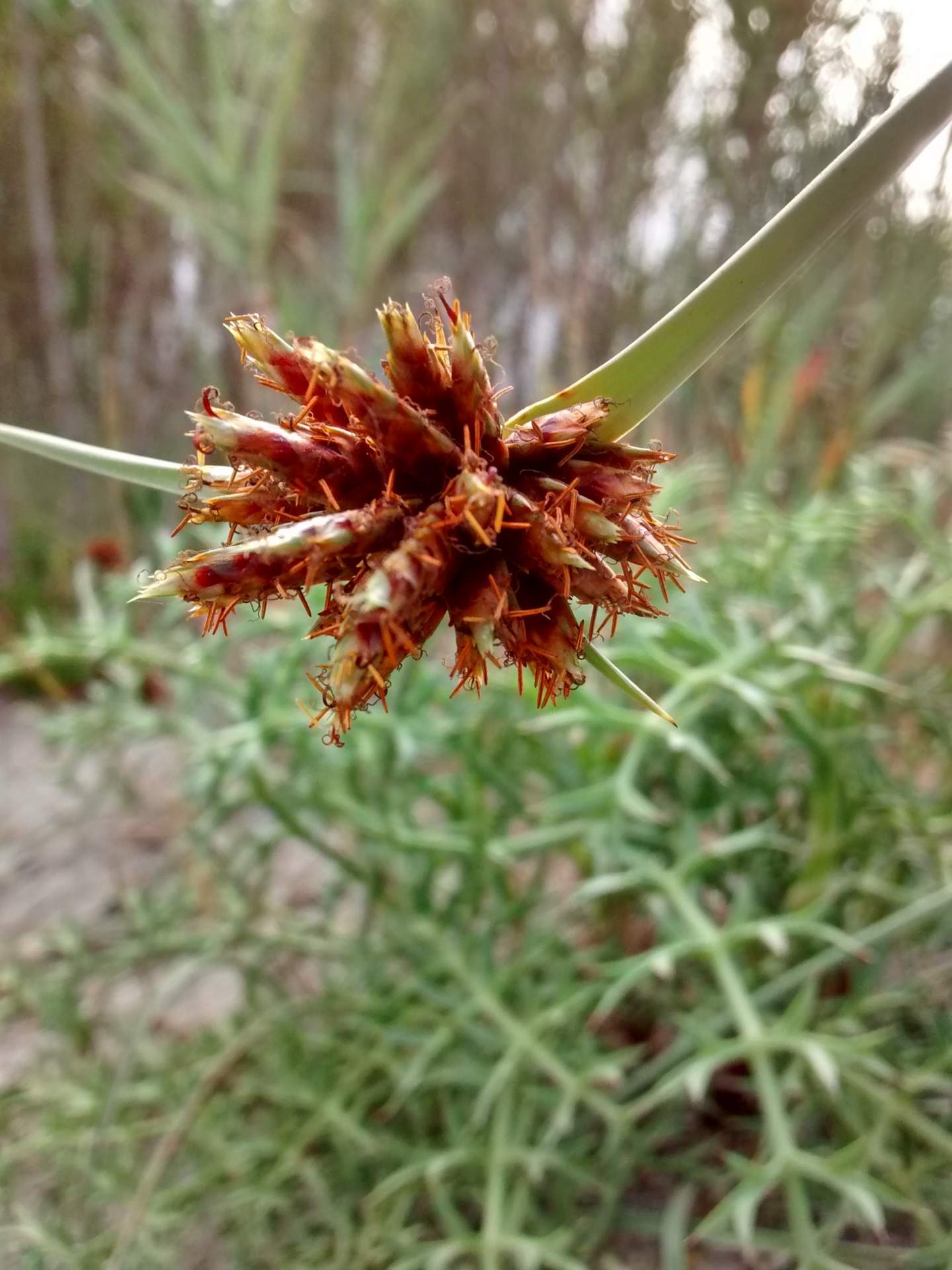
Perennial herbaceous plant, Zigolo delle spiagge has an erect habit and variable dimensions between 10 and 50 cm in height. The stem is cylindrical, glabrous, glaucous green in color, not hollow and sometimes slightly curved at the base. The leaves, arranged alternately along the stem, are linear, rigid, grooved and curved, with a closed sheath and lacking stipules; their width ranges from 2 to 6 mm and their length often exceeds that of the stem.
The root system consists of a well-developed, deeply thickened and long rhizome that extends horizontally beneath the sandy surface. The rhizome is covered by scales and wrapped in brown fibers, characteristics that promote the stability of the plant in the mobile substrates typical of coastal environments.
The inflorescence is a distinctive element: it appears as a subspherical head, solitary and terminal at the apex of the stem, with a diameter of 2-3 cm. It is composed of numerous reddish-brown spikelets, each made up of 4 to 12 flowers, closely clustered. The inflorescence is wrapped by 3-6 large, horizontal and patent leafy bracts, unequal in size, with revolute and sub-spiny margins, 3 to 12 cm long and widened at the base. The spikelets are oblong or lanceolate (8-20 mm long and 3-4 mm wide), with glumes from ovate to lanceolate, mucronate and with scarious margins. The flowers lack petals and are green in color, with 3 stamens equipped with long dilated filaments and 3 stigmas.
The fruit is a trigonous achene, coriaceous and indehiscent, about one third the length of the glume, which allows seed dispersal. The absence of petals and the compact structure of the inflorescence are adaptations to the specific environmental conditions of the coastal habitat.
Habitat and distribution
The species is typical of Mediterranean sandy coasts, with a steno-Mediterranean range mainly limited to the littoral belt. In Italy it grows on sandy beaches and in the first coastal dunes, in well-preserved marine environments characterized by mobile and arid substrates. The plant prefers sandy, permeable soils subject to wind action and saline influence, conditions that make survival difficult for many other plant species.
In the Mediterranean area, it is found along the coasts of France, Corsica and other regions facing the Mediterranean Sea. Its presence is closely linked to the stability of coastal dunes, where it plays a fundamental role in soil consolidation thanks to its extensive and robust rhizome.
The growth altitude is generally low, limited to coastal areas where the plant is exposed to full sun and the typical climatic conditions of marine beaches.
Flowering period
Flowering occurs between May and September, with some possible variation linked to local climatic conditions. Generally, the species flowers in late spring and summer, a period during which climatic conditions favor flower maturation and subsequent fruit production.
Ecology and pollination
Zigolo delle spiagge adapts to extreme environmental conditions, such as intense heat, high salinity and constant wind typical of the Mediterranean coastal belt. The plant has a limited transpiring surface, also due to the sunken stomata, which reduces water loss and improves drought resistance.
Pollination is predominantly anemophilous, i.e. wind-mediated, given the compact structure and lack of showy petals of the flowers. The shape of the inflorescence and the presence of long stigmas increase the efficiency of pollen capture transported by the air.
Seed dispersal occurs through the coriaceous achenes, which remain indehiscent and can be transported by sand and wind along the coasts, facilitating colonization of new dune areas.
Curiosities and traditional uses
No medicinal, food or particular ethnobotanical uses related to this species are known. Its importance is mainly ecological, as it contributes to the consolidation of coastal dunes and the stability of the sandy habitat, particularly vulnerable to erosion.
Etymology
The genus name Cyperus derives from the Greek "kýpeiros", meaning angular rush, referring to the shape of the plants of the genus. The specific epithet capitatus comes from the Latin caput, capitis (head), and refers to the compact head-like shape of the inflorescence, similar to a small head or flowering head.
The Italian common name, Zigolo delle spiagge, recalls the sandy coastal habitat where the plant is typically found, with “zigolo” being a term used for some Cyperaceae species with a similar habit.
Sources
- Acta Plantarum - Flora delle regioni italiane (actaplantarum.org)
- Acta Plantarum - Scheda di Giuliano Salvai
- Tela Botanica / H. Coste, Flore descriptive et illustrée de la France
Characteristics
Scheda botanica
| Famiglia | Cyperaceae |
|---|---|
| Fioritura | maggio – settembre |
| Forma biologica | Rhizomatous |
| Habitat | with green flowers, psammophilous plant, flower without petals |
Domande frequenti
- Quando fiorisce Zigolo delle spiagge?
- Zigolo delle spiagge fiorisce maggio – settembre.
- Che tipo di pianta è Zigolo delle spiagge?
- Zigolo delle spiagge è una Geophytes (Rhizomatous) secondo la classificazione di Raunkiaer.
- A quale famiglia appartiene Zigolo delle spiagge?
- Zigolo delle spiagge appartiene alla famiglia botanica Cyperaceae.
Where I found it (1 sightings)
Classification
- Kingdom
- Plantae
- Family
- Cyperaceae
- Full name
- Cyperus capitatus Vand.
- Synonyms
- Cyperus kalli (Forssk.) Murb.; Cyperus mucronatus (L.) Mabille
- Life form
- Geophytes rhizomatous
Similar species
Search for species with similar characteristicsFurther reading
Noticed an error in the identification? Write to me
Other species of the same family
Cyperaceae
Explore
Other species of Cyperaceae