Botanical species
Carex distans
L.
Distant Sedge
Description
Morphological description
Perennial herbaceous plant belonging to the family Cyperaceae, with a tufted habit and height varying between 30 and 80 cm, which can also reach 60 cm according to some sources. The plant develops from short, robust, and fibrous rhizomes, forming dense and compact clumps.
The stem is erect, smooth, and robust, with an obtusely triangular (trigonous) cross-section, sometimes sinuous in the inflorescence part. The leaves are mostly basal, green-glaucous tending to grayish, flat, rigid, and with rough margins. Their width varies from 2 to 6 mm, generally shorter than the stem. The basal sheaths are entire and fibrous, with color ranging from pale to dark brown.
The ligule, located at the base of the leaf blade, measures between 2 and 3 mm, has an obtuse or subacute shape, and is narrower than the blade itself; the antiligule is triangular, about 1 mm long, sometimes barely visible.
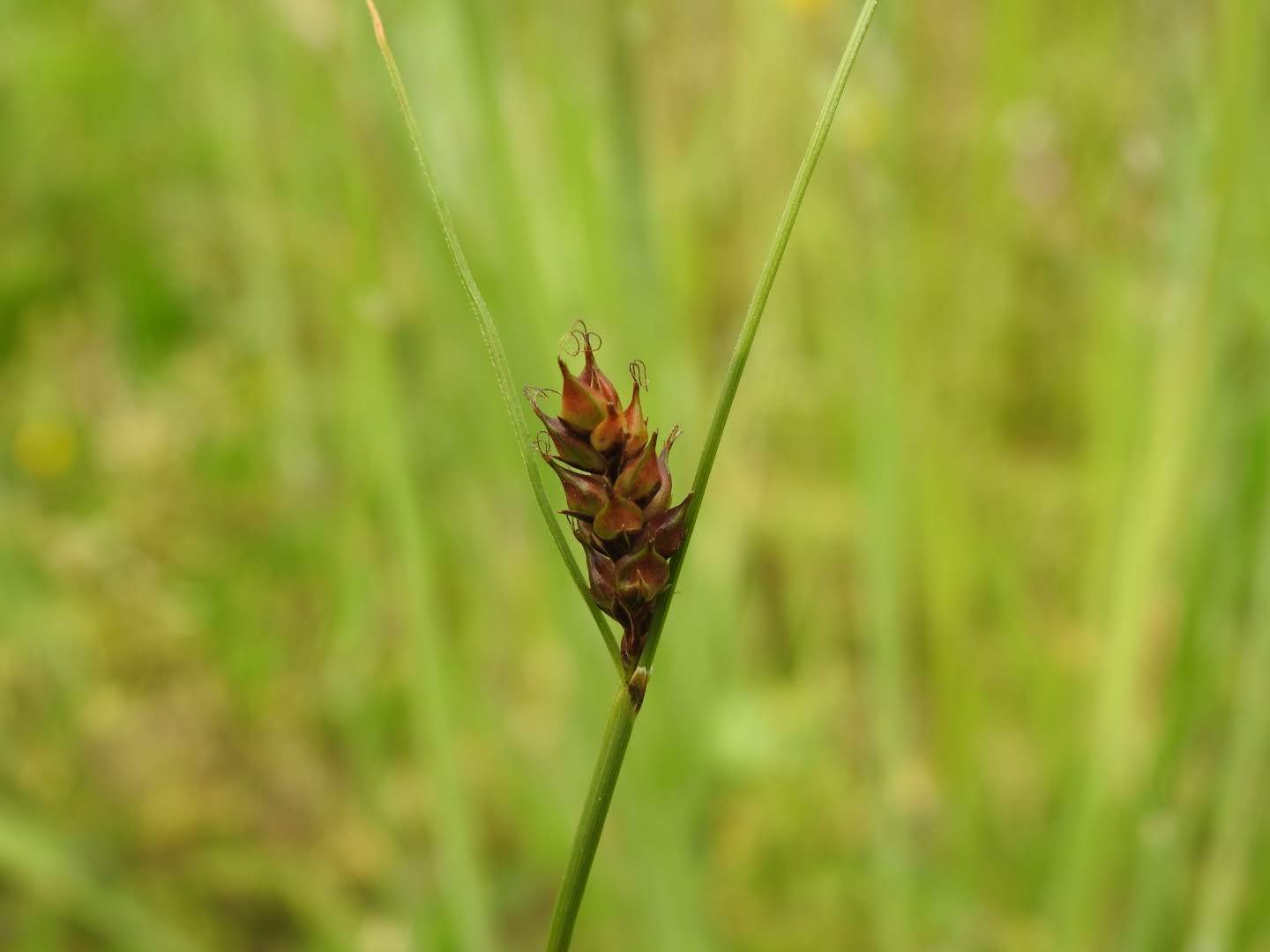
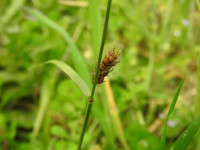
The inflorescence is very characteristic: green-yellowish in color, elongated and can measure from 8 up to 30 cm, composed of a terminal male spike and 2-4 female spikes spaced apart. The male spike is fusiform, 1.5 to 3.5 cm long, with glumes varying in color from light brown to purplish brown, oblong or obovate with an acute or mucronate apex. The female spikes are cylindrical, spaced, sized between 1 and 2.7 cm, sessile or pedunculate; the lower spike can be erect or pendulous. The female glumes are oval, with a green median nerve and color from chestnut brown to reddish tones, never purplish, with apex from acute to obtuse and sometimes mucronate.
The flowers are unisexual: the male ones reduced to 1 (sometimes 3) stamens with anthers 2.5-3.5 mm long, while the female ones have 3 stigmas. The plant is monoecious, with distinct male and female flowers present on the same plant.
The fruit is a pseudanthium (utricle) of pyriform or elliptical shape, 3-5 mm long, glabrous and shiny, with prominent lateral veins and sometimes dotted with red. The utricle narrows into a bifid beak, up to 1.1 mm long, with a rough surface. Inside is the achene, elliptical, trigonous, yellow-brown, 2.3-3.3 mm long.
The root system consists of short and robust rhizomes, which allow the plant to form dense clumps.
Habitat and distribution
Species with a predominantly eurymediterranean range, mainly distributed along Mediterranean coasts with extensions to the north and east. In Italy it is found in wet habitats such as wet meadows, marshes, and edges of watercourses, as well as in anthropized environments such as mown meadows and roadside margins.
It prefers soils rich in bases and nitrogen compounds, showing good adaptability to environmental variations and tolerating even low saline concentrations in the soil. It typically grows in stations belonging to the Molinetalia and Holoschonetalia communities, environments characterized by the presence of water and constant humidity.
The typical altitude range extends from the plain up to the lower mountain level (hill-mountain), in areas with a temperate climate. Exposure may vary, but the species is generally associated with habitats with moist or periodically flooded soils.
Flowering period
Flowering mainly occurs between March and June (months 3-6), with possible variations linked to local climatic conditions and altitude. The best phase for identification is fruiting, which coincides with the formation of utricles and fruit maturation.
Ecology and pollination
The flowers of Distant Sedge are unisexual and lack petals, lacking perianth, with herbaceous bracts (glumes) subtending them. Pollination is anemophilous (wind-borne), typical of Cyperaceae, which do not rely on pollinating insects for reproduction.
Seed dispersal occurs through the achenes contained in the utricles, which are structures adapted to protect the seed and facilitate dissemination. The shape and structure of the utricle, with the bifid beak and glabrous surface but with prominent veins, suggest an adaptation to dispersal by water or passive transport mechanisms.
Curiosities and traditional uses
No known food or medicinal uses of this species are reported. The genus Carex, although very numerous and widespread, does not present particular uses in ethnobotanical or pharmaceutical fields.
From a botanical point of view, Carex species are distinguished from Poaceae by the presence of unisexual flowers, the structure of the inflorescences, and the absence of perianth. These peculiarities make the genus interesting for studies in systematic and phylogenetic botany.
The genus name is of classical Latin origin, but its etymology is uncertain; it could derive from the Greek κείρω (keíro), "I cut", referring to the often sharp cutting edge of the leaves.
Etymology
The scientific name is composed of the genus Carex, a classical Latin term of uncertain origin, possibly linked to the Greek κείρω (keíro), meaning "to cut", probably referring to the sharp edge of the leaves. The specific epithet distans derives from Latin and means "distant" or "separated", referring to the arrangement of the female spikes in the inflorescence, which are well spaced apart.
The Italian common name “Carice a spighe distanziate” refers precisely to this distinctive characteristic of the female spikes spaced apart on the inflorescence, which facilitates species recognition.
Sources
- Acta Plantarum - Flora delle regioni italiane (scheda di Roberta Alberti)
- World Flora Online (WFO)
Characteristics
Scheda botanica
| Famiglia | Cyperaceae |
|---|---|
| Fioritura | marzo – giugno |
| Forma biologica | Tufted |
| Habitat | with green flowers, flower without petals, Perennial plant |
Domande frequenti
- Quando fiorisce Distant Sedge?
- Distant Sedge fiorisce marzo – giugno.
- Che tipo di pianta è Distant Sedge?
- Distant Sedge è una Hemicryptophytes (Tufted) secondo la classificazione di Raunkiaer.
- A quale famiglia appartiene Distant Sedge?
- Distant Sedge appartiene alla famiglia botanica Cyperaceae.
Where I found it (7 sightings)
Classification
- Kingdom
- Plantae
- Family
- Cyperaceae
- Full name
- Carex distans L.
- Life form
- Hemicryptophytes tufted
Similar species
Search for species with similar characteristicsNoticed an error in the identification? Write to me
Other species of the same family
Cyperaceae
Explore
Other species of Cyperaceae