Botanical species
Commelina communis
L.
Asiatic Dayflower
Description
Morphological description
Perennial herbaceous plant belonging to the family Commelinaceae, with a creeping or prostrate-ascending habit, reaching a height between 30 and 70 cm. The stem is branched, soft, jointed with zigzagging nodes, often rooting in the lower parts, a characteristic that favors vegetative spread. The surface of the stem presents a fine and variable pubescence.
The leaves are alternate, sessile, with a cylindrical and closed leaf sheath, fleshy and thick. The blade is ovate-lanceolate in shape, acute at the apex and rounded at the base, generally measuring between 5 and 12 cm in length and 1-4 cm in width. The color is bright green.
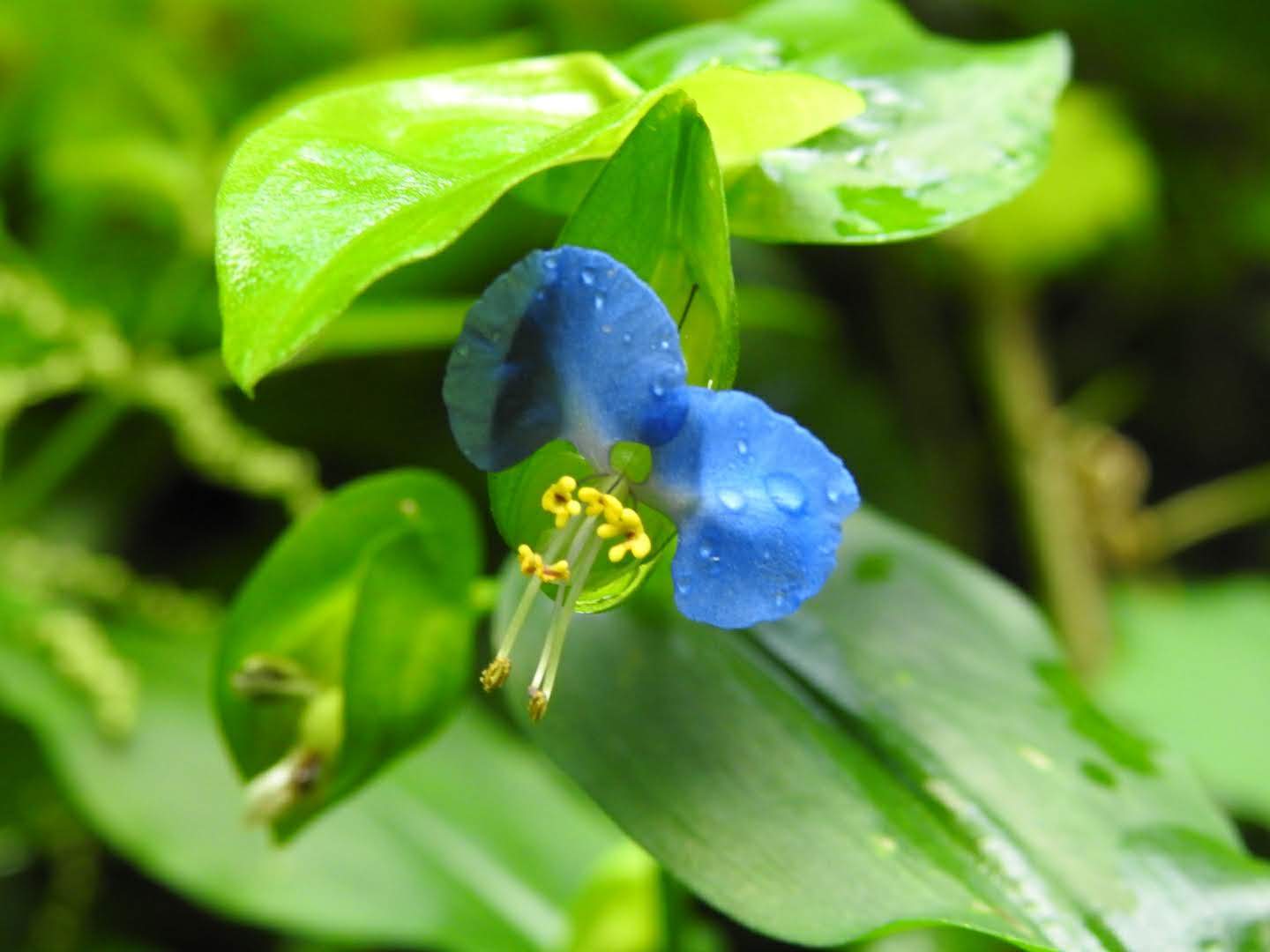
The flowers, hermaphroditic and zygomorphic, are gathered in inflorescences enclosed in a crescent-shaped bracteate spathe. Each flower has three membranous, ovate, green sepals and three petals: two upper ones of blue-violet color, large and showy, and one much reduced lower petal, white or pale in color. There are six stamens, of which three fertile are positioned in the lower part of the flower; two lateral stamens are light brown and one central stamen is yellow with elliptical anthers. The three sterile staminodes are yellow with brown spots and cross-shaped anthers.
The fruit is a bilocular capsule, dehiscent by two valves, measuring between 4.5 and 8 mm in length, glabrous and brownish in color. Each capsule generally contains four seeds of deltoid or triangular shape, measuring 2.5 to 4.2 mm by 2-3 mm, brown or yellow-brown in color, with a rugose-reticulate surface covered by small farinose granules. The root system develops mainly from the basal nodes of the stem, allowing effective anchorage and rooting.
Habitat and distribution
Native to East Asia, the species is now naturalized and considered an invasive neophyte in Italy and some Mediterranean areas. It is particularly widespread in wet areas such as edges of rice paddies, canals, and damp paths, but can also be found at forest edges and in disturbed areas such as landfills or cultivated zones.
The plant prefers moist soils, often peaty or clayey, with exposure from full sun to partial shade. It is mainly present at hill and low mountain altitudes, up to about 1000 meters above sea level, where it finds favorable conditions for growth and reproduction.
In Italy it is reported mainly in northern regions, particularly in rice cultivation areas, where it can become a weed and reduce the biodiversity of native plant communities.
Flowering period
Flowering extends from July to September, with possible geographic variation tending to anticipate or prolong flowering in warmer climates or southern Mediterranean basin areas.
Ecology and pollination
The species is mainly pollinated by pollinating insects attracted by the colored petals and the hermaphroditic arrangement of the flowers. The presence of fertile stamens and staminodes suggests a reproductive strategy that favors cross-pollination but does not exclude self-fertilization.
Seed dispersal occurs through the dehiscence of capsules that release small, rugose seeds, facilitating propagation both in natural and anthropized environments. Furthermore, the ability to root from stem nodes contributes to its vegetative spread, making it a weed especially in rice paddies and wet soils.
Curiosities and traditional uses
In China, this plant is used in phytotherapy for its anti-inflammatory, febrifuge, and diuretic properties. It is traditionally employed to relieve sore throat and tonsillitis. Moreover, in some cultures it has also been used as fodder.
The Italian common name “erba miseria asiatica” reflects its geographic origin and its weedy nature in cultivated fields. The plant was probably introduced to Europe in the 18th century as an ornamental or cultivated plant, from which it later naturalized.
Etymology
The genus name “Commelina” is a tribute to Jan Commelin (1629-1692) and his nephew Kaspar Commelin (1667-1731), both Dutch botanists who studied European and colonial flora.
The specific name “communis” means “common,” indicating the wide distribution of the species, now also present outside its original range.
The common name “erba miseria” probably alludes to its weedy nature and ability to grow in harsh environments, often associated with poor or disturbed soils.
Sources
- Acta Plantarum - Flora delle regioni italiane (scheda di Marinella Zepigi)
- Tela Botanica / H. Coste, "Flore descriptive et illustrée de la France"
- World Flora Online (WFO)
Characteristics
Scheda botanica
| Famiglia | Commelinaceae |
|---|---|
| Fioritura | luglio – settembre |
| Forma biologica | Bulbous |
| Habitat | creeping plant, plant with a prostrate-ascending habit |
Domande frequenti
- Quando fiorisce Asiatic Dayflower?
- Asiatic Dayflower fiorisce luglio – settembre.
- Che tipo di pianta è Asiatic Dayflower?
- Asiatic Dayflower è una Geophytes (Bulbous) secondo la classificazione di Raunkiaer.
- A quale famiglia appartiene Asiatic Dayflower?
- Asiatic Dayflower appartiene alla famiglia botanica Commelinaceae.
Where I found it (3 sightings)
Classification
- Kingdom
- Plantae
- Family
- Commelinaceae
- Full name
- Commelina communis L.
- Synonyms
- Commelina virginica auct. Fl. Ital., non L.
- Life form
- Geophytes bulbous
Similar species
Search for species with similar characteristicsFurther reading
Noticed an error in the identification? Write to me
Explore
Other species of Commelinaceae