Botanical species
Colchicum alpinum
DC.
Alpine Autumn Crocus
Description
Morphological description
Perennial herbaceous plant up to about 30 cm tall, characterized by a root system formed by a small ovoid bulb-tuber, 1-1.5 cm long and covered by a brown tunic. The stem is scapose, that is, leafless along its height, bearing the flowers in an erect and isolated position.
The leaves, green in color, are generally 2-3 (up to 5), emerge after flowering and have a linear-lanceolate or linear-spatulate shape with an obtuse apex. The dimensions vary from 8 to 28 cm in length and from 0.6 to 2 cm in width. The texture is herbaceous, typical of mountain plants.
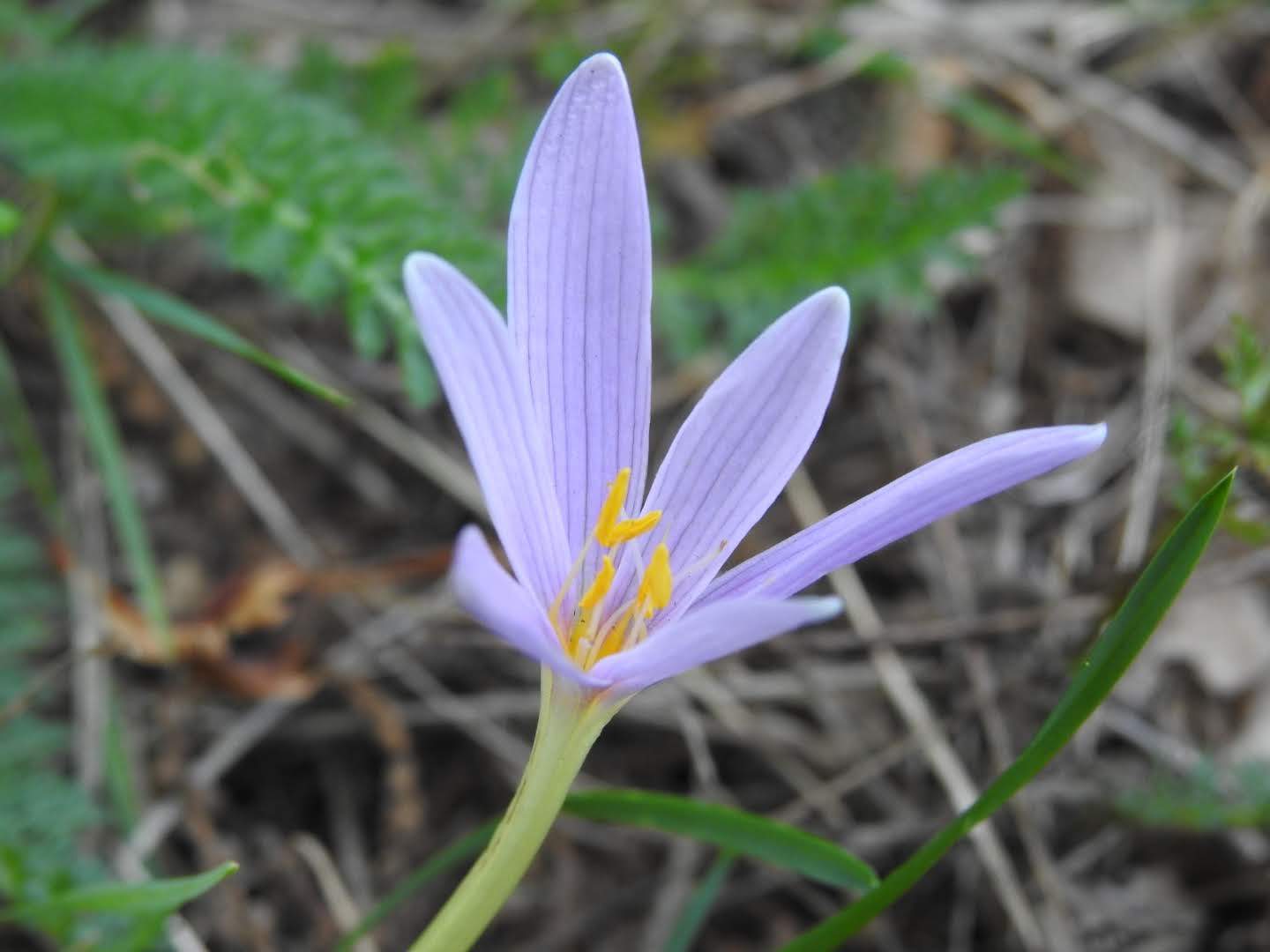
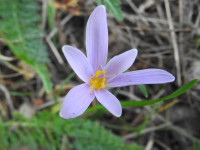
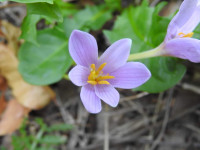
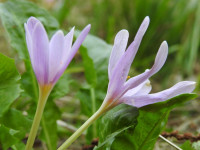
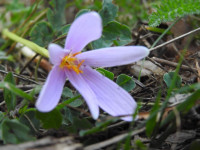
The flowers are solitary or, more rarely, grouped in clusters of 2-3, about 15 cm tall. The perigonium consists of a tube 10-12 cm long, yellowish in color. The tepals are 6, elliptic-lanceolate, pink-lilac with darker longitudinal stripes that give a variegated appearance, and measure 2-3.5 cm. The stamens are 6, with yellow-orange anthers. The styles are 3, erect and generally shorter than the stamens; the stigma is shaped like a small head, at most 1 mm long and not descending along the filament.
The fruit is an ovoid capsule 1.5-3 cm long, equipped with a mucro.
Habitat and distribution
The species is typical of the mountainous regions of Northern Italy and the northwestern Mediterranean basin, with an orophytic distribution. It grows in dry meadow environments from the hill to the alpine level, at altitudes between 200 and 2200 meters above sea level. It prefers well-drained soils and sunny or semi-shaded exposures typical of mountain and subalpine habitats.
Flowering period
Flowering mainly occurs between June and September, with peaks that may vary slightly depending on altitude and latitude. In higher mountain contexts, flowering may be concentrated more towards late summer.
Ecology and pollination
The Alpine Autumn Crocus blooms at a time when the surrounding vegetation is generally lush; its pollination is entrusted to pollinating insects, presumably bees and bumblebees, attracted by the lilac color of the flowers and the yellow-orange anthers. The flower morphology, with long tubular tepals, is suited to these pollinators. Seed dispersal occurs through the capsule which, once mature, releases the seeds into the surrounding soil; no particular long-distance dispersal strategies are known.
Curiosities and traditional uses
All parts of the plant are toxic due to the presence of the alkaloid colchicine, concentrated especially in the seeds and bulb-tubers. Ingestion can cause severe symptoms such as nausea, abdominal colic, intense thirst, fever, kidney damage, delirium, and in the most severe cases death within a few hours.
Despite its toxicity, colchicine is used in medicine as a mitotic agent for the treatment of certain tumors, gout, inflammatory phenomena, and more recently in the treatment and prevention of pericarditis. Historically, in the Middle Ages, the plant was used in decoctions to treat arthritis and to eliminate parasites, both human and animal, and as a dye for eggs and fishing nets.
In agriculture, the presence of the plant in forage was considered harmful to livestock, although sheep and goats consumed it, producing toxic milk. In floriculture, despite its toxicity, it is appreciated for its ability to form colorful carpets in gardens.
Etymology
The genus name "Colchicum" derives from the ancient Greek “κολχικόν” (kolchikón), which indicated the region of Colchis, located in the area of the Black Sea and made famous by the mythology of Medea. This area was known for the abundance of these poisonous flowers. The specific epithet "alpinum" emphasizes its typical distribution in mountain or alpine environments. In Italian it is commonly known as "colchico minore", to distinguish it from other species of the genus, referring to its smaller size and habitat.
Sources
- Acta Plantarum - Flora delle regioni italiane (actaplantarum.org)
- Acta Plantarum - Flora delle regioni italiane (scheda di Antonino Messina)
- World Flora Online (WFO)
Characteristics
Scheda botanica
| Famiglia | Colchicaceae |
|---|---|
| Fioritura | giugno – settembre |
| Forma biologica | Bulbous |
| Habitat | with lilac flowers, toxic plant, Perennial plant |
| Tossicità | Tossica — non consumare |
Domande frequenti
- Quando fiorisce Alpine Autumn Crocus?
- Alpine Autumn Crocus fiorisce giugno – settembre.
- È tossica Alpine Autumn Crocus?
- Alpine Autumn Crocus è una pianta tossica o velenosa. Non consumare nessuna sua parte senza aver consultato un esperto.
- Che tipo di pianta è Alpine Autumn Crocus?
- Alpine Autumn Crocus è una Geophytes (Bulbous) secondo la classificazione di Raunkiaer.
- A quale famiglia appartiene Alpine Autumn Crocus?
- Alpine Autumn Crocus appartiene alla famiglia botanica Colchicaceae.
Where I found it (8 sightings)
Classification
- Kingdom
- Plantae
- Family
- Colchicaceae
- Full name
- Colchicum alpinum DC.
- Synonyms
- Colchicum alpinum DC. subsp. parvulum (Ten.) Nyman; Colchicum parvulum Ten.
- Life form
- Geophytes bulbous
Similar species
Search for species with similar characteristicsNoticed an error in the identification? Write to me
Explore
Other species of Colchicaceae