Botanical species
Arum italicum
Mill.
Italian Lords-and-Ladies
Description
Morphological description
Perennial herbaceous plant, glabrous and erect in habit, Arum italicum generally reaches a height between 20 and 60 cm, sometimes up to 100 cm under favorable conditions. The true stem is practically absent as the plant develops from a tuberous, ovoid, and thick rhizome, located deep in the soil, which serves as a storage and sustenance organ during the winter season.
The leaves are triangular-sagittate in shape, with basal lobes diverging like ears, up to 30 cm long with petioles that can be twice the length of the leaf blade. The upper surface of the leaves is glossy, intense green, often with whitish or yellowish veins clearly visible along the nerves, while the leaf blade is trilobed: one apical lanceolate lobe and two divergent basal lobes. There is notable morphological variability, with leaves sometimes showing white variegations or purple or blackish spots.
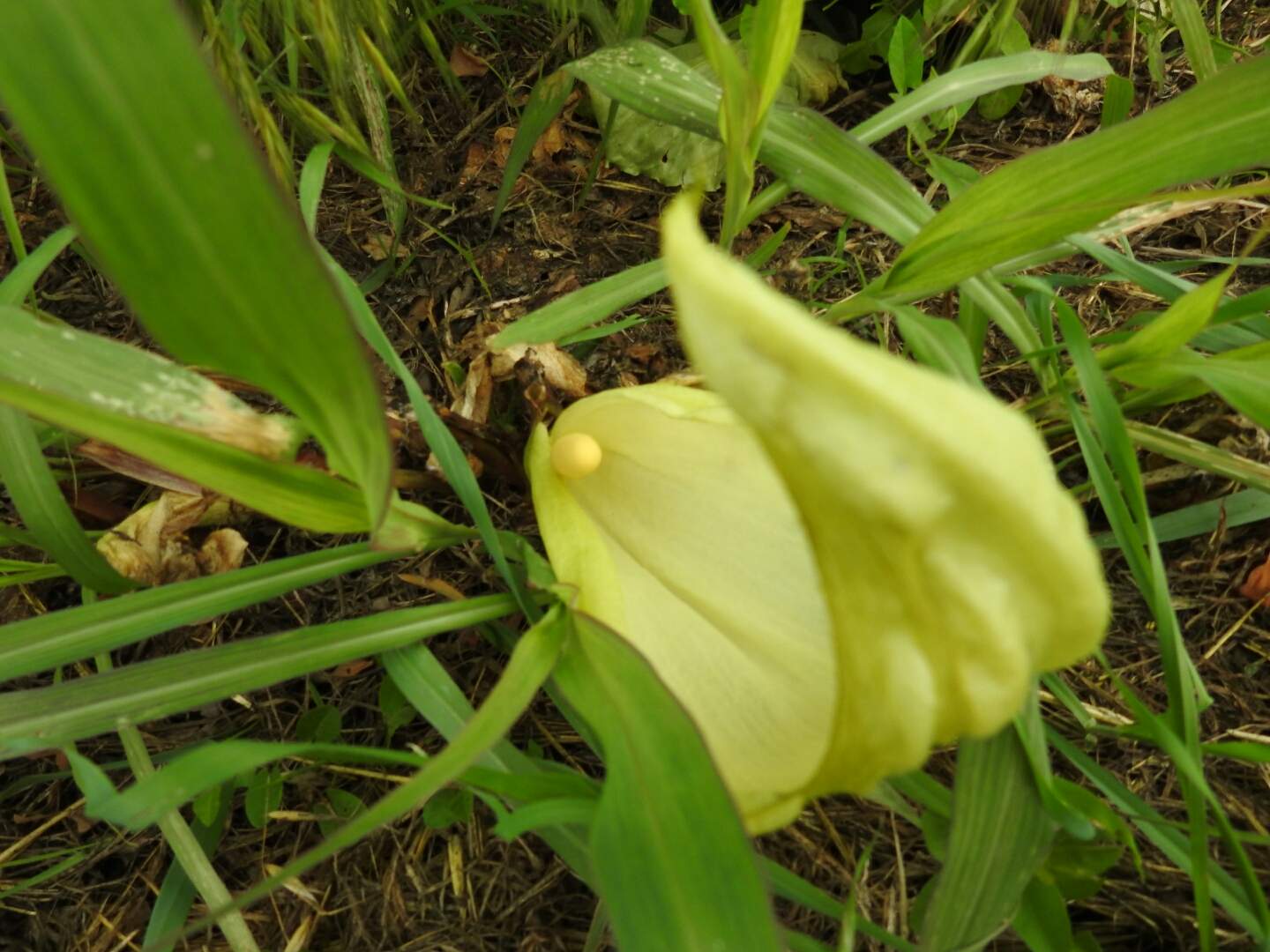
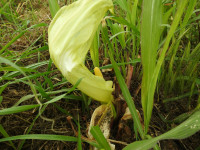
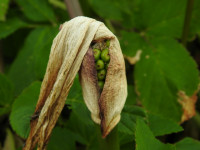
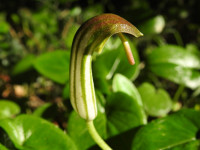
The flowers are small and unisexual, gathered in an inflorescence called a spadix, shaped like a pale yellow club, generally less than half the length of the spathe that encloses it. The spathe is a hood-shaped structure, up to 30 cm long, yellow-green in color with possible purple or violet shades, which protects the spadix and maintains an internal temperature higher than the external one, thanks to active metabolic expenditure. The spathe and spadix together form the characteristic inflorescence of the species.
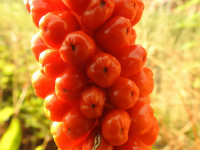
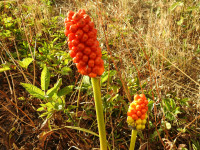
The fruits are berries similar in size to a pea, initially green and then red at maturity, arranged along the axis of the spadix.
The root system is represented by the tuberous rhizome, located deep in the soil, from which new autumn leaves develop each year.
Habitat and distribution
Arum italicum is a species typical of the Mediterranean area, with a range that includes the entire Mediterranean Europe, particularly widespread along the coasts and central and southern Italy, including the major islands. It is rarer in Northern Italy. In Italy, it commonly grows from the plains up to 800-1000 meters of altitude.
It prefers woodland habitats, hedgerows, ditch edges, vineyards, olive groves, and uncultivated areas, favoring moist and well-drained soils. The species adapts well to shaded or semi-shaded exposures, typical of woodland environments and Mediterranean scrublands.
Flowering period
Flowering mainly occurs between March and May, with some variations related to altitude and latitude. Leaves emerge in autumn and overwinter, thus anticipating the appearance of flowers that develop in spring. In milder Mediterranean climates, flowering can begin as early as April, while in cooler areas it extends until May.
Ecology and pollination
The spathe performs a protective and thermoregulatory function, maintaining an internal temperature of the flowers higher than the external environment. This phenomenon favors the attraction and retention of pollinating insects, particularly small dipterans and beetles, which are attracted by the characteristic, rather unpleasant odor described as cadaverous. Pollination thus occurs through these insects, which move inside the spathe and spadix.
Seed dispersal occurs through the mature red berries, which can attract frugivorous animals, although the plant's toxicity limits predation. The berries are therefore the primary unit of seed dispersal.
Curiosities and traditional uses
The entire plant is toxic due to the presence of compounds such as aroin (a saponin) and cyanogenic glycosides, which release hydrocyanic acid in the presence of water. Ingestion of the fruits or parts of the plant can cause severe poisoning: symptoms include vomiting, diarrhea, hemorrhages, tachycardia, dermatitis, and contact blisters. Fortunately, the irritating taste and unpleasant odor often reduce the risk of accidental ingestion, especially in children.
Despite its toxicity, in the past the rhizome, containing about 70% starch, was used after heat treatment that reduced its toxicity. It was used as a flour additive or sold as starch under the name "Portland Tapioca." Furthermore, leaves and rhizome were used in folk medicine as adjuvants in respiratory tract ailments.
In ethnobotanical and folkloric contexts, Gigaro was considered a magical plant in ancient times, believed to ward off evil spirits, protect newborns, and bring luck in love.
Etymology
The generic name Arum derives from ancient Greek, but its exact origin is uncertain. The specific name italicum indicates its main and recognized distribution in the Italian region, which represents its area of greatest development.
The common name "Italian Lords-and-Ladies" refers both to the bright appearance of the spathe and its distribution in Italy (Gigaro is a traditional local term).
Sources
- Acta Plantarum - Flora delle regioni italiane (actaplantarum.org)
- Acta Plantarum - Flora delle regioni italiane (scheda di Giuliano Salvai)
- Tela Botanica / H. Coste, "Flore descriptive et illustrée de la France"
- World Flora Online (WFO)
Characteristics
Where I found it (6 sightings)
Classification
- Kingdom
- Plantae
- Family
- Araceae
- Full name
- Arum italicum Mill.
- Life form
- Geofite rizomatose
Similar species
Search for species with similar characteristicsFurther reading
Noticed an error in the identification? Write to me
Other species of the same family
Araceae
Explore
Other species of Araceae