Botanical family
Araceae
Description
Botanical characteristics
The plants of this family are predominantly perennial herbs, with a typical biological form defined as rhizomatous or tuberous geophytes. This means that they bear buds in underground organs such as rhizomes or tubers, from which roots and aerial stems develop every year. During the adverse season, the aerial parts disappear, leaving only the dormant underground organs. In European species, aquatic forms are also found, belonging to the subfamily Lemnoideae, which are free-floating hydrophytes.
The underground stem is therefore a tuberous rhizome, while the aerial part is herbaceous or bushy, generally with an erect or climbing habit; in the tropics it can also assume a woody character. Some genera have aquatic or floating habits, while other species are epiphytic, with aerial roots.
The leaves can be simple or compound, with a blade varying from broad to ensiform. The arrangement on the stem is spiral, alternate, or distichous, without stipules; the petioles often sheath the stem at the base. The blade is glabrous, continuous or fenestrated, and may present various types of venation: palmate, pinnate, pedate, or intermediate. Some species possess bulbiferous leaves. In aquatic forms, the leaves are few per plant.
The inflorescence is characteristic and of an indefinite type: a spadix, that is a long floral axis densely covered with very closely spaced sessile flowers, wrapped by a large spathe often colored, which serves as a banner and protection. The female flowers are arranged in the basal part, the male ones in the apical part, with intermediate zones of sterile flowers. Among the various sections there are setiform outgrowths that trap pollinating insects. In aquatic species the spadix is reduced and the spathe often present.
The flowers are actinomorphic and can be hermaphroditic or unisexual; the plants are generally monoecious (male and female flowers on the same plant), rarely dioecious. The perianth is sepaloid type, with 4-6 more or less fused segments; in the ex-Lemnaceae it is often absent. The stamens are up to 6 (rarely 12), with poricidal anthers. The gynoecium is syncarpous, with 2-3 fused carpels (1 in ex-Lemnaceae), superior ovary and single stigma. The placentation is variable.
The fruit is predominantly a colored berry containing polyhedral or globose seeds, with a coriaceous or mucilaginous seed coat. In aquatic species the fruit can be a nutlet, a drupe, or similar to a nut.
Distribution and diversity
The family is cosmopolitan, with a significant presence in tropical and temperate regions. In the European territory the species are often rhizomatous or tuberous geophytes, while in the tropics the family is enriched with aquatic, epiphytic, and arboreal forms. The family includes about 114 genera and over 3,700 species worldwide.
Main genera and representative species
Among the best known and representative genera are:
- Arum: the type genus, with perennial herbaceous species that contain calcium oxalate and milky sap. Some species are present in Italy, such as Arum maculatum.
- Monstera: known for its large and fenestrated leaves, equipped with stiff stellate hairs inside the tissues.
- Lemna: belonging to the subfamily Lemnoideae, includes free-floating aquatic plants of minimal size, such as Wolffia arrhiza, among the smallest flowering plants in the world.
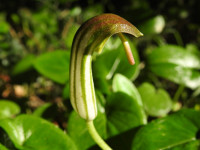
- Arisaema: characterized by plants with dioecious flowers (rarely), also present in Europe.
These genera represent the morphological and ecological variety of the family, ranging from perennial terrestrial plants to floating aquatic species.
Etymology
The family name derives from the type genus Arum, which in turn comes from the Greek "aron" or the Hebrew "ar", terms meaning "heat". This reference is linked to the ability of some species of this family to emit heat during flowering, a phenomenon that favors the attraction of pollinating insects.
Curiosities and uses
The Araceae are known for the phenomenon of thermogenesis, that is the production of heat by the spadix during flowering, which can raise the temperature up to 14 °C above the ambient temperature. This heat helps to volatilize odorous compounds, often unpleasant, which attract pollinating insects such as flies and beetles. The spathe, with its shape and positioning, also acts as a sliding trap, retaining insects until pollination is complete. Self-pollination is avoided thanks to the protandrous maturation of the flowers, in which the female flowers mature before the male ones.
In aquatic species pollination can also occur through small mollusks, while vegetative reproduction is particularly important in forms with rudimentary inflorescences.
Sources
- Wikipedia
Species of the family
2 species catalogued
Explore
Other botanical families