Botanical species
Arisarum vulgare
O.Targ.Tozz.
Common arisarum
Description
Morphological description
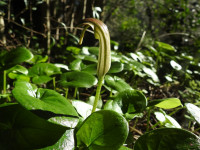
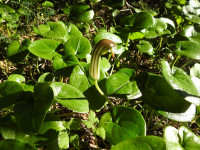
Perennial herbaceous plant reaching a maximum height of about 30 cm. The storage organ is represented by an ovoid or cylindrical tuber, located in the soil, from which leaves and flowers develop every year. The leaves, positioned above the tuber, are ovate or sagittate (arrow-shaped), with an obtuse or slightly mucronate apex (equipped with a rigid and hard point). The leaf petioles are notably long, up to 20 cm, thin and characterized by purplish speckles that give a dotted appearance.
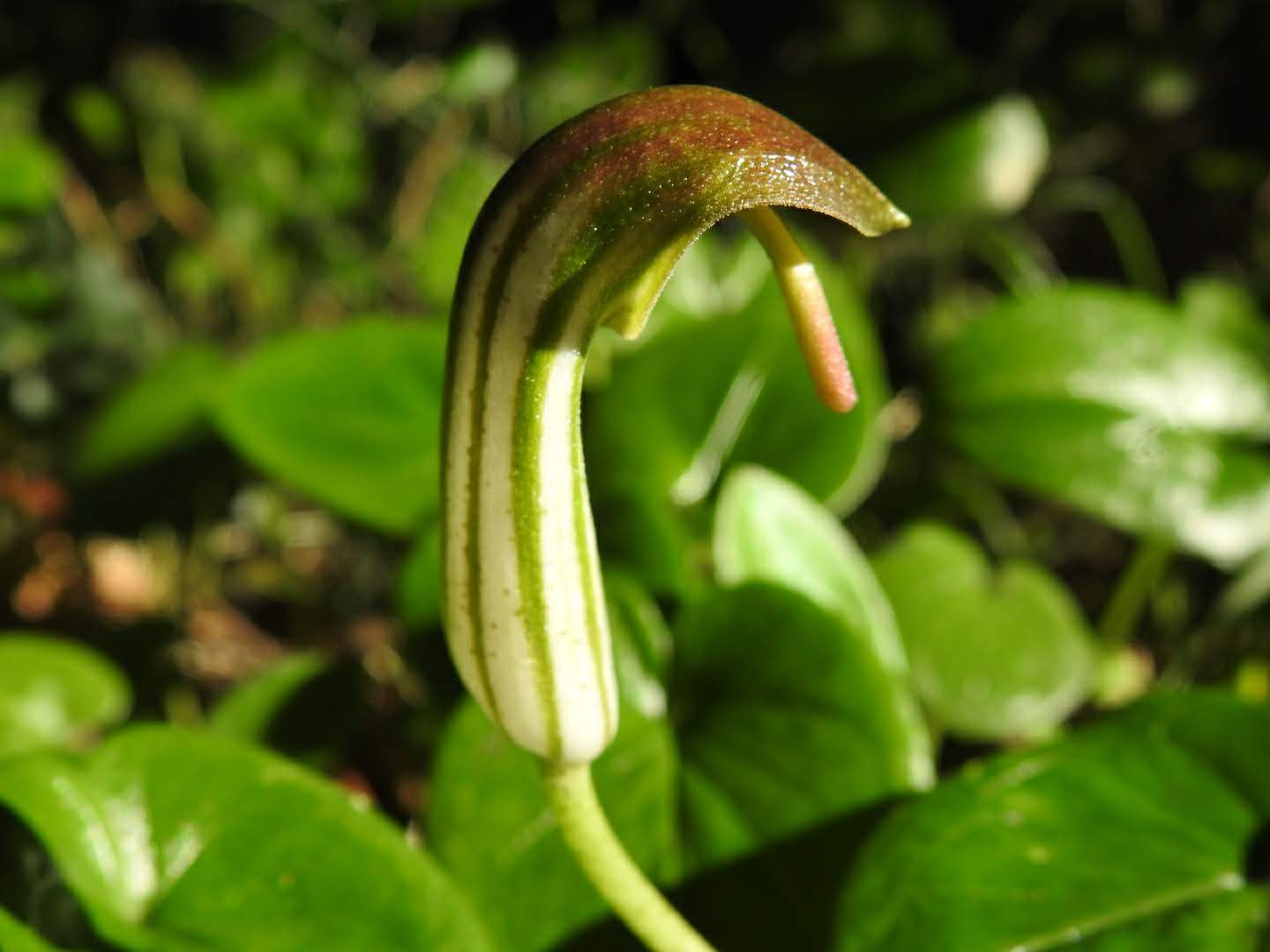
The floral scape, which reaches a length similar to or slightly shorter than that of the petioles, bears at the apex a tubular spathe shaped like a hood. This spathe is pale green in color, with reddish-purple streaks in the lower part; the upper part is instead dark green or brown-purple and appears more flared, rounded or with a more or less acute apex, ending with a frontal opening. From the opening emerges the spadix, the sword-shaped inflorescence, greenish in color, curved and slightly clavate (with the terminal part thickened).
The flowers are unisexual and contiguous, arranged inside the scape at the base of the spadix, in a unilateral manner. There are 3 to 5 female flowers at the base, while above there are about 20 male flowers, each equipped with a single stamen. The arrangement is such that the male flowers are more numerous and overshadow the female ones.
The fruit consists of a globose berry about 1 cm in diameter, which at maturity takes on a brownish-green coloration. Inside there are 2 to 6 whitish seeds.
The root system consists of a deep tuberous rhizome, rich in starch, which serves as a storage organ for the plant.
Habitat and distribution
It is a typically Mediterranean species, with a steno-Mediterranean distribution mainly limited to the coasts and inland areas of the Mediterranean belt. In Italy it is found especially in coastal regions and in territories characterized by the presence of the main Mediterranean-type vegetation formations, such as the olive, holm oak, and chestnut belts.
The preferred habitat includes soils rich in organic matter (humus), frequently shaded and located in wooded or uncultivated environments. It often grows at the foot of walls or in cool and shady areas. The altitude range varies from sea level up to about 800 meters.
It is also present in other regions of the Mediterranean basin such as Provence, Corsica, and Roussillon, and has been naturalized in some areas like Gironde.
Flowering period
Flowering extends from October to May, with a peak in the spring months (March-May) and a second autumn period (October-November). This double phenological window is typical of Mediterranean species, which exploit both the spring and autumn seasons for reproduction.
Ecology and pollination
The flowers of this species are unisexual and arranged contiguously inside the spathe; the very particular structure of the spathe and spadix suggests a specialized pollination strategy, probably linked to specific insects attracted by the green-purple shape and color, although no precise details are available about the pollinating insects.
The unilateral arrangement of female and male flowers and the presence of the spadix protruding from the spathe could facilitate encounters with pollinators, while the production of berries with whitish seeds favors dispersal. Wild boars are known to feed on the rhizomes, potentially contributing to the dispersal and renewal of individuals in wooded areas.
Curiosities and traditional uses
The plant is toxic in all its green parts (leaves, stem, and berries), but in the past it had some traditional medicinal and food uses. In particular, in some areas of Tuscany, the leaves were used in decoctions as an antipyretic, to reduce fever in case of colds.
The rhizome contains starch and has been used as a laxative, diuretic, expectorant, aphrodisiac, vulnerary, and healing agent. In ancient times, the dried tuber ground into flour was also consumed by humans as an emergency food. Today, however, it is much sought after by wild boars, which are very fond of it.
It should be emphasized that, due to its toxicity, any medicinal or food use must be considered with extreme caution and is not advisable without adequate knowledge.
Etymology
The generic name "Arisarum" derives from the Greek "asaron," a term attributed to Dioscorides to indicate plants of the Araceae family. The specific epithet "vulgare" derives from Latin and means "common," referring to the relative distribution of the species in its natural range. The Italian common name "Common arisarum" reflects precisely this characteristic of distribution.
Sources
- Acta Plantarum - Flora delle regioni italiane (actaplantarum.org)
- Acta Plantarum - Scheda di Giuliano Salvai
- Tela Botanica / H. Coste, Flore descriptive et illustrée de la France
Characteristics
Scheda botanica
| Famiglia | Araceae |
|---|---|
| Fioritura | gennaio, febbraio, marzo, aprile, maggio, ottobre, novembre, dicembre |
| Forma biologica | Rhizomatous |
| Habitat | toxic plant, with green flowers, plant with leaves with mucronate apex |
| Tossicità | Tossica — non consumare |
Domande frequenti
- Quando fiorisce Common arisarum?
- Common arisarum fiorisce gennaio, febbraio, marzo, aprile, maggio, ottobre, novembre, dicembre.
- È tossica Common arisarum?
- Common arisarum è una pianta tossica o velenosa. Non consumare nessuna sua parte senza aver consultato un esperto.
- Che tipo di pianta è Common arisarum?
- Common arisarum è una Geophytes (Rhizomatous) secondo la classificazione di Raunkiaer.
- A quale famiglia appartiene Common arisarum?
- Common arisarum appartiene alla famiglia botanica Araceae.
Where I found it (10 sightings)
Classification
- Kingdom
- Plantae
- Family
- Araceae
- Full name
- Arisarum vulgare O.Targ.Tozz.
- Life form
- Geophytes rhizomatous
Similar species
Search for species with similar characteristicsFurther reading
Noticed an error in the identification? Write to me
Other species of the same family
Araceae
Explore
Other species of Araceae