Botanical species
Amaranthus retroflexus
L.
Common Amaranth



Description
Morphological description
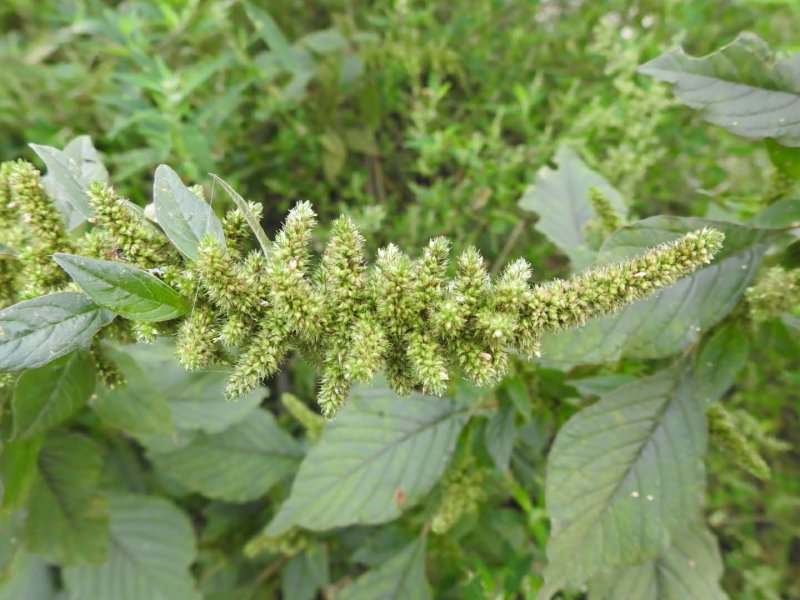
Annual herbaceous plant, monoecious, with an erect habit and variable height between 20 and 100 cm, but sometimes reaching up to 300 cm. The stem is robust, erect, and from simple to branched, with a woody texture in the lower part; it has a light green color tending to reddish especially at the base, while the surface is striated and pubescent in the upper part and on the branches, which bear a dense inflorescence.
The leaves are long-petiolate, with the petiole sometimes reaching the length of the blade. The leaf blade is ovate-rhomboid or elliptical in shape, measuring between 2 and 15 cm in length and 1-7 cm in width. The apex can be acute, obtuse, or flat, and the margin shows a slight undulation. The lower surface of the leaf displays well-marked and pubescent veins.
The inflorescence is a compact panicle consisting of terminal and lateral spikes of similar size, often with the tip retroflexed (bent backward), from which the epithet "retroflexus" derives. The flowers are unisexual and pentamerous, with spatulate-ovate or lanceolate-spatulate tepals, white or whitish in color, about 2.5-4 mm long. The bracts of the female flowers are lanceolate or awl-shaped, with a rigid and sharp terminal mucro, longer than the tepals (3.5-6 mm). Each male flower has five stamens longer than the perianth, while the stigmas of the female flowers are 2 or 3.
The fruit is a subglobose (pyxidium) ellipsoid capsule, similar in size to the perianth, which opens horizontally (dehiscent). The seeds are lenticular in shape, dark brown or reddish in color, with a wrinkled and shiny surface, about 1-1.4 mm in diameter.
The root system is not specifically described in the consulted sources, but as an annual herbaceous species it is presumed to have a taproot or fibrous root system typical of plants colonizing disturbed habitats.
Habitat and distribution
Native to North America, it is now a cosmopolitan species widespread in all temperate zones of the world. In Italy and the Mediterranean basin it commonly grows in anthropic and disturbed habitats such as cultivated fields, uncultivated land, ruins, rubble, gravel areas, and along riverbanks, from sea level up to about 900 m altitude.
It prefers well-drained soils, often gravelly or sandy, and sunny or partially shaded exposure conditions. It is frequently considered a weed, given its adaptability and rapid growth in open and disturbed environments.
Flowering period
Flowering extends from May to October, with possible variation depending on altitude and latitude. In Italy, the plant generally flowers from late spring to late autumn, exploiting the warm seasons for seed production.
Ecology and pollination
The species has unisexual flowers with male and female flowers mixed in the inflorescence, favoring cross-pollination. The flower morphology, small and inconspicuous with white tepals, suggests adaptation to anemophilous pollination (pollen transport by wind), although occasional insect visits are not excluded.
Seed dispersal occurs through horizontal dehiscence of the fruit, which releases small, shiny, and wrinkled seeds easily transported by wind, water, or human activities. Rapid germination and growth allow this species to quickly colonize open and disturbed spaces.
Curiosities and traditional uses
Common Amaranth is an edible species with various food and traditional uses. The leaves, harvested in the rosette stage, are consumed as a vegetable, usually boiled for soups, with a flavor reminiscent of spinach. The young stem, before the development of the inflorescence, can be used like asparagus.
The seeds, ground and used as flour, enrich the diet with proteins, representing an alternative resource to traditional cereals. From a nutritional point of view, the plant is rich in vitamins A and C, calcium, and iron, with astringent and revitalizing properties, traditionally used to improve the health status of debilitated individuals.
However, it is important to avoid using the cooking water of the leaves, as the plant accumulates nitrates that can contaminate the water.
Etymology
The genus name, Amaranthus, derives from the Greek "a-maraino" meaning "I do not wither," referring to the calyx and the scarious bracts of the plant that seem never to wither. In the past, it has also been interpreted as "imperishable" or, by other authors, as deriving from "amor" and "anthos" (flower of love).
The specific epithet retroflexus refers to the characteristic central spike of the inflorescence that often bends backward. The Italian common name "amaranto comune" highlights its wide distribution and recognizability among amaranth species.
Sources
- Acta Plantarum - Flora delle regioni italiane (actaplantarum.org)
- Acta Plantarum - Flora delle regioni italiane (scheda di Antonino Messina)
- World Flora Online (WFO)
Characteristics
Scheda botanica
| Famiglia | Amaranthaceae |
|---|---|
| Fioritura | maggio – ottobre |
| Forma biologica | Scapose |
| Habitat | with white flowers, edible plant, annual plant |
| Uso alimentare | Commestibile |
Domande frequenti
- Quando fiorisce Common Amaranth?
- Common Amaranth fiorisce maggio – ottobre.
- È commestibile Common Amaranth?
- Common Amaranth è considerata commestibile. Verifica sempre le parti eduli e la preparazione corretta prima del consumo.
- Che tipo di pianta è Common Amaranth?
- Common Amaranth è una Therophytes (Scapose) secondo la classificazione di Raunkiaer.
- A quale famiglia appartiene Common Amaranth?
- Common Amaranth appartiene alla famiglia botanica Amaranthaceae.
Where I found it (10 sightings)
Classification
- Kingdom
- Plantae
- Family
- Amaranthaceae
- Full name
- Amaranthus retroflexus L.
- Synonyms
- Amaranthus delilei Loret ; Amaranthus spicatus Lam., nom. illeg.
- Life form
- Therophytes scapose
Similar species
Search for species with similar characteristicsFurther reading
Noticed an error in the identification? Write to me
Explore
Other species of Amaranthaceae