Botanical species
Sambucus ebulus
L.
Dwarf Elder
Description
Morphological description
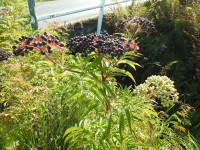
Perennial herbaceous plant, bushy and robust, it can reach a height of up to 150-200 cm. The stem is erect, simple or slightly branched, herbaceous in texture with light longitudinal ribs and white pith, sometimes glabrous or slightly hairy, with green or sometimes reddish coloration. The rhizome is creeping, stoloniferous and deep, a characteristic that favors rapid vegetative spread and the formation of dense colonies.
The leaves are opposite, petiolate and imparipinnate, generally composed of 5-9 lanceolate leaflets, acuminate at the apex, 10-15 cm long and 2-5 cm wide. The margin is finely serrated, with very evident parallel secondary veins. The upper surface is glabrous and dark green, while the lower one is lighter and pubescent. The stipules are persistent, ovate or subrounded in shape, about 1 cm long, with an acute apex and dentate margin.
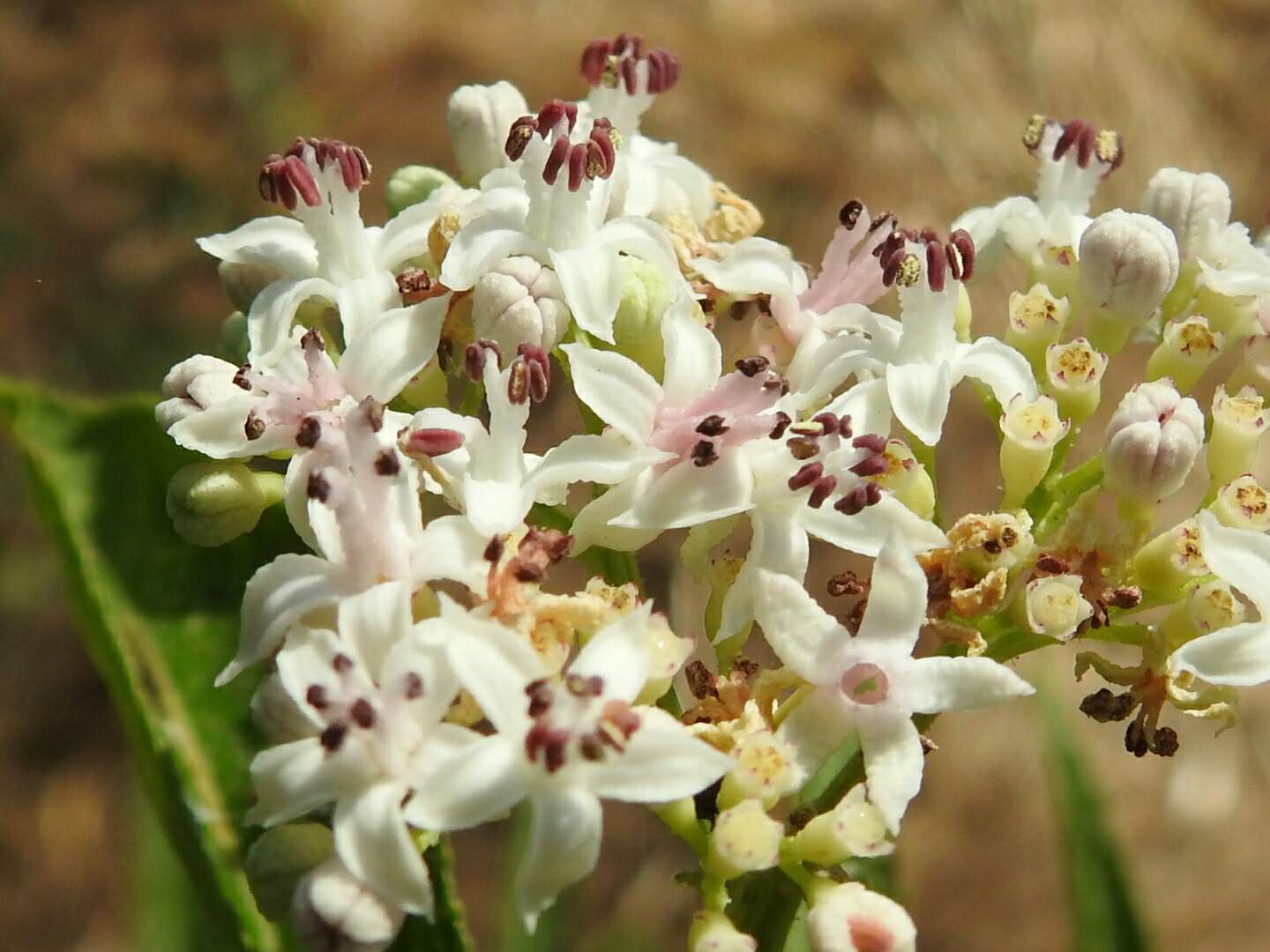
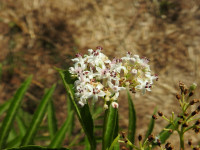
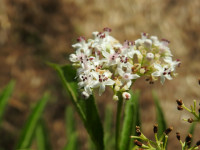
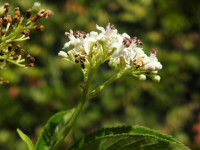
The flowers, numerous (200-250 per corymb), are gathered in wide and flat corymbs, 5-16 cm long, formed by 3 main rays, often directed upwards even after fruiting. Each flower is pentamerous, actinomorphic and pedunculate, with a calyx reduced to a short tube with 5 inconspicuous teeth. The corolla is rotate, white or white-pinkish on the outside, with ovate, pointed and slightly reflexed lobes at maturity, about 4 mm long. The stamens are 5, free, with violet or purple anthers.
The fruit is a glabrous drupe, globose-pyriform in shape, 4-7 mm long, shiny and black at maturity, containing 3-4 prismatic and wrinkled stones. The plant emits a characteristic unpleasant and fetid odor, particularly noticeable in the green parts.
Habitat and distribution
The species is mainly widespread in Mediterranean and Eurymediterranean climate zones, with a range extending from the Mediterranean coasts northwards and eastwards to Western Asia and North Africa. In Italy it commonly grows in uncultivated places, field edges, paths, ditches and pastures, preferring calcareous, clayey and fresh soils. It can grow up to 1300 m in altitude, especially on well-drained and sunny or partially shaded soils.
Its ability to spread rapidly through stoloniferous rhizomes makes it an invasive species in some environments, where it can form dense colonies.
Flowering period
Flowering generally occurs from June to July, with geographical variations that can extend it from May until the end of July, depending on local climatic conditions. Fruiting follows flowering, with berry maturation between September and October.
Ecology and pollination
The plant is mainly pollinated by pollinating insects, including bees and other hymenopterans, attracted by the scent and white color of the flowers. The open and flat structure of the corymbs facilitates access for pollinator visitors. Seed dispersal occurs mainly through birds and small mammals that consume the ripe berries, contributing to the spread of the species.
The underground stoloniferous rhizome also allows rapid vegetative expansion, enabling the plant to colonize new spaces and survive in disturbed environments.
Curiosities and traditional uses
This species has long been known for its medicinal properties, although it is considered toxic. The root is used as a laxative, diuretic and anti-edematous; the bark and leaves, dried, are employed as anti-rheumatic; the dried flowers have sudorific and expectorant properties and are used in the treatment of bronchial ailments. The berries, although toxic if ingested in excessive quantities due to the presence of cyanogenic glucosides and an unidentified purgative, are used in the preparation of repellents, dyes and inks.
The common name "Dwarf Elder" or "Ebbio" derives from the Latin "ebulum," an ancient term indicating this plant, while the generic name "Sambucus" has uncertain origins, probably linked to the name of an ancient musical instrument made of elder wood. In popular tradition, the plant has been used cautiously for its medicinal properties, but its unpleasant odor and toxicity limit its food use.
Etymology
The scientific name derives from "Sambucus," a Latin name used by Pliny and Columella to indicate the black elder and of uncertain origin. The specific term "ebulus" comes from Latin and refers to the dwarf elder, an ancient name of the plant, mentioned by Virgil and other classical authors. In Italian, the name "Sambuco ebbio" recalls this nomenclatural tradition and the distinction from the more common species Sambucus nigra.
Sources
- Prof. S. Pignatti, "Flora d'Italia"
- Acta Plantarum - Flora delle regioni italiane (scheda di Giuliano Salvai)
- Tela Botanica / H. Coste, "Flore descriptive et illustrée de la France"
- World Flora Online (WFO)
Characteristics
Scheda botanica
| Famiglia | Adoxaceae |
|---|---|
| Fioritura | maggio – luglio |
| Forma biologica | Rhizomatous |
| Habitat | with white flowers, plant with a spreading bushy habit |
Domande frequenti
- Quando fiorisce Dwarf Elder?
- Dwarf Elder fiorisce maggio – luglio.
- Che tipo di pianta è Dwarf Elder?
- Dwarf Elder è una Geophytes (Rhizomatous) secondo la classificazione di Raunkiaer.
- A quale famiglia appartiene Dwarf Elder?
- Dwarf Elder appartiene alla famiglia botanica Adoxaceae.
Where I found it (8 sightings)
Classification
- Kingdom
- Plantae
- Family
- Adoxaceae
- Full name
- Sambucus ebulus L.
- Life form
- Geophytes rhizomatous
Similar species
Search for species with similar characteristicsFurther reading
Noticed an error in the identification? Write to me
Other species of the same family
Adoxaceae
Explore
Other species of Adoxaceae