Botanical species
Viburnum lantana
L.
Wayfaring Tree
Description
Morphological description
It is a deciduous shrub or small tree, with a bushy habit, which can reach a height between 1 and 5 meters. The stem is woody and covered by brown-pink bark; young branches are thin, flexible and characterized by a dense pubescence composed of stellate hairs and furfuraceous scales, giving them a woolly and gray-green appearance. Older branches take on an ochre coloration. Branches that touch the ground can root, contributing to the plant's ability to expand. The buds are opposite, tomentose, white and without scales; floral buds are short, conical and develop at the tips of the current year's twigs, while leaf buds are larger, club-shaped and with dentate margins.
The leaves are opposite, ovate-lanceolate or elliptical, with variable sizes from 4-6 cm wide to 6-12 cm long. Their margin is finely dentate or crenate-dentate. The upper surface is dark green, subglabrous and slightly rough, while the lower surface is gray-green, rough and covered by a dense woolly and tomentose pubescence, with well-evident veins. The petiole is arcuate and about 1–3 cm long, also tomentose.
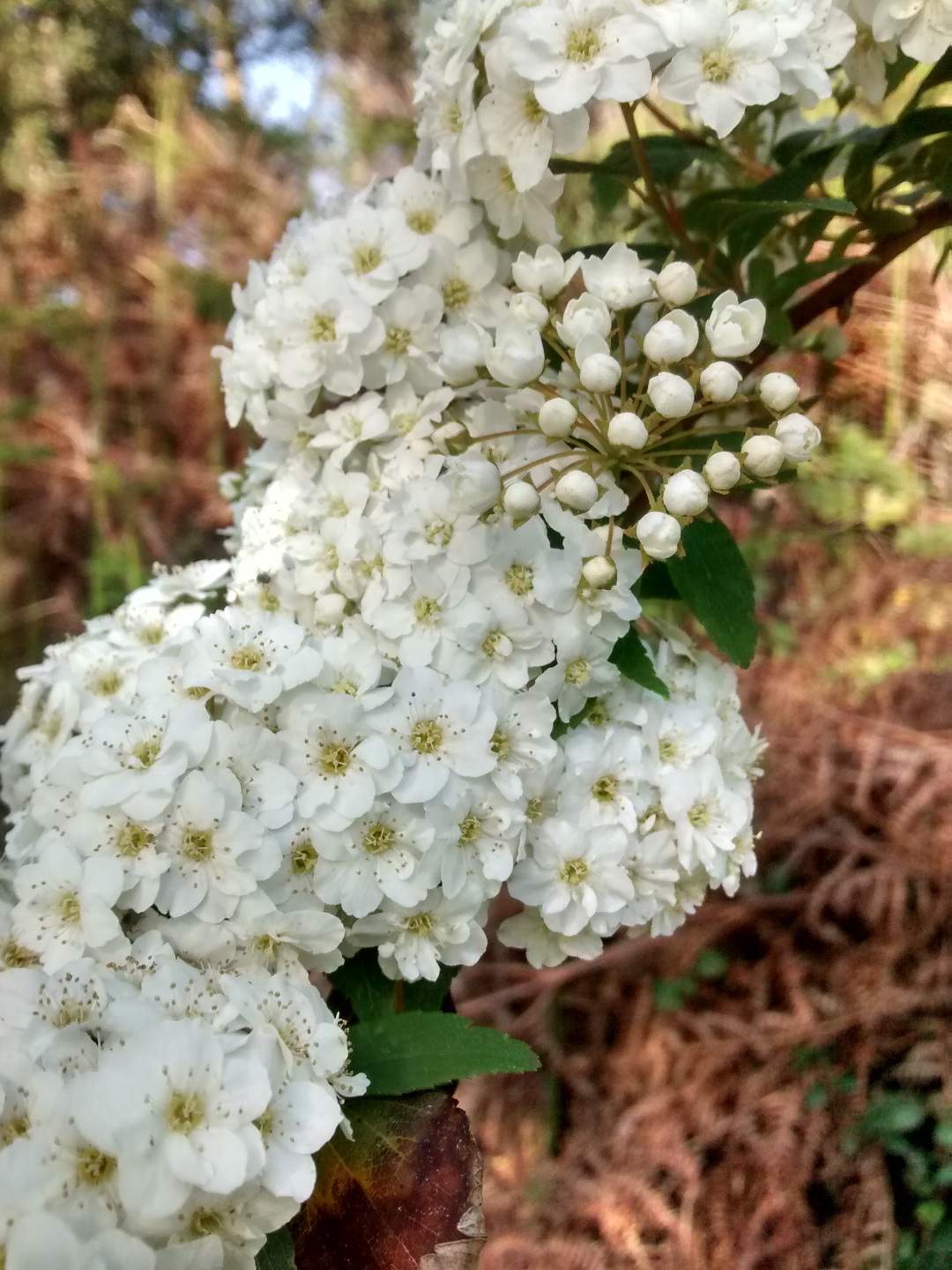
The flowers, hermaphroditic and slightly fragrant, are gathered in terminal umbels of an umbel-like shape, with a diameter that can reach 10 cm and composed of numerous flowers (about 7 rays in the umbel). Each flower presents a white campanulate corolla, 6-8 mm wide, formed by five oval and rounded lobes. Before opening, the buds can take on a pinkish coloration. The calyx is reduced, with five obtuse teeth, while the stamens are five, with white filaments and yellow anthers. The flowers do not show size differentiation between peripheral and central ones.
The fruits are ovoid drupes, slightly flattened laterally, 7-10 mm long. During ripening they change color from green to bright red, then becoming black and shiny at full maturity. They contain a flat brown stone, with a characteristic groove on both sides.
The root system is typical of a bushy shrub, capable of producing roots from branches that touch the soil, thus favoring the formation of dense populations.
Habitat and distribution
This species is widespread in southern and central Europe, western Asia and North Africa, with a well-established presence in Italy and the Mediterranean basin. In Italy it commonly grows at the edge of deciduous woods and in thickets, preferring heliophilous and thermophilous environments. It is a pioneer species that settles in poor, well-drained and calcium-rich soils, often in association with downy oaks, hornbeams, hazels and hop-hornbeams.
Viburnum lantana adapts to live from the plain up to 1,400 meters altitude, colonizing forest edges, hedges and shrubs. It generally prefers sunny exposures and calcareous soils, with a good ability to withstand poor soils and relatively dry conditions.
Flowering period
Flowering occurs mainly between April and May, with some possibility of local variations depending on altitude and climate. The flowers, white and fragrant, develop in well-evident umbels that attract numerous pollinating insects. Fruiting follows flowering and occurs from August to September, when the drupes mature and change color.
Ecology and pollination
The flowers are hermaphroditic and suitable for entomophilous pollination, mainly by pollinating insects attracted by their scent and bright white color. The presence of compact umbels facilitates the simultaneous visit by multiple insects, increasing pollination efficiency.
Seed dispersal occurs thanks to the fleshy fruits, which are consumed by various bird species. These contribute to the spread of the plant through seed expulsion in other sites, facilitating colonization of new habitats.
Curiosities and traditional uses
Historically, the young and flexible shoots of Viburnum lantana have been used as weaving material, replacing willow, both for bindings and for basket making. The secondary bark was used to extract an adhesive substance.
From a phytotherapeutic point of view, the species is known for its medicinal properties, although it is toxic if not properly used. In gemmotherapy, Viburnum lantana is used as a remedy for allergic asthma, thanks to its ability to calm the pulmonary neurovegetative system and reduce bronchial spasms. The infusion of the inflorescences has anti-inflammatory effects, while that of leaves and young twigs is used externally to prepare compresses applied on corns, ulcers and boils. Moreover, it is useful to strengthen the gums and to counteract small hemorrhages.
The ripe fruits constitute an important food source for birdlife, thus contributing to the ecological balance of the habitats where the species is present.
Etymology
The genus name derives from the Latin "viere", meaning “to weave”, referring to the flexibility of the branches traditionally used for basket and binding making. The specific epithet "lantana" probably also alludes to this characteristic of bending easily, deriving from the Latin "lentare", meaning “to bend”.
In Italian, the common name “lantana” or “viburno lantana” directly recalls the scientific denomination, while other popular names are linked to the traditional use and physical characteristics of the plant.
Sources
- Prof. S. Pignatti, "Flora d'Italia"
- Acta Plantarum - Flora delle regioni italiane (scheda di Marinella Zepigi)
- Tela Botanica / H. Coste, "Flore descriptive et illustrée de la France"
- World Flora Online (WFO)
Characteristics
Where I found it (1 sightings)
Classification
- Kingdom
- Plantae
- Family
- Adoxaceae
- Full name
- Viburnum lantana L.
- Life form
- Fanerofite cespugliose
Similar species
Search for species with similar characteristicsFurther reading
Noticed an error in the identification? Write to me
Other species of the same family
Adoxaceae
Explore
Other species of Adoxaceae