Botanical species
Phytolacca americana
L.
American Pokeweed
Description
Morphological description
Perennial herbaceous plant, vigorous, native to North America, with an erect habit and variable height from 1 to 3 meters, sometimes up to 7 meters under favorable conditions. The stem is robust, often lignified at the base, quadrangular (tetragonal) in section and glabrous, with coloration ranging from light green to reddish-violet, intensifying as the growing season progresses. The branches are subcylindrical and branched, giving the plant a bushy appearance.
The leaves are alternate, shortly petiolate (1-6 cm), with a lanceolate or ovate-lanceolate blade, varying in size from 3-5 cm up to 35 cm in length and up to 18 cm in width, with entire margins and a base ranging from obtuse to slightly cordate. The apex is acuminate or acute, often mucronate. The upper surface is light green and shiny, tending to yellow if exposed to full sun, while the lower surface appears matte green with prominent often reddish veins.
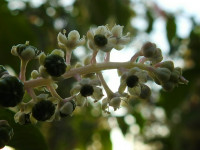
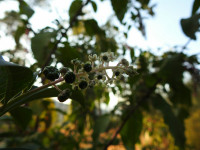
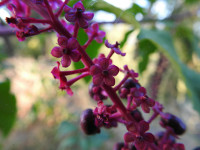
The flowers, lacking true petals, are small, pentamerous, with a sepaloid perianth composed of 5 ovate, concave, and persistent tepals, varying in color from white-greenish to pink or purplish. They are grouped in erect or slightly pendulous racemes, ranging from 6 to 30 cm long, borne on peduncles up to 15 cm long, with pedicels about 3-13 mm. Each flower has 9-12 erect stamens inserted on a fleshy disk, and a superior ovary formed by 6-12 carpels fused at least halfway, with short persistent styles. Flowering mainly occurs from July to October.
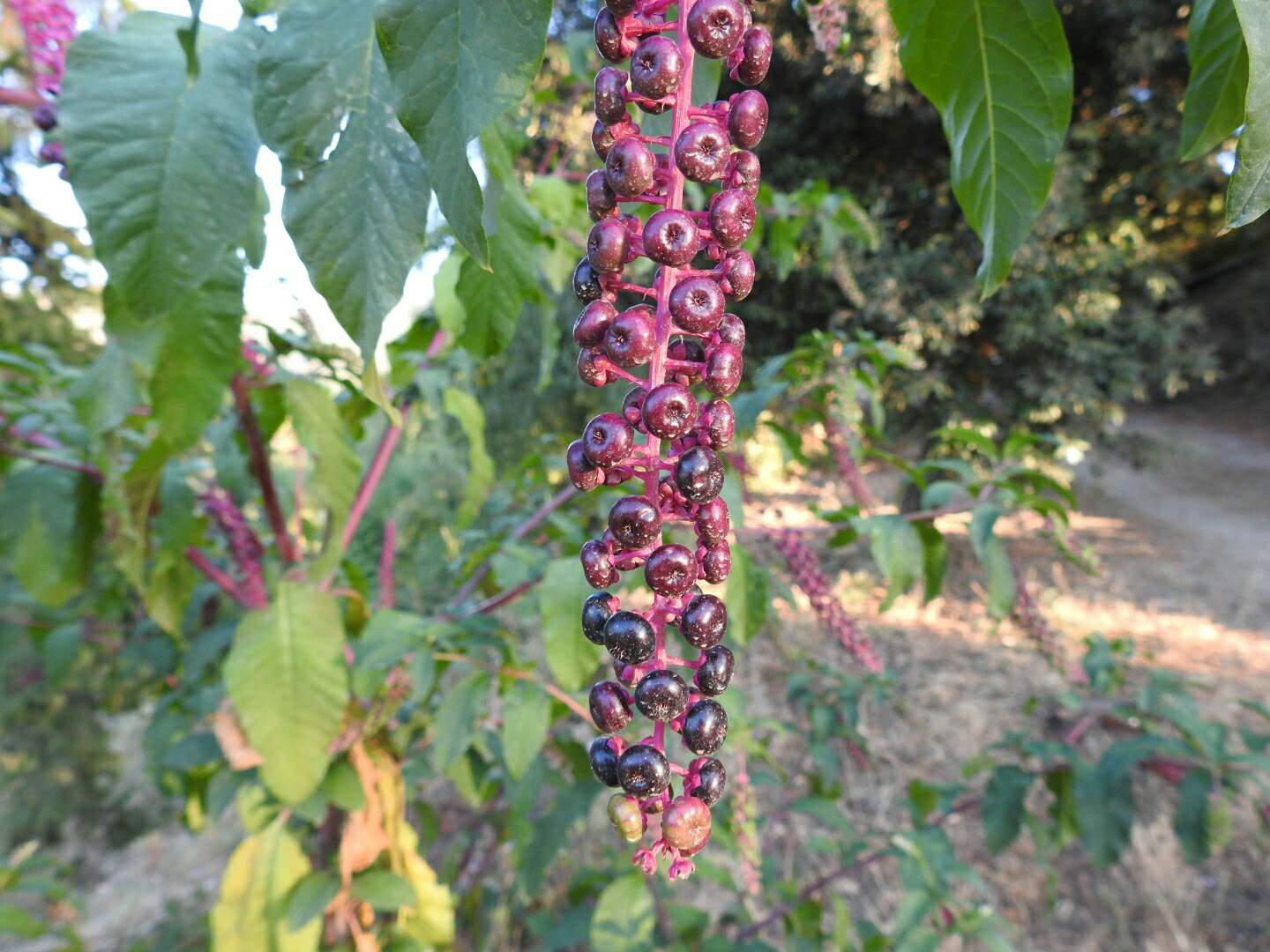
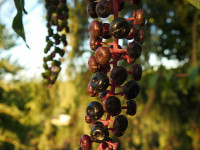
The fruits are globose berries, slightly flattened and ribbed with 10 ribs corresponding to the 10 carpels, 5-11 mm in diameter. The coloration varies from initial green to dark purple tending to black at maturity, with a glossy surface. The seeds are black, lenticular, shiny, about 3 mm. The clusters of berries, initially erect, become pendulous at maturity due to the bending of the peduncles and persist on the plant for a long time.
The root system consists of a taproot, tuberous and deep, fusiform in shape with white pulp, contributing to the vigorous expansion of the species.
Habitat and distribution
Native to North America, the species is now widely naturalized and considered an invasive neophyte in many Italian regions and the Mediterranean. It prefers disturbed environments such as uncultivated lands, fields, road margins, riverbanks, gardens, and ruderal habitats, generally on fresh, humus-rich, well-drained soils. Its presence is reported up to 400 meters altitude.
In Italy it is widespread throughout the territory, with particular presence in southern regions and Mediterranean areas. The species adapts to sunny or partially shaded exposures, showing some tolerance to anthropized environments.
Flowering period
Flowering extends from July to October, with some geographic variation linked to local climate and resource availability. In more temperate Mediterranean areas it can start as early as June and continue until September.
Ecology and pollination
The small white-greenish or purplish flowers, lacking showy petals, are mainly pollinated by pollinating insects attracted by nectar and the pale color of the tepals. The plant produces abundant fleshy berries that favor seed dispersal through frugivorous animals, particularly birds, which facilitate its spread in the surroundings.
The robust tuberous root allows the plant rapid regeneration and remarkable colonization capacity, contributing to its invasive character in natural and anthropized habitats.
Curiosities and traditional uses
Despite its ornamental beauty and historical use as a garden plant, the entire plant is toxic: it contains triterpenoid saponins, glycosides, lectins, and other poisonous substances that can cause severe symptoms if ingested, such as burning, vomiting, hemorrhagic diarrhea, convulsions, and coma. Contact with the sap can cause contact dermatitis in sensitive individuals.
Historically, the berries were used to produce red dyes, employed to color wines and fabrics, while the root, rich in saponins, was used to make soaps.
In traditional medicine, the plant has been used as a bitter herb, cathartic, insecticide, and anti-inflammatory, especially to treat autoimmune diseases, inflammations, and skin infections, although its use is limited by toxicity. Native Americans used it as an emetic and antirheumatic, applying root poultices in cases of mastitis and other inflammations.
Some young parts, after careful boiling and water changes, were consumed as vegetables similar to asparagus in some culinary traditions, but consumption is generally discouraged due to the plant's danger.
From a pharmacological point of view, antiviral proteins (such as PAP, pokeweed antiviral protein) have been isolated and used in studies against the HIV virus, highlighting scientific interest in the species' bioactive compounds.
Etymology
The generic name "Phytolacca" derives from the combination of the Greek "phytón" (plant) and the Indian term "lakh," referring to a dye obtained from an insect, recalling the purplish color of the berry juice. The specific epithet "americana" indicates the geographic origin of the species, i.e., the North American continent.
The Italian common name "fitolacca americana" derives from Latin and the scientific name, with the addition of "americana" to emphasize its extra-European origin.
Sources
- Prof. S. Pignatti, "Flora d'Italia"
- Acta Plantarum - Flora delle regioni italiane (scheda di Marinella Zepigi)
- Tela Botanica / H. Coste, "Flore descriptive et illustrée de la France"
- World Flora Online (WFO)
Characteristics
Scheda botanica
| Famiglia | Phytolaccaceae |
|---|---|
| Fioritura | luglio – ottobre |
| Forma biologica | Rhizomatous |
| Habitat | with white flowers, toxic plant |
| Tossicità | Tossica — non consumare |
Domande frequenti
- Quando fiorisce American Pokeweed?
- American Pokeweed fiorisce luglio – ottobre.
- È tossica American Pokeweed?
- American Pokeweed è una pianta tossica o velenosa. Non consumare nessuna sua parte senza aver consultato un esperto.
- Che tipo di pianta è American Pokeweed?
- American Pokeweed è una Geophytes (Rhizomatous) secondo la classificazione di Raunkiaer.
- A quale famiglia appartiene American Pokeweed?
- American Pokeweed appartiene alla famiglia botanica Phytolaccaceae.
Where I found it (6 sightings)
Classification
- Kingdom
- Plantae
- Family
- Phytolaccaceae
- Full name
- Phytolacca americana L.
- Synonyms
- Phytolacca decandra L.; Phytolacca vulgaris Bubani, nom. illeg.; Phytolacca vulgaris Crantz
- Life form
- Geophytes rhizomatous
Similar species
Search for species with similar characteristicsFurther reading
Noticed an error in the identification? Write to me
Explore
Other species of Phytolaccaceae