Botanical family
Phytolaccaceae
Description
Botanical characteristics
The Phytolaccaceae are a family of angiosperm plants mainly characterized by a woody habit, although in rare cases herbaceous forms are also found. The leaves are arranged alternately along the stem, without stipules. The flowers are generally tripartite, that is with three distinct floral whorls, and are grouped in racemose inflorescences, that is with sessile or pedunculate flowers arranged along a central axis.
The perianth is often petaloid and formed by 5 elements, that is it is pentamerous. The stamens are present in a number equal to or multiple of the tepals, and the ovary is superior, composed of 5 ovules, with 2 carpels per ovule (5 x 2 carpels). The fruits are variable: they can be achenes, capsules or berries, depending on the genus and species.
Among the distinctive characters of the family are the tripartite floral structure with petaloid perianth and the arrangement of the stamens, as well as the presence of a superior ovary with a particular organization of the ovules. These aspects distinguish it from other related families of the order Caryophyllales.
Distribution and diversity
The Phytolaccaceae family has a predominantly American distribution, with species mainly widespread in the Americas. The family is relatively small and includes few botanical genera, although with a fair variety of species.
According to current taxonomy, the main genera included in the family are Agdestis, Anisomeria, Ercilla and Phytolacca. Overall, the family counts several dozen species, many of which are native to the tropical and subtropical regions of the American continent.
Main genera and representative species
The most important genera of the Phytolaccaceae family are:
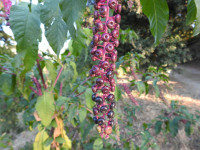
- Phytolacca: it is the best known and widespread genus, including species such as Phytolacca americana (American pokeweed), a perennial herbaceous plant often considered invasive in some regions. This species is also known for producing black-violet colored berries.
- Agdestis, Anisomeria and Ercilla are lesser known genera, with more limited distributions and less global relevance.
In Italy, the presence of the Phytolaccaceae family is very limited and generally recorded only in naturalized or introduced form, especially with species like Phytolacca americana, which can be found in some areas as a spontaneous or invasive plant.
Etymology
The name of the family derives from the type genus Phytolacca. The term "Phytolacca" derives from the ancient Greek "phyto" (plant) and from the Latin "lacca", probably referring to the reddish-violet color of the berries produced by some species of the genus and their traditional use as a dye.
Sources
- Wikipedia
Species of the family
1 species catalogued
Explore
Other botanical families