Botanical species
Nymphaea alba
L.
White Water-Lily
Description
Morphological description
Perennial aquatic plant equipped with a long fleshy rhizome, often up to 7 cm thick and up to 1 meter long, buried in the mud of the bottoms of still or slow-flowing waters. The rhizome is provided with rootlets distributed along its entire surface and covered by the scars of the petioles of fallen leaves.
The leaves are floating, suborbicular or oval in shape, with sizes ranging from 10 to 30 cm in diameter, with a flat, smooth, and fleshy blade, waxy in texture on the upper surface to facilitate water runoff and prevent stomatal occlusion. The margin is entire and the leaf base has a deep cordate sinus. The petiole is cylindrical, flexible, and equipped with numerous aerenchyma tubes that ensure buoyancy; it is inserted at a point located about one-third of the blade, in a narrow and deep sinus. Young leaves, when still submerged, appear rolled up on themselves.
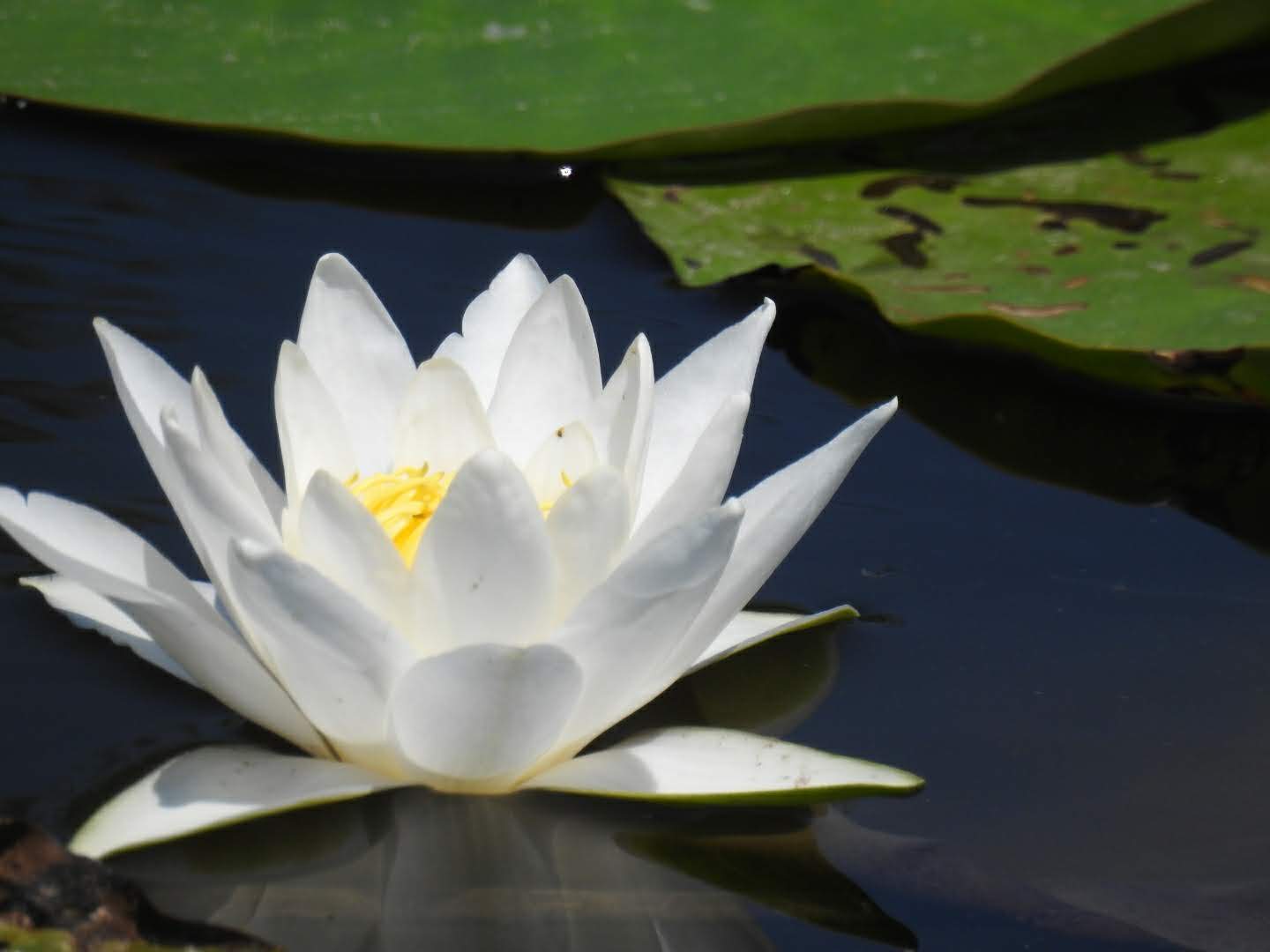
The flowers are solitary, floating or emerging from the water, with a diameter generally ranging between 10 and 12 cm, but can reach up to 20 cm. They consist of four leathery sepals, green on the outside and white on the inside, shorter than the petals, which are numerous (about 20-25), white with yellowish shades at the base, arranged in a spiral. Toward the center of the flower, the petals gradually transform into yellow stamens. The calyx is circularly inserted on the floral receptacle. The stamens are numerous, with filaments about as wide as the anthers and lacking apical appendages. The ovary is multilocular, semi-inferior, with completely united carpels and a flat disc-shaped stigma with 8-25 rays.
The fruit is a hemispherical capsule, about 2.5-3 cm in diameter, containing numerous ellipsoid, smooth seeds, 2-5 mm long. After maturation, the fruit detaches and falls into the water, where it breaks allowing the seeds, wrapped in a floating mucilaginous envelope, to rise to the surface for dispersal.
Habitat and distribution
This species is widespread in Eurasian Europe, with a significant presence in the Po Plain and Alpine valleys, where it is critical. In Italy, it is progressively rarefied and absent in some regions such as Marche, Abruzzo, and Calabria; it is instead rare in Sicily, Sardinia, and Corsica.
It grows in still or slow-flowing waters, such as ponds, lakes, lagoons, and canals, preferring environments with shallow waters up to about 1,500 meters altitude. It favors waters not too rich in nutrients and muddy bottoms where the rhizome can sink. It is also found in coastal environments and Mediterranean and Atlantic wetlands, with inland penetration.
Flowering period
Flowering mainly occurs between June and September, with slight geographical variations related to altitude and latitude. The flowers open in the morning and close at sunset, displaying a delicate fragrance.
Ecology and pollination
The White Water-Lily is a rooted hydrophyte, with submerged perennial organs. Its reproductive strategy is based on entomogamous pollination, favored by pollinating insects attracted by the white color and fragrance of the flowers. The gradual transformation of petals into stamens allows efficient pollen production.
Seed dispersal occurs mainly through water (hydrochory) and aquatic birds which contribute to transport and dissemination, thanks to the mucilaginous envelope that encloses air bubbles and makes the seeds buoyant.
Curiosities and traditional uses
The White Water-Lily has always aroused interest for its beauty and for the numerous legends and myths associated with it. In Greek tradition, nymphs were spirits of waters and woods, and the flower symbolized beauty and art. According to a legend reported by Pliny the Elder, the name would derive from a nymph in love and jealous of Hercules, transformed into a flower after his death from grief.
From an ethnobotanical point of view, the plant is medicinal but toxic: it contains compounds such as nympheine, nufarine, glycosides, resins, and tannins. Nympheine, at low doses, has sedative and anaphrodisiac properties, but at high doses is highly toxic, causing paralysis and cardiac arrest. The flowers contain nymphalin, a glucoside with action similar to digitalis.
The fresh rhizome has a rubefacient effect on the skin. In medieval times, White Water-Lily infusions were used to calm hysterics and nymphomaniacs, and decoctions were employed as astringents for diarrhea. The rhizome, rich in starch, was consumed as a vegetable or transformed into flour during famine periods, after double cooking to eliminate alkaloids and toxic substances. Flower buds were also preserved under salt or in brine.
Today the plant is cultivated for ornamental purposes in aquatic gardens and parks, valued for its elegant flowers and ability to float on water.
Etymology
The genus name probably derives from the Arabic “ninufar,” a name attributed to an aquatic plant of uncertain identification. According to ancient Greek sources, the term “nymphaia” indicated plants typical of wet areas frequented by nymphs, female spirits of mythology. Pliny the Elder associates the name with the nymph in love and jealous of Hercules, from whom the flower would derive.
The specific name “alba” is a Latin adjective meaning “white,” referring to the color of the flowers. The common name “ninfea” directly recalls the myth of the nymphs and the particular morphology of the plant, with elegant and floating flowers, symbol of purity and beauty.
Sources
- Prof. S. Pignatti, "Flora d'Italia"
- Acta Plantarum - Flora delle regioni italiane (scheda di Marinella Zepigi)
- World Flora Online (WFO)
Characteristics
Scheda botanica
| Famiglia | Nymphaeaceae |
|---|---|
| Fioritura | giugno – settembre |
| Forma biologica | Rooting |
| Habitat | with white flowers, Perennial plant |
Domande frequenti
- Quando fiorisce White Water-Lily?
- White Water-Lily fiorisce giugno – settembre.
- Che tipo di pianta è White Water-Lily?
- White Water-Lily è una Hydrophytes (Rooting) secondo la classificazione di Raunkiaer.
- A quale famiglia appartiene White Water-Lily?
- White Water-Lily appartiene alla famiglia botanica Nymphaeaceae.
Where I found it (4 sightings)
Classification
- Kingdom
- Plantae
- Family
- Nymphaeaceae
- Full name
- Nymphaea alba L.
- Synonyms
- Nymphaea alba L. subsp. minoriiflora (Borbás) Stucchi; Nymphaea candida auct.
- Life form
- Hydrophytes rooting
Similar species
Search for species with similar characteristicsFurther reading
Noticed an error in the identification? Write to me
Explore
Other species of Nymphaeaceae