Botanical species
Daphne gnidium
L.
Flax-leaved Daphne
Description
Morphological description
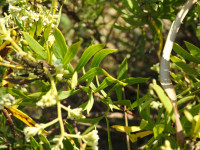
Shrubby, evergreen and perennial plant, with an erect habit, reaching a height between 60 and 150(200) cm. The stems are cylindrical, smooth and branched especially in the apical part; in the juvenile stage they are puberulent, meaning covered with a slight hairiness, while the mature bark initially takes on a brown-reddish color that tends to gray with age.
The leaves are arranged spirally along the branches, with an oblanceolate or oblanceolate-linear blade, varying in size between 3-5 mm in width and 20-45 mm in length, more rarely up to 50 mm. They have entire margins, are glabrous (i.e. hairless), leathery and persistent for about one year. The leaf apex is acute and mucronate (ending with a small point), while the lower surface has small punctiform glands. The leaves, of intense green color, vaguely resemble those of laurel, from which the generic name derives.
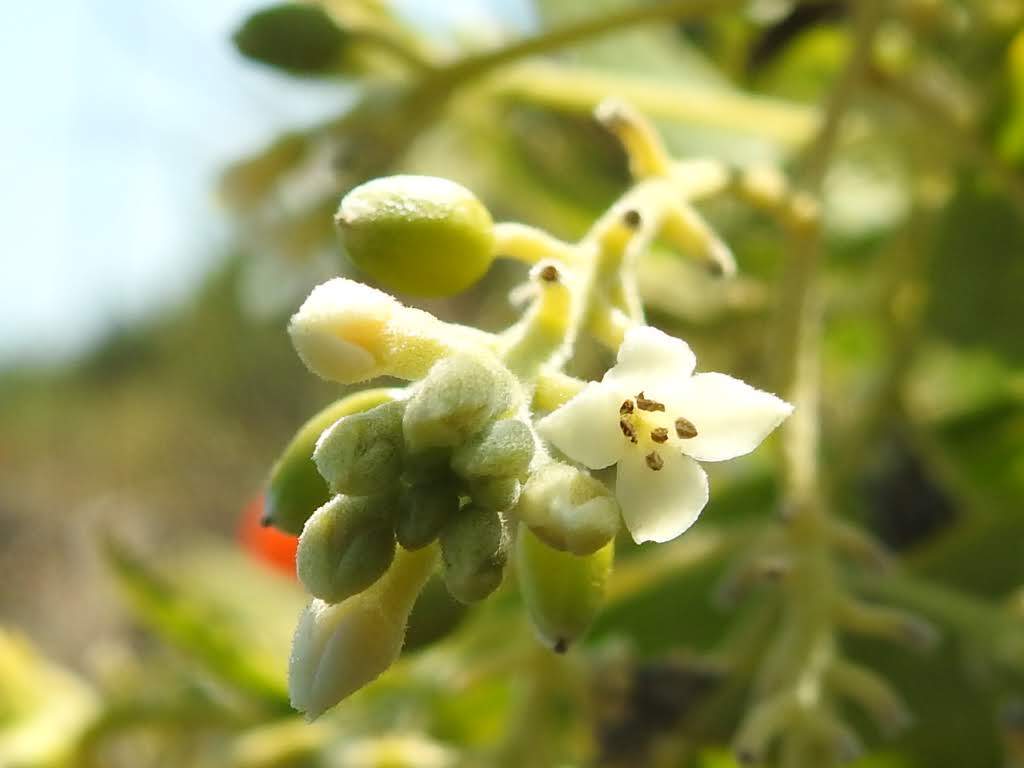
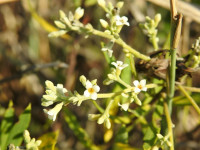
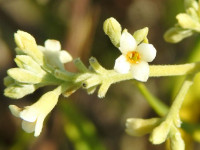
The flowers, hermaphroditic, are gathered in terminal inflorescences with a contracted and branched panicle, which can host from 10 up to 60 flowers. They are actinomorphic, petal-less but equipped with a tubular perianth (hypanthium) of milky white or yellowish color, with a gray-woolly surface, about 2.5-4 mm long. The hypanthium is formed by four ovate-obtuse lobes, 1.5-2.5 mm long. The flowers are pedicellate, with tomentose pedicels, and emit a pleasant fragrance. The stamens are eight, inserted inside the perianth tube, while the ovary is superior and unilocular with a very short style and a capitate stigma.
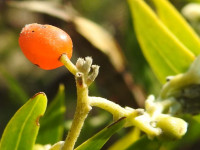
The fruit is a fleshy drupe, ovoid or pyriform, about 7-8 mm long and 6-7 mm wide, with an exocarp that changes color from green to reddish-orange at maturity. The seeds inside are ovoid, tapered at the apex, 4-5 x 2-3 mm. The root system is not described in detail in the available sources.
The whole plant is highly toxic due to the presence of compounds such as mezerein and daphnin, resinous and glycosidic substances that exert purgative, irritating and vesicant effects on the skin and mucous membranes.
Habitat and distribution
The species is typical of the Mediterranean region and Macaronesia, present in Italy mainly in southern regions, in Sardinia and Corsica, as well as in the western Mediterranean basin and in some areas of southern France (Provence, Languedoc, Roussillon), in Spain and on the Atlantic coasts of France.
It grows mainly in arid environments, on sandy or rocky substrates with a generally basic or slightly acidic pH. It is characteristic of evergreen Mediterranean scrub, garrigue, open woods and hedges, with heliophilous exposure (prefers sun) and xerophilous adaptation (adapted to drought). It is generally found from sea level up to about 800 meters altitude.
Flowering period
Flowering extends from July to September, with possible geographical variations that may anticipate it from March up to October in the milder areas of the Mediterranean. The flowers are therefore present for much of the summer season.
Ecology and pollination
Pollination is entomogamous, mainly mediated by insects such as lepidopterans, attracted by the fragrance and white color of the flowers. The plant produces a high number of hermaphroditic flowers to maximize pollination chances.
Seed dispersal occurs mainly through endozoochory, i.e. through ingestion of the drupes by animals that facilitate dissemination via feces or regurgitation. This mechanism allows the species to colonize new areas even far from the mother plant.
Curiosities and traditional uses
The genus Daphne has been known since antiquity for its strong toxicity and medicinal properties. The chemical substances contained in the plant, such as mezerein and daphnin, are highly poisonous and have been used in the past for medicinal purposes as purgatives, rubefacients (circulation stimulants) and vesicants (causing blisters). However, their use requires extreme caution, as they are dangerous even in small doses.
From an ethnobotanical perspective, Daphne gnidium was used with care in some folk traditions for its pharmacological properties, but it is not suitable for food use due to its high toxicity. No culinary or edible uses are documented, but the plant has been appreciated for its ornamental habit and the fragrance of its flowers.
The Italian common name "Flax-leaved Daphne" recalls the similarity of its leaves to those of laurel, which in Greek is called "dàphne", and its association with the mythological legend of Daphne, a nymph transformed into laurel to escape Apollo.
Etymology
The scientific name derives from the Greek "dàphne", meaning laurel, referring to the similarity between the leaves of this plant and those of laurel. The specific epithet "gnidium" refers to the ancient Greek city of Cnidus (in Latin "Cnidus", in ancient Greek "Κνίδος"), located in Anatolia, from which probably comes a synonym or a population of this species.
The Italian common name "Flax-leaved Daphne" is a local variant that recalls both the shape of the plant and its affinity with the genus Daphne.
Sources
- Prof. P.V. Arrigoni, "Flora analitica della Toscana", "Flora dell'Isola di Sardegna"
- Acta Plantarum - Flora delle regioni italiane (scheda di Anja Michelucci)
- Tela Botanica / H. Coste, "Flore descriptive et illustrée de la France"
Characteristics
Scheda botanica
| Famiglia | Thymelaeaceae |
|---|---|
| Fioritura | luglio – settembre |
| Forma biologica | Shrubby |
| Habitat | with white flowers, toxic plant |
| Tossicità | Tossica — non consumare |
Domande frequenti
- Quando fiorisce Flax-leaved Daphne?
- Flax-leaved Daphne fiorisce luglio – settembre.
- È tossica Flax-leaved Daphne?
- Flax-leaved Daphne è una pianta tossica o velenosa. Non consumare nessuna sua parte senza aver consultato un esperto.
- Che tipo di pianta è Flax-leaved Daphne?
- Flax-leaved Daphne è una Phanerophytes (Shrubby) secondo la classificazione di Raunkiaer.
- A quale famiglia appartiene Flax-leaved Daphne?
- Flax-leaved Daphne appartiene alla famiglia botanica Thymelaeaceae.
Where I found it (7 sightings)
Classification
- Kingdom
- Plantae
- Family
- Thymelaeaceae
- Full name
- Daphne gnidium L.
- Life form
- Phanerophytes shrubby
Similar species
Search for species with similar characteristicsFurther reading
Noticed an error in the identification? Write to me
Explore
Other species of Thymelaeaceae