Botanical family
Thymelaeaceae
Description
Botanical characteristics
The plants belonging to this family are generally woody, including tree, shrub, and sometimes herbaceous forms, with both annual and perennial life cycles. In temperate European areas, the prevalent forms are dwarf phanerophytes and suffrutescent chamaephytes, i.e., perennial plants with a woody base and buds located at a low height from the ground, while the herbaceous parts dry out annually. The stem is usually woody, with hard, fibrous, and shiny bark, and can be either prostrate and unbranched or erect with more robust lateral branches.
The leaves are simple, without stipules or sheaths, arranged alternately or oppositely along the stem. The blade is generally petiolate or sessile, with entire margins and small size, and can be either persistent or deciduous.
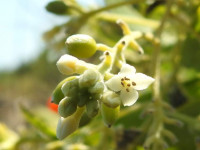
The flowers are hermaphroditic in most cases, but can also be unisexual or dioecious. They are actinomorphic (radial), rarely zygomorphic, and have a monoclamydeous perianth consisting only of the calyx, which takes on a petaloid and colored appearance (pink, red, purple, yellow, white, or greenish). The perianth is formed by a cylindrical calyx tube ending with 4 or 5 lanceolate or ovate lobes, often externally provided with hairs or membranous bracts. The petals are reduced or absent, replaced by petaloid sepals.
The androecium is composed of a variable number of stamens: generally double the number of perianth lobes (8 or 10), but it can also be lower or very high (up to 100 in some genera). The stamens are free, arranged in two whorls, and inserted into the calyx tube. The gynoecium has a superior ovary, generally uni-locular and uni-carpellate, with an almost sessile and capitate stigma.
Pollination is predominantly entomophilous, favored by fragrant flowers that produce nectar at the base of the ovary, with pollinating insects mainly lepidopterans (butterflies and bees) or flies, depending on the length of the calyx tube. Self-pollination is also possible.
The fruits are variable: drupes, nuts, berries, or capsules, generally spherical and monospermous, containing a single seed rich in oily substances.
Distribution and diversity
The family has a cosmopolitan distribution, with species present on almost all continents, including tropical America, southern Africa, the Mediterranean region, central-western Asia, and Australia. Most species live in habitats such as broadleaf forests, evergreen thickets, and dry rocky areas.
The number of genera and species is considerable worldwide, although in temperate European regions the family is represented by a smaller number of taxa. The best-known and studied genera include Edgeworthia, Daphne, Pimelea, Aquilaria, Gonystylus, and Lasiosiphon.
Main genera and representative species
Among the most important and well-known genera are:
- Daphne: including shrub species often used in gardening and ornamentation, some of which are present in Italy. For example, Daphne mezereum is known for its fragrant flowers and poisonous fruit.
- Edgeworthia: used in gardening and floral decoration, appreciated for its showy flowers.
- Pimelea: with small flowers often gathered in conspicuous inflorescences.
- Aquilaria, Gonystylus, Gyrinops: tropical genera important for timber, used in furniture and paneling.
- Lasiosiphon: used for medicinal purposes.
In Italy, the most common species mainly belong to the genus Daphne, found in woodland and Mediterranean scrub environments.
Etymology
The family name derives from two Greek roots: timos (= thyme) and elaìa (= olive). The first part refers to the habit and perhaps some aromatic characteristics similar to thyme, while the second alludes to the resemblance of the leaves to those of the olive.
Curiosities and uses
Although the family has limited economic importance, some species are appreciated in gardening and floral decoration for the beauty and fragrance of their flowers, as in the case of Edgeworthia, Daphne, and Pimelea. Other genera, such as Daphne and Lasiosiphon, are used in traditional medicine. Some species provide valuable timber used in furniture and paneling, especially in the tropics (Aquilaria, Gonystylus, Gyrinops).
It is important to emphasize that some species, such as Daphne mezereum, produce very poisonous fruits if ingested, posing a risk to humans and animals.
Sources
- Wikipedia
Species of the family
1 species catalogued
Explore
Other botanical families