Botanical species
Acanthus mollis
L.
Bear's-Breech
Description
Morphological description
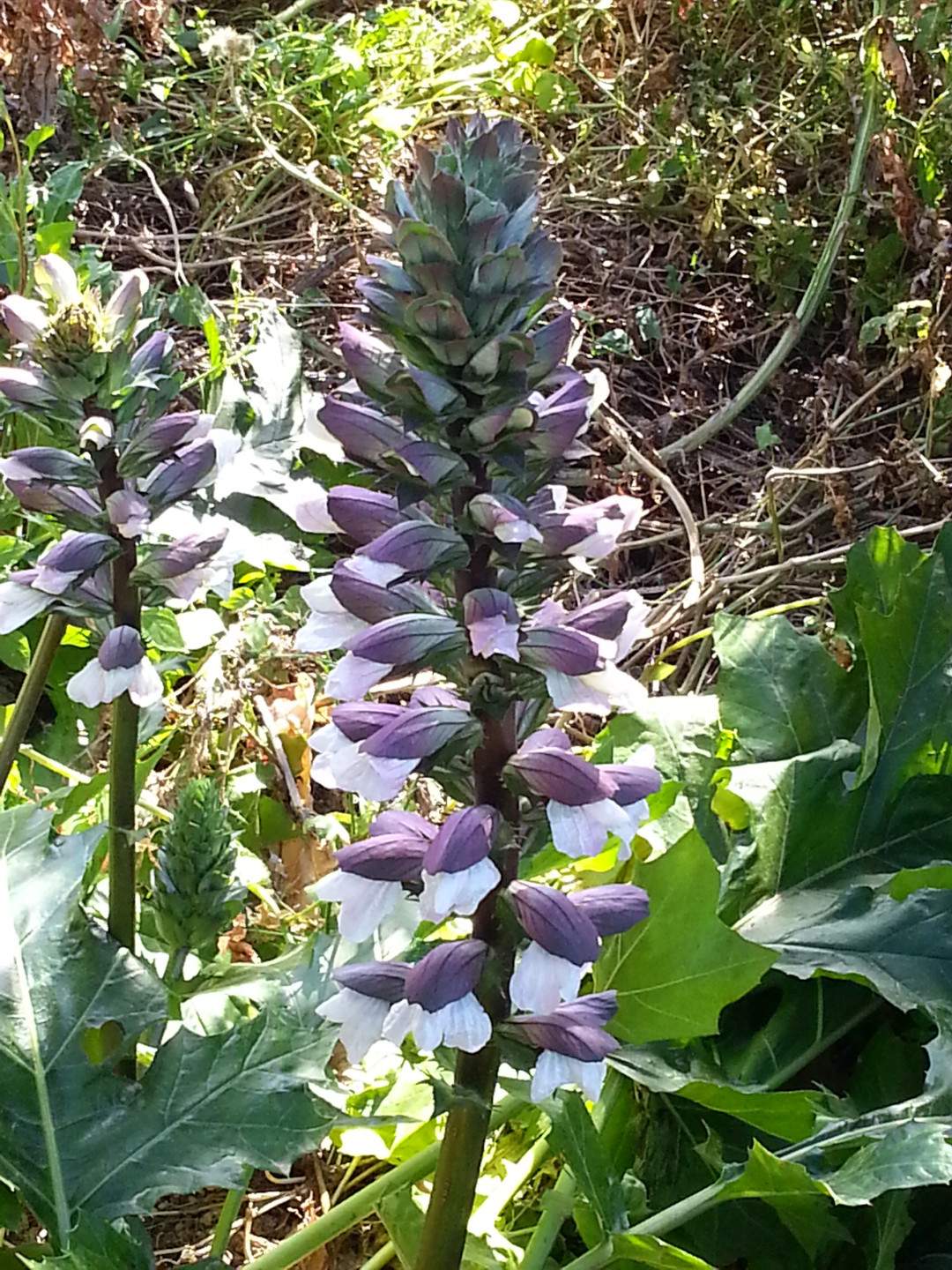
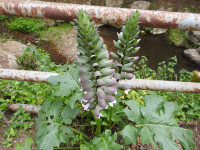
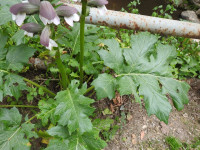
Perennial herbaceous plant of considerable size, with an erect habit that can reach a height between 50 and 120 cm, up to about 1 meter. The stem is robust, simple, somewhat woody and pubescent, often leafless during flowering (scape-like). The leaves are arranged in basal rosettes, large in size up to 80 cm long, with a bright green upper blade, darker than the lower side. The shape is palmatifid (pinnatifid) with broad lobes, deeply incised-toothed or crenate-toothed, with toothed and often jagged margins. The upper surface is generally smooth or slightly villous, while the underside has pubescence on the veins and petiole. The upper leaves, smaller and sessile, have an ovate-lanceolate shape with often spiniform apex.
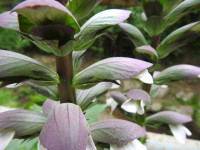
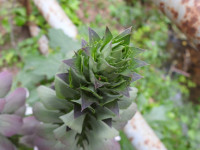
The inflorescence is a dense, cylindrical terminal spike, formed by numerous large flowers (3-5 cm), sessile, arranged spirally along the axis. The bracts accompanying the flowers are ovate-lanceolate, up to 4 cm long, with spiny margins and apex. The flowers are zygomorphic and bilabiate, with a bilabiate calyx, glabrous and lobed, divided almost to the base into two unequal lips. The corolla has a very short tube and a trilobed, obovate and parchment-like lower lip, whitish with purple veins, while the larger upper lip is hood-shaped and violet or pink in color. The stamens (4 in number) are didynamous, with glabrous filaments and hairy anthers on the lower part. The ovary is superior, bilocular and ovoid, with a filiform style longer than the stamens and bifid stigmas.
The fruit is a glabrous, oval, two-valved loculicidal capsule, with explosive dehiscence that projects the brown-black seeds at a distance. Each locule contains from two to four seeds of relatively large size compared to other species of the same family.
Habitat and distribution
Typically Mediterranean species, widespread in western Europe of the Mediterranean basin, from Liguria to Spain and North Africa (Algeria), also present in Corsica and Sardinia. In Italy it grows mainly in regions with a Mediterranean climate, adapting to cool and humid places, preferring wooded environments, shady undergrowth, slopes and meadows with partly shaded exposure. It is frequent on well-drained soils rich in organic matter, with a preference for fresh and shady substrates.
The growth altitude ranges from sea level up to about 700 meters, with greater presence in hilly and submontane areas. The plant is adapted to mild and humid climates, where it can find sufficient shading and moisture conditions.
Flowering period
Flowering generally occurs from late spring to summer, with months ranging from May to September, with geographic and altitudinal variations that can slightly anticipate or delay this interval. In some areas of the western Mediterranean, flowering can begin as early as May, while in more northern areas or at higher altitudes it is concentrated more towards June-July. The flowers open progressively in a spiral along the spike.
Ecology and pollination
Acanthus mollis is mainly pollinated by pollinating insects, such as bees and bumblebees, attracted by the large showy flowers and contrasting colors (white with purple veins and violet upper lip). The tubular structure and the trilobed lower lip facilitate access to nectar, while the curved stamens are arranged to favor contact with pollinating insects.
Seed dispersal occurs through an explosively dehiscent capsule, which scatters the seeds at a distance, favoring colonization of nearby new areas. The seeds, relatively large in size and brown-black in color, are actively released, contributing to the spread of the species.
Curiosities and traditional uses
Bear's-Breech has a long history of both ornamental and medicinal use. Its leaves, highly decorative due to the palmatifid shape and jagged margins, have been a source of inspiration for art and architecture, particularly in the decoration of Corinthian and composite capitals in classical antiquity.
From a medicinal point of view, the plant is known for its astringent, emollient, vulnerary and cleansing properties. In the past, fresh leaves were crushed and used as poultices to treat skin inflammations, erythema and insect bites, while infusions prepared with the plant were used as emollients for intestinal and inflammatory disorders. The presence of mucilages made Bear's-Breech useful in phytotherapy to relieve irritations and inflammations.
In the food sector, no widespread uses are documented, but it is important to emphasize that any collection or use must always be guided by botanical experts to avoid risks of confusion with similar potentially toxic species.
It is still cultivated today as an ornamental plant for shady and cool gardens, appreciated for its large decorative leaves and spectacular flowering.
Etymology
The scientific name Acanthus derives from the Greek "akantha", meaning "thorn" or "spine", referring to the spiny or toothed margins of the leaves of some species of the genus. The term "mollis" in Latin means "soft" or "tender" and refers to the softer texture of the leaves of this species compared to those of Acanthus spinosus, characterized by stiffer and spiny margins.
The Italian common name "acanto" derives directly from the Latin and Greek term, preserving the original root. Some dialect or popular names such as "branca orsina" or "brancalupo" refer to the large size and particular shape of the leaves.
Sources
- Prof. P.V. Arrigoni, "Flora analitica della Toscana", "Flora dell'Isola di Sardegna"
- Acta Plantarum - Flora delle regioni italiane (scheda di Giuliano Salvai)
- Tela Botanica / H. Coste, "Flore descriptive et illustrée de la France"
Characteristics
Where I found it (6 sightings)
Classification
- Kingdom
- Plantae
- Family
- Acanthaceae
- Full name
- Acanthus mollis L.
- Life form
- Emicriptofite scapose
Similar species
Search for species with similar characteristicsFurther reading
Noticed an error in the identification? Write to me
Explore
Other species of Acanthaceae