Description
Botanical characteristics
The Acanthaceae are a family of angiosperm plants characterized by a very varied habit that includes annual or perennial herbs, shrubs, climbers, and occasionally small trees. Some species exhibit anomalous secondary growth and the stems can be erect, decumbent, or lianoid, sometimes subwoody and with a subquadrangular or hexagonal cross-section due to the presence of collenchyma bundles. Several species are spiny and some, such as those of the genus Avicennia, are adapted to halophilic conditions with stilt roots and pneumatophores.
The leaves are generally opposite, petiolate or sessile, lacking stipules, with an entire blade ranging from oval to lanceolate in shape and margins dentate, undulate, or crenate. In very rare cases, the blade may be pinnatifid or pinnatipartite. Some species show a reddish lower surface or salt glands that secrete hypersaline solutions forming salt crystals. The venation is mostly pinnate.
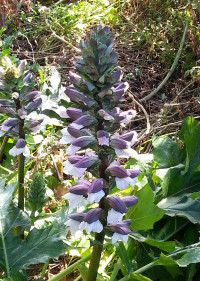
The flowers are hermaphroditic, gamopetalous, and zygomorphic, generally bilabiate, with a calyx formed by 4 or 5 narrow lobes, often covered by glandular trichomes. The corolla may have a short or elongated tube, sometimes ventricose or curved, and presents a reduced or absent upper lip and a trilobed lower lip, often flat and spreading. The flower color varies from pink to purple, from yellow to orange, from red to white.
The androecium consists of 2-4 stamens (rarely other numbers), often didynamous, with filaments adnate to the corolla and bilocular dorsifixed anthers. The gynoecium is formed by a superior bicarpellary and bilocular ovary with axile placentation and anatropous or campylotropous ovules. The style bears a stigma with two unequal lobes.
The fruits are bilobed capsules, from oblong to ellipsoid, that open elastically (loculicidal dehiscence by explosion). The seeds are numerous, flattened, wingless, and without hygroscopic trichomes, except for some subfamilies.
Distribution and diversity
The family Acanthaceae is widespread worldwide, with a higher concentration in tropical and subtropical regions. It includes a considerable number of genera and species, although the exact total is not specified in the sources provided here. The very variable habit and morphological characteristics reflect adaptation to different habitats, including aquatic and brackish coastal environments.
Main genera and representative species
Among the best-known genera of the family are Acanthus, Thunbergia, Mendoncia, Avicennia, Ruellia, Eranthemum, and Blecchum. Some of these include lianoid or shrubby species with particular adaptations such as aerial roots or pneumatophores. In Italy, species belonging to this family are present, although specific documentation on local genera and species is not detailed in the provided sources.
Etymology
The family name derives from the type genus Acanthus, which in turn comes from the Greek "akanthos" meaning "thorn". This name refers to the numerous spiny plants of the genus Acanthus. The word is linked to a legend narrated by the Roman architect Vitruvius, according to which the Corinthian capital was inspired by the shapes of this plant. The scientific name Acanthaceae was formally defined in 1789 by the French botanist Antoine-Laurent de Jussieu.
Curiosities and uses
The species of Acanthaceae are predominantly pollinated by insects such as bees, wasps, moths, and butterflies (entomogamous pollination), but also by birds such as hummingbirds (ornithogamous pollination). Some species possess cleistogamous flowers, which self-pollinate without opening. The particular structure of the flowers, with movements of the corolla lobes, facilitates contact of the stamens with the pollinators. Some members of the family contain chemical compounds such as phenolic glycosides, iridoid alkaloids, and diterpenoids, which may have defensive or pharmacological roles.
Sources
- Wikipedia
Species of the family
1 species catalogued
Explore
Other botanical families