Botanical family
Verbenaceae
Description
Botanical characteristics
The Verbenaceae are a family of angiosperm plants including annual or perennial herbaceous species, subshrubs, shrubs, and small trees, as well as lianas. Generally, these plants are not aromatic and often have a stem with a quadrangular section with slightly concave faces, due to the presence of collenchyma bundles at the vertices; in other cases, the stem is round. Some species have a woody base, others are prostrate, some are spiny, while others develop stoloniferous roots.
The leaves are arranged along the stem oppositely or suboppositely, often rotated 90° between one whorl and another, and in some species they can be trifoliate or reduced to scales. The leaf blade varies from lanceolate to ovate, linear or spiny, with dentate or lobed margins. Stipules are absent. The venation is generally pinnate and the surface can be glabrous or tomentose.
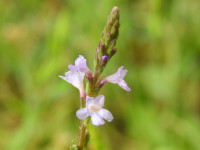
The flowers are hermaphroditic, tetracyclic (with four whorls: calyx, corolla, androecium, and gynoecium) and pentamerous, although they can sometimes vary from 4 to 8 elements per whorl. The calyx is gamosepalous, tubular or campanulate, with 2-5 persistent lobes that in some species enlarge at maturity almost completely enclosing the fruit. The corolla is gamopetalous, generally tubular, weakly zygomorphic or actinomorphic, with 4-5 often bilabiate lobes. The color varies from white to yellow, pink, blue, violet, mauve, or purple. Inside the corolla throat, glandular hairs are often present that prevent access to insects ineffective in pollination.
The androecium consists of four fertile stamens (rarely two), often included and adnate to the corolla, with dorsifixed or basifixed anthers and longitudinal dehiscence. A staminode or a fifth fertile stamen may be present. The gynoecium is formed by a superior bicarpellary ovary, sometimes monocarpellary or tetracarpellary, with two locules and pendulous ovules with axile placentation. The style, which ends with a bilobed stigma, is short or less than three times the length of the ovary.
The fruit can be a schizocarpic capsule that divides into four mericarps, each with one seed, or a drupe with two or four pyrenes. The endosperm is absent. The inflorescences are often terminal or axillary, consisting of racemes, cymes, spikes, or panicles, with reduced bracts.
Fertilization occurs mainly through insects (entomophilous pollination) and in the tropics also through birds such as hummingbirds (ornithophilous pollination). Seed dispersal initially occurs by wind and subsequently by insects, particularly ants, or other animals.
Distribution and diversity
This family has a predominantly American distribution, especially in the tropical central-southern regions of the continent, but some genera such as Verbena and Chascanum are cosmopolitan, also present in other parts of the world. Some genera are found in Africa and Asia, especially in the tribes Lantaneae and Priveae.
The family includes about 33 genera and about 900 species, divided into 8 main tribes. Most species are found in tropical environments, with few species present in temperate zones, including Italy.
Main genera and representative species
Among the most significant genera are:
- Verbena: type genus of the family, including cosmopolitan species, some of which are also widespread in Italy.
- Lantana: widely distributed, with many ornamental species known for their colorful flowers.
- Duranta: tropical genus with shrubby species highly appreciated as ornamental plants.
- Stachytarpheta: including numerous tropical and subtropical species.
- Aloysia and Lippia: genera with many species, some known for medicinal or aromatic uses.
In Italy, species of the genus Verbena are mainly present, growing wild in various habitats, from meadows to dry places.
Etymology
The family name derives from the type genus Verbena, an ancient Latin word that indicated the common European verbena, also called "herbena" for its green appearance. The term is already attested in the writings of Pliny the Elder and Virgil. In ancient times, verbena twigs were used in druidic ritual ceremonies, worn as crowns by priests.
The scientific name Verbenaceae was officially defined in 1805 by the French botanist Jean Henri Jaume Saint-Hilaire.
Curiosities and uses
The Verbenaceae include plants of ornamental interest for their colorful and decorative flowers, used in gardens and parks. Some species have an important ecological role as a source of nectar for pollinating insects and, in tropical regions, for birds such as hummingbirds. Some species contain iridoid compounds, phenolic glycosides that may have pharmacological applications, although they are not common aromatic plants like the Lamiaceae.
Sources
- Wikipedia
Species of the family
1 species catalogued
Explore
Other botanical families