Botanical species
Tribulus terrestris
L.
Small Caltrops
Description
Morphological description
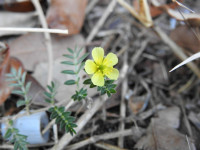
Annual herbaceous plant with a creeping or prostrate-ascending habit, with simple or branched stems that can reach a variable length from 10 to 100 cm, often radiating from a basal crown. The stems are characterized by an angular section, tomentose and rough surface, with silky or bristly hairs that give a rough and sometimes slightly velvety texture, especially in the younger parts, while they tend to become glabrous with age.
The leaves are opposite, paripinnate, with a rachis about 2-4 cm long, and are composed of 8-14 opposite segments, ovate or elliptical in shape, with sizes ranging between 2-3 mm by 6-8 mm, with entire margins and herbaceous texture. The leaf segments are unequal, with one leaflet longer and the other shorter within the same pair, and are covered by a dense silky pubescence that gives young leaves a silvery appearance. The stipules are triangular, small, 1-5 mm long, slightly pubescent.
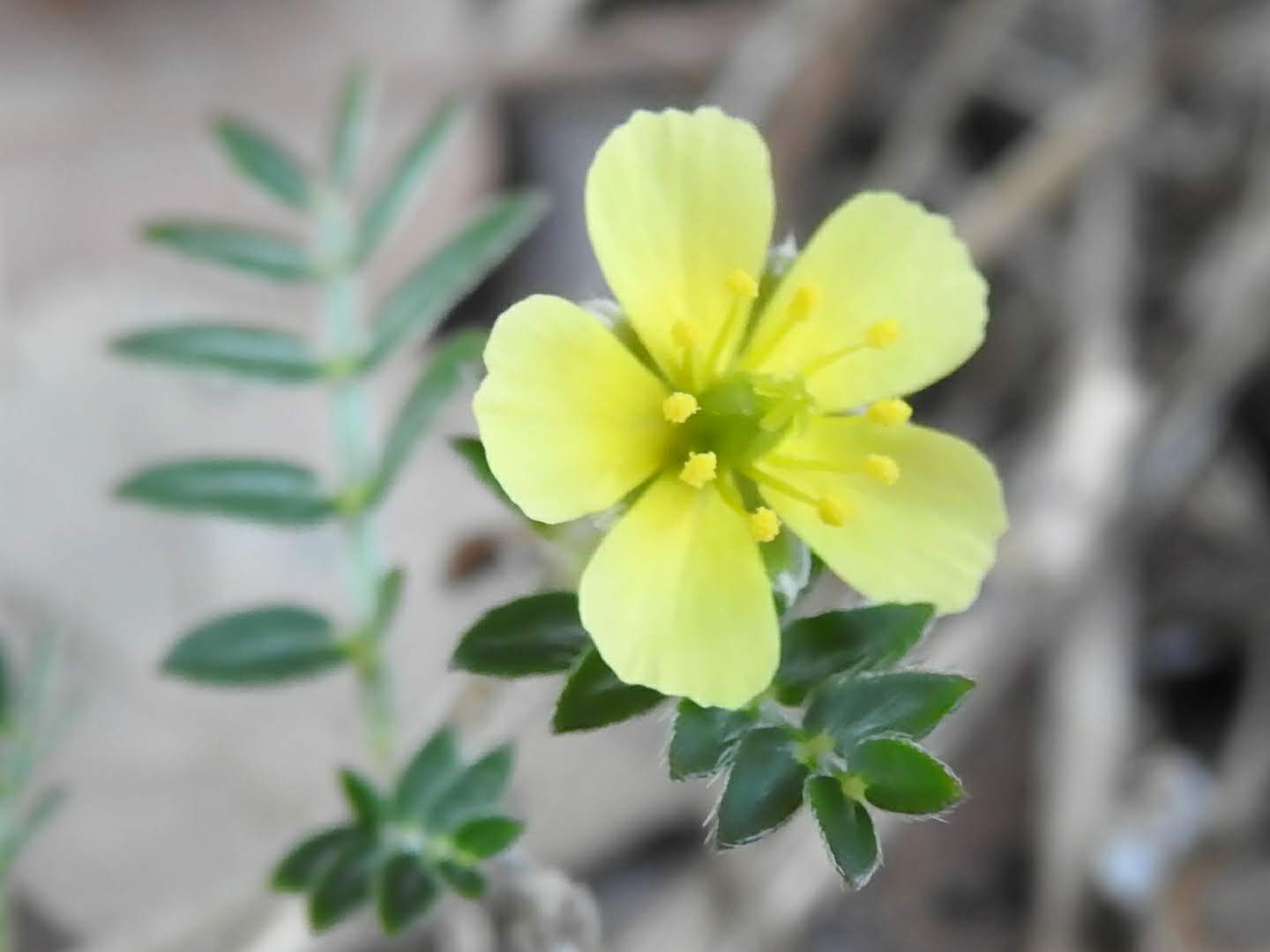
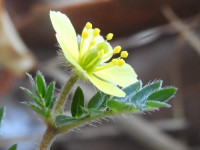
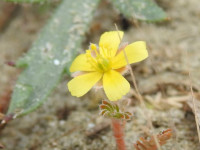
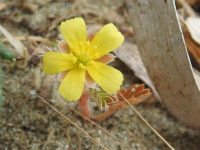
The flowers are hermaphroditic, solitary and actinomorphic, placed in the leaf axils on short peduncles, 2-7 mm long, also pubescent and rigid. The corolla consists of 5 free petals, bright yellow, oblanceolate or obovate, with sizes ranging from 3 to 12 mm in length and 1-3 mm in width. The calyx is formed by 5 ovate-lanceolate, acute sepals, about 3 mm long, with thin, membranous and slightly ciliate margins. The 10 stamens are arranged in two whorls, with cordate and versatile anthers. The ovary is superior, hairy with stiff trichomes, composed of 5 carpels, while the style is short (1-1.5 mm) with a globose stigma.
The fruit is a pentamerous schizocarp which, upon maturation, divides into 5 independent mericarps arranged in a star shape. Each mericarp is tuberculate, covered with silky or bristly hairs, with two divergent conical dorsal spines 3-7 mm long and two shorter spines in a basal position, pointing downward or absent. The mericarps vary in size between 8 and 15 mm and contain 2-3 oval, obtuse, smooth and whitish seeds. The hard and sharp spines of the fruit are distinctive features of the species and facilitate mechanical dispersal.
The root system is typical of annual plants adapted to sandy soils, with fibrous and shallow roots that allow anchorage in loose and dry substrates.
Habitat and distribution
The species is cosmopolitan and found in all Italian regions, with greater diffusion in coastal areas and arid environments. It prefers sandy and psammophilous habitats, such as beaches, dunes, roadsides, dry uncultivated land and disturbed soils, often in maritime areas but also inland, especially along railway lines. It grows from sea level up to about 800 m altitude and adapts to loose, sandy or nutrient-poor soils, preferably in sunny exposure and arid conditions.
In the Mediterranean basin it is common in all coastal countries, where it occupies similar habitats characterized by sandy substrates and warm, dry climatic conditions. Its presence is frequent in disturbed environments, where it can rapidly colonize open spaces.
Flowering period
Flowering extends from September to March, with some local variations related to climate and latitude, but generally the species flowers during autumn and winter, especially in Mediterranean regions where milder temperatures allow a long growing season. The flowers are short-lived, falling soon after opening.
Ecology and pollination
The species is mainly pollinated by pollinating insects attracted by the bright yellow color of the flowers, which offer nectar and pollen. The reproductive strategy involves solitary hermaphroditic flowers, with numerous stamens and intrastaminal nectariferous glands, elements that favor entomophilous pollination. Seed dispersal occurs mainly thanks to the spiny fruits: the sharp spines can hook onto animal fur or injure their paws, thus facilitating dissemination away from the mother plant (epizoochory). Furthermore, the schizocarp structure allows division into mericarps that detach easily and can be transported by wind or water.
Curiosities and traditional uses
Small Caltrops has been known for centuries for its medicinal uses, especially in traditional Indian and Chinese medicine. It is used as a stimulant, tonic and appetizer, as well as to improve athletic performance and muscle tone. In popular use it is employed to counteract sexual dysfunctions due to the presence of steroidal saponins, particularly protodioscin, an active principle studied for its pharmacological properties.
In Italy, although not a widespread traditional use, the plant has occasionally been used for phytotherapeutic purposes. Due to the presence of sharp spines, it is often considered a troublesome weed in cultivated lands and areas frequented by domestic animals.
The common name “tribolo” refers precisely to the sharp spines of the fruit, which recall the ancient military devices used to stop the charge of enemy horses, called precisely "triboli" or “pungoli”.
Etymology
The scientific name derives from the Greek "tribolos" and Latin "tribulus", a term indicating an ancient weapon composed of sharp points, referring to the pointed and dangerous spines of the fruits that characterize the species. The specific epithet "terrestris" alludes to the creeping and prostrate habit of the plant, which grows close to the ground.
The Italian name “tribolo comune” refers to the particular spiny shape of the fruit, well known for its potentially annoying effect on animals and humans, while other local names may vary but remain linked to this characteristic.
Sources
- Prof. S. Pignatti, "Flora d'Italia"
- Acta Plantarum - Flora delle regioni italiane (scheda di Anja Michelucci)
- World Flora Online (WFO)
Characteristics
Scheda botanica
| Famiglia | Zygophyllaceae |
|---|---|
| Fioritura | maggio – ottobre |
| Forma biologica | Creeping plants |
| Habitat | with yellow flowers, creeping plant, psammophilous plant |
| Uso officinale | Pianta officinale |
Domande frequenti
- Quando fiorisce Small Caltrops?
- Small Caltrops fiorisce maggio – ottobre.
- Che tipo di pianta è Small Caltrops?
- Small Caltrops è una Therophytes (Creeping plants) secondo la classificazione di Raunkiaer.
- A quale famiglia appartiene Small Caltrops?
- Small Caltrops appartiene alla famiglia botanica Zygophyllaceae.
Where I found it (6 sightings)
Classification
- Kingdom
- Plantae
- Family
- Zygophyllaceae
- Full name
- Tribulus terrestris L.
- Life form
- Therophytes creeping plants
Similar species
Search for species with similar characteristicsFurther reading
Noticed an error in the identification? Write to me
Explore
Other species of Zygophyllaceae