Botanical species
Saxifraga tridactylites
L.
Rue-leaved Saxifrage
Description
Morphological description
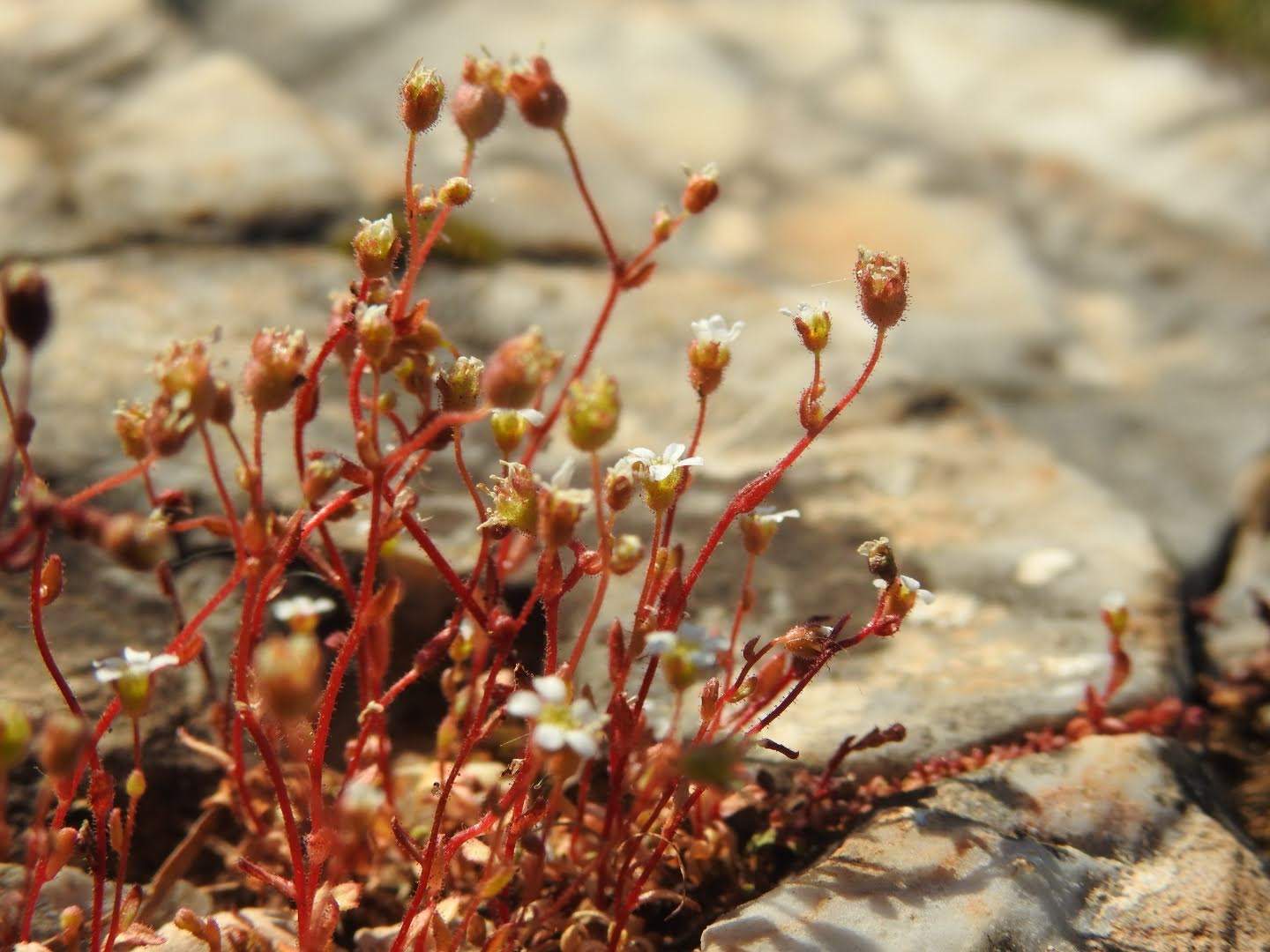
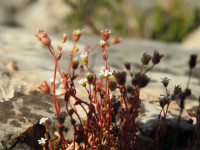
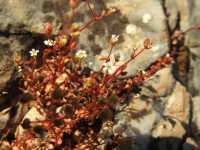
Annual herbaceous plant of modest size, generally 3 to 10 (up to 15) cm tall, characterized by an erect and slender habit. The stem is often forked in the upper part and bears thin erect branches. The plant is covered with glandular hairs, which give it a viscous texture and often a purplish or reddish color, which may intensify with age.
The leaves are both basal and cauline. The basal leaves, which usually form a rosette, are deciduous before flowering and have a cuneate or spatulate shape, with dentate or lobed margins (3-5 divergent teeth or lobes), of very variable size, generally between 1x3 mm and 7x20 mm. The cauline leaves are alternately arranged along the stem, have an elliptical or deltoid blade, often with the central lobe more developed than the lateral ones, and are subsessile or with a small petiole. The margins are dentate or crenulate, and the surface may present stalked glands.
The inflorescence consists of subcorymbose cymes or loose panicles with few flowers (from 1 up to 10-50 in some cases), often with lanceolate bracts similar to the cauline leaves, entire or lobed. The peduncles are thin and can be 3-30 mm long, elongating further during fruiting.
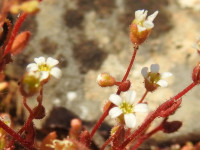
The flowers are scapose, with five white, spatulate petals, 2 to 3-5 mm long, often with an emarginate apex and not overlapping. The calyx is gamosepalous, with ovate-triangular sepals of 1-2 mm, shorter than the corolla, often with stipitate-glandular margins and surfaces, erect and obtuse. The flowers have 10 stamens and a subglobose inferior ovary with two divergent styles. Pollination is ensured by pollinating insects attracted by the white flowers.
The fruit is an obovoid capsule of 3-4 mm that opens longitudinally to release numerous dark and papillose seeds, equipped with an adequate surface for dispersal. The root system, although not detailed in the sources, is typical of annual herbs, with fibrous roots of modest size, suitable for settling in poor and mobile substrates.
Habitat and distribution
The species is widespread throughout the Italian territory, being quite common, with a eurymediterranean range extending from the Mediterranean northwards and eastwards, up to Central Europe and Asia (up to Japan). It grows mainly in mountainous and hilly environments up to 1500 m altitude, with reports at higher elevations (up to 2500 m in Valle d’Aosta), where intermediate forms with related species are found.
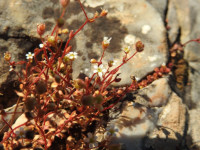
It prefers loose soils, sands, gravels, more or less consolidated debris, rocky slopes, cliffs, walls, and roofs. It adapts well to poor and well-drained substrates, often calcareous or siliceous, in sunny and warm exposures. In Switzerland, for example, it has spread significantly since the 1980s along railway lines, colonizing anthropized environments with mineral and disturbed substrates.
Flowering period
The flowering extends from January to July, with peaks that may vary depending on local climatic conditions and altitude. In cooler mountainous environments or at high altitudes, flowering may be concentrated in the spring months, while in warmer and lower areas it can start already in winter.
Ecology and pollination
The plant has a reproductive strategy typical of annual therophytes, rapidly completing its life cycle from germination to fruiting in a few weeks. Pollination is entomogamous, mediated by pollinating insects attracted by the white flowers, which present a well-visible corolla and petals longer than the sepals, facilitating access to nectar and pollen.
Seed dispersal occurs mainly through the capsule that opens longitudinally, releasing numerous papillose seeds, favoring colonization of new unstable and mobile substrates. The plant is adapted to dynamic and disturbed habitats, where rapid seed production is fundamental for the species’ survival.
Curiosities and traditional uses
No particular ethnobotanical applications or traditional medicinal uses are known for this species, probably due to its modest size, annual cycle, and often marginal habitats. The etymology of the name, however, reflects a historical curiosity: "Saxifraga" derives from Latin and means "herb that breaks rocks," referring to the ability of some species of the genus to grow in rock crevices and contribute to rock disintegration. The specific name “tridactylites” refers to the shape of the leaves, which have three lobes or teeth, similar to “three fingers.”
The Italian common name "Sassifraga annuale" clearly indicates the annual nature of the plant and its affinity with rocks (stones), emphasizing its preferred habitat. Despite its small size, the species is an important element of spontaneous mountain and hill flora, contributing to the biodiversity of Mediterranean and temperate ecosystems.
Etymology
The genus name "Saxifraga" derives from the Latin "saxum" (rock) and "frangere" (to break), meaning "herb that breaks rocks," referring to the ability of some species to grow in rock crevices and promote rock disintegration. The specific epithet "tridactylites" derives from Greek "tri-" (three) and "dàctylos" (finger), alluding to the characteristic leaf shape with three teeth or lobes, similar to fingers.
The Italian common name "Sassifraga annuale" emphasizes the annual nature of the plant and its typical habitat linked to rocky or stony substrates.
Sources
- Prof. P.V. Arrigoni, "Flora analitica della Toscana", "Flora dell'Isola di Sardegna"
- Acta Plantarum - Flora delle regioni italiane (scheda di Giuliano Salvai)
- World Flora Online (WFO)
Characteristics
Scheda botanica
| Famiglia | Saxifragaceae |
|---|---|
| Fioritura | gennaio – luglio |
| Forma biologica | Scapose |
| Habitat | with white flowers, annual plant |
Domande frequenti
- Quando fiorisce Rue-leaved Saxifrage?
- Rue-leaved Saxifrage fiorisce gennaio – luglio.
- Che tipo di pianta è Rue-leaved Saxifrage?
- Rue-leaved Saxifrage è una Therophytes (Scapose) secondo la classificazione di Raunkiaer.
- A quale famiglia appartiene Rue-leaved Saxifrage?
- Rue-leaved Saxifrage appartiene alla famiglia botanica Saxifragaceae.
Where I found it (5 sightings)
Classification
- Kingdom
- Plantae
- Family
- Saxifragaceae
- Full name
- Saxifraga tridactylites L.
- Life form
- Therophytes scapose
Similar species
Search for species with similar characteristicsFurther reading
Noticed an error in the identification? Write to me
Explore
Other species of Saxifragaceae