Botanical species
Monotropa hypopitys
L.
Yellow Bird's-nest
Description
Morphological description
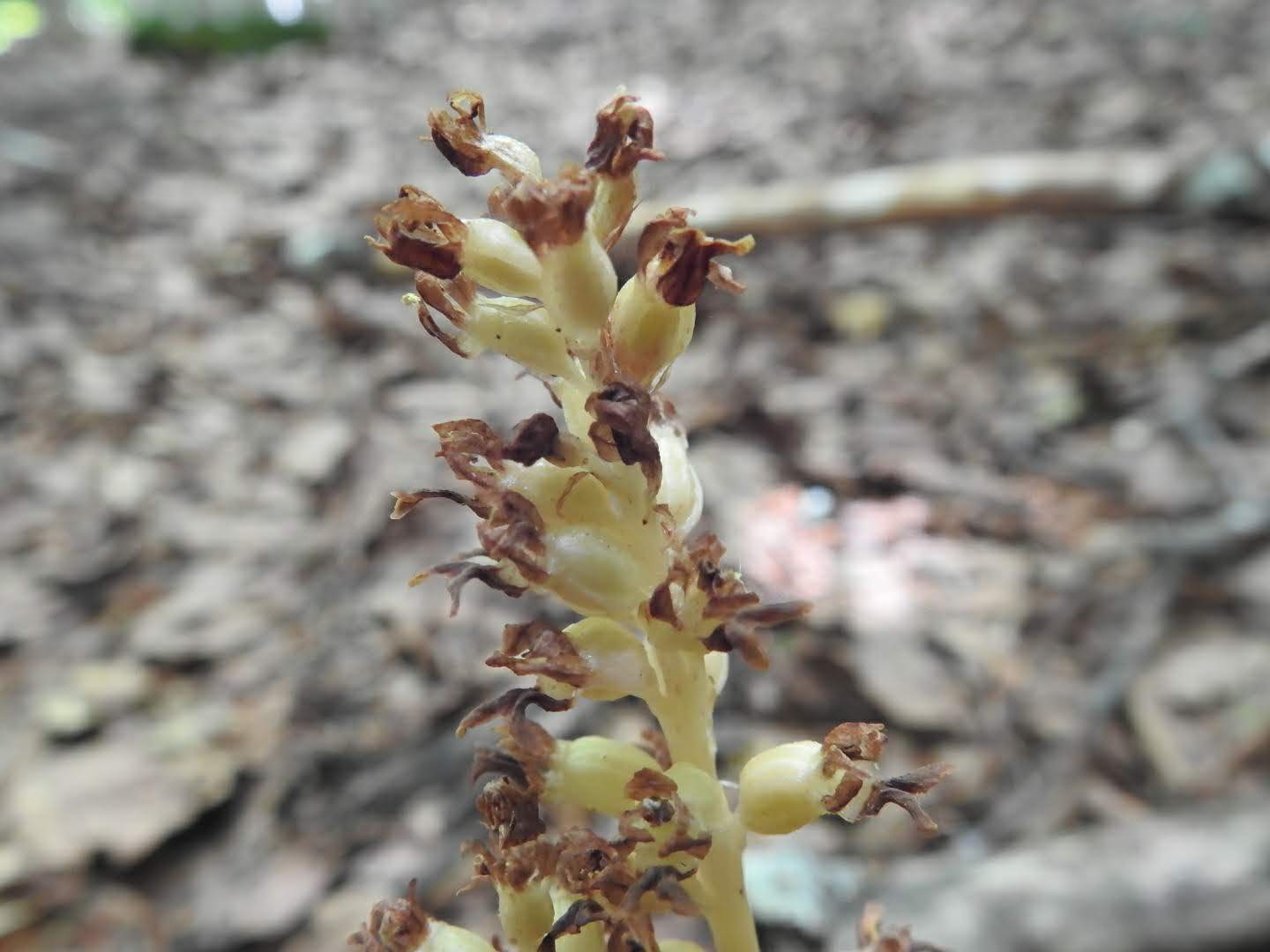
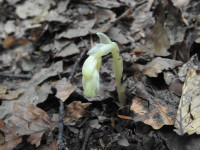
Perennial herbaceous plant belonging to the family Ericaceae, lacking chlorophyll and therefore incapable of autonomous photosynthesis, the species has an erect habit and a height ranging from 8 to 40 cm. The stem is simple, fleshy, straw yellow, sometimes tending to reddish, and has a grooved surface and sometimes pubescent with glandular hairs. At flowering, the stem is slightly curved at the apex, while it becomes erect during fruiting.
The leaves are reduced to small ovate, imbricate, sessile, and alternate scales, arranged along the stem: the lower ones are closer together, while the upper ones are more spaced. The plant has a fleshy, tangled, coral-like, and aromatic rhizome from which the stems arise. This rhizome is sapro-mycotrophic, meaning it lives in symbiosis with mycorrhizal fungi (mainly of the genus Tricholoma), from which it obtains nutrients by exploiting the sap of host trees.
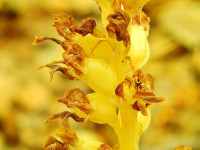
The inflorescence is a terminal unilateral raceme, initially curved and then erect at fruiting, composed of 6-18 hermaphrodite flowers, shortly pedicellate and slightly vanilla-scented. The lateral flowers are tetramerous (with four petals), while the terminal one is often pentamerous (with five petals). The bracts accompanying the flowers are linear, membranous, and denticulate. The calyx is formed by 4-5 free sepals, oblong or elliptical, with an irregularly dentate margin. The corolla, straw yellow transparent in color, has 4-6 petals saccate at the base and irregularly crenulate at the margin, 7 to 12 mm long, hairy especially on the inside.
The stamens are 8-12 with pubescent filaments and horseshoe-shaped anthers that open through a single terminal slit. The style is single, straight, hollow, and pubescent, with an orbicular and lobed stigma (3-5 lobes), typically yellow. The ovary is superior, pubescent, and has axile placentation.
The fruit is an ovoid or ellipsoid capsule, dehiscent into four or five valves, with variable dimensions between 5 and 10 mm, with a persistent style. The capsule contains numerous winged seeds, favoring anemochory (dispersal by wind).
Habitat and distribution
The species is widespread in Europe, Western and Northern Asia, as well as in North America, with a circumboreal distribution. In Italy, it grows mainly in woodland environments, preferring both beech woods and coniferous forests, with a greater presence in fresh, shady woods and on moist soils often covered by mosses. The altitude of growth ranges between 500 and 1600 meters above sea level.
In the Mediterranean environment it is less common but can be found in mountainous areas with similar conditions, always in the presence of host trees and mycorrhizal fungi. The plant prefers shady exposures and well-drained soils rich in organic matter.
Flowering period
Flowering occurs mainly in the summer months, from June to July, with possible extensions until August in the more northern or mountainous areas. Fruiting immediately follows flowering, continuing until September-October.
Ecology and pollination
Being a sapro-mycotrophic plant, it lives in symbiosis with mycorrhizal fungi that provide the necessary nutrients, exploiting the fungal network to extract sap from host trees. This adaptation allows it to live in shady and low-light environments where photosynthesis would be impossible.
The flowers, slightly vanilla-scented, attract pollinating insects, particularly small hymenopterans and flies, which favor pollination. The unilateral arrangement of the flowers and the curved habit facilitate access for pollinating insects.
Seed dispersal is anemochorous: the winged seeds are carried by the wind far from the mother plant, allowing colonization of new suitable sites.
Curiosities and traditional uses
This species is often called “Yellow Bird's-nest” in English, but it is also known as “false yellow asparagus” or “yellowish spargolo” in some regions. The plant is characterized by an aromatic odor, sometimes described as similar to vanilla.
No significant food or medicinal uses are documented in Italian popular tradition, probably due to its rare presence and the fact that, lacking chlorophyll, it has no direct nutritional properties. However, its particular ecology and relationship with fungi are of great scientific interest for the study of mycorrhizal relationships and forest biodiversity.
Etymology
The genus name derives from the Greek mónos (alone, single) and trépo (to turn), referring to the characteristic arrangement of the flowers all facing the same side of the inflorescence. The specific epithet hypopitys comes from two Greek words: hypo (under) and pitys (pine), indicating the preferred habitat of the plant, that is under conifers.
The Italian common name “ipopitide” derives directly from the scientific name, maintaining the Greek root and adapting it to Italian phonetics.
Sources
- Prof. S. Pignatti, "Flora d'Italia"
- Acta Plantarum - Flora delle regioni italiane (scheda di Anja Michelucci)
- Tela Botanica / H. Coste, "Flore descriptive et illustrée de la France"
- World Flora Online (WFO)
Characteristics
Scheda botanica
| Famiglia | Ericaceae |
|---|---|
| Fioritura | giugno – luglio |
| Forma biologica | Parasite |
| Habitat | with yellow flowers, parasitic plant, plant without chlorophyll |
Domande frequenti
- Quando fiorisce Yellow Bird's-nest?
- Yellow Bird's-nest fiorisce giugno – luglio.
- Che tipo di pianta è Yellow Bird's-nest?
- Yellow Bird's-nest è una Geophytes (Parasite) secondo la classificazione di Raunkiaer.
- A quale famiglia appartiene Yellow Bird's-nest?
- Yellow Bird's-nest appartiene alla famiglia botanica Ericaceae.
Where I found it (6 sightings)
Classification
- Kingdom
- Plantae
- Family
- Ericaceae
- Full name
- Monotropa hypopitys L.
- Life form
- Geophytes parasite
Similar species
Search for species with similar characteristicsFurther reading
Noticed an error in the identification? Write to me
Explore
Other species of Ericaceae