Botanical species
Juncus acutus
L.
Sharp Rush
Description
Morphological description
Perennial tufted plant that forms dense bushes of significant size, with a diameter that can exceed one meter. The height varies from 70 cm up to about 2 meters. The stem is robust, erect, cylindrical, smooth and without nodes, dark green or glaucous in color; it is characterized by a rigid consistency and particularly sharp to the touch. The leaves are similar to the stems, cylindrical, erect, with a sharp surface, and have shiny brown or blackish sheaths.
The root system consists of short and fibrous rhizomes, which allow the plant to expand forming tight clumps. Stolons are absent.
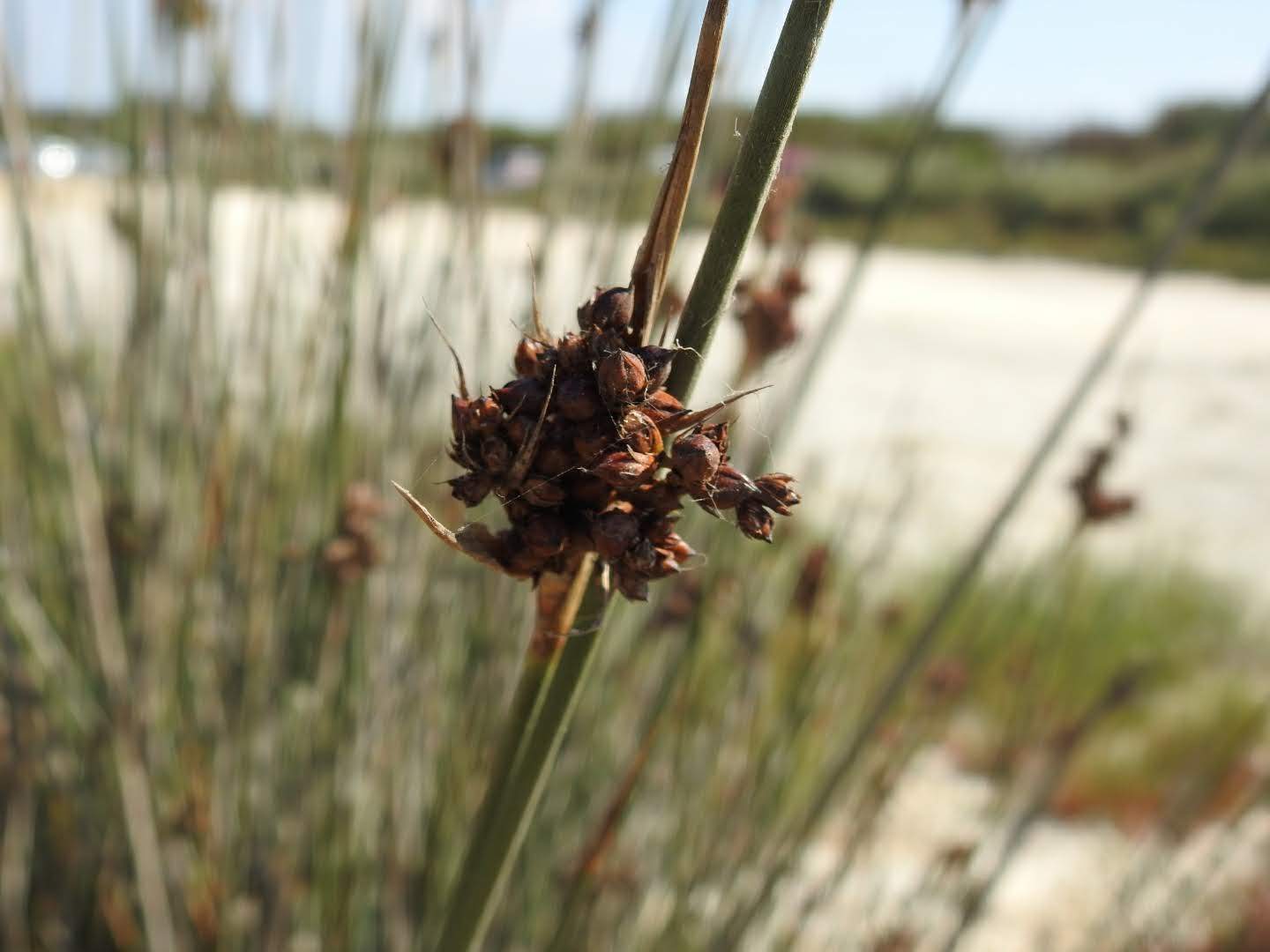
The inflorescence is dense, of a glomerulate or paniculate type, with flowers gathered in fairly compact clusters, often somewhat lateral to the lower bract. This bract is particularly long, keeled and sharp, rusty brown in color, and exceeds in length the shorter upper bracts which are similar in appearance.
The flowers are small, hermaphroditic, characterized by a persistent perigonium formed by six tepals in two series; the outer ones are lanceolate while the inner ones are ovate and obtuse. The color of the flowers varies from brown to reddish. They have six stamens with reddish anthers.
The fruit is an ellipsoid capsule, pointed, rusty brown in color, larger than the perigonium (about twice its length). The capsule contains three fusiform seeds, brownish-reddish, each ending with a small tail at both ends. The surface of the fruit is glossy.
Habitat and distribution
This species is typical of halophilous environments, preferring coastal and brackish aquatic habitats such as wet sands, pond margins, marshes and salty clays. In Italy it is widespread along the Mediterranean coasts, where it finds favorable conditions for its growth. It is also present in other European regions, particularly along the coasts of the English Channel, the Atlantic Ocean and in Corsica.
Its range extends across Europe, Asia, Africa and America, with a clear prevalence for Mediterranean and temperate coastal zones. It generally grows at low altitude, in areas close to the sea and in environments with saline or brackish soil, such as coastal marshes and salty wetlands.
Flowering period
Flowering mainly occurs from April to July, with a higher concentration in the spring months and early summer. No significant variations in the flowering period are indicated depending on the geographical area, but the period may slightly anticipate or extend depending on the local climate.
Ecology and pollination
The flowers, inconspicuous and brown-reddish in color, are hermaphroditic and found in dense inflorescences. Pollination is generally anemophilous, favored by the structure of the inflorescences and the presence of well-visible stamens. The species is tufted and reproduces sexually through seeds, but also vegetatively via rhizomes.
The seeds, equipped with ciliate appendages at the ends, are probably dispersed by water and wind, favoring the colonization of new coastal and wet habitats. The presence of a capsule larger than the perigonium facilitates the dispersion and protection of the seeds themselves.
Curiosities and traditional uses
Sharp Rush is a plant with a long history of artisanal and traditional use, especially in Mediterranean coastal areas. The rhizomatous base of the culms is edible, although its food use is now little widespread.
The stems of Juncus acutus have historically been highly valued for weaving and producing everyday objects. Containers for ricotta, baskets, sieves, olive pressing strainers, fishing traps, mats, sunshades, flask coverings and chair seats were made. The inner pith of the plant was also used as a wick for lamps.
A particular use, now almost disappeared, concerned pasta preparation: the stems were used to spin spaghetti and bucatini, demonstrating the adaptability and economic importance of this plant in traditional coastal cultures.
The ancient art of weaving Sharp Rush has gradually been lost due to the reclamation of coastal areas and the introduction of more modern and practical materials, but lacking the charm and sustainability of traditional craftsmanship.
Etymology
The genus name Juncus derives from the Latin "iúngo", meaning "I join", probably referring to the fibrous and interlacing structure of the plant. The specific epithet "acutus" derives from the Greek "aké" meaning "needle" or "point", emphasizing the main characteristic of this species: its sharp rigidity.
The Italian common name "Sharp Rush" directly recalls this distinctive morphological characteristic, which makes the plant easily recognizable in the field.
Sources
- Acta Plantarum - Flora delle regioni italiane (scheda di Marinella Zepigi)
- Tela Botanica / H. Coste, Flore descriptive et illustrée de la France
- World Flora Online (WFO)
Characteristics
Scheda botanica
| Famiglia | Juncaceae |
|---|---|
| Fioritura | aprile – luglio |
| Forma biologica | Tufted |
| Habitat | spiny plant, Perennial plant, plant with a spreading bushy habit |
Domande frequenti
- Quando fiorisce Sharp Rush?
- Sharp Rush fiorisce aprile – luglio.
- Che tipo di pianta è Sharp Rush?
- Sharp Rush è una Hemicryptophytes (Tufted) secondo la classificazione di Raunkiaer.
- A quale famiglia appartiene Sharp Rush?
- Sharp Rush appartiene alla famiglia botanica Juncaceae.
Where I found it (3 sightings)
Classification
- Kingdom
- Plantae
- Family
- Juncaceae
- Full name
- Juncus acutus L.
- Synonyms
- Juncus multibracteatus Tineo
- Life form
- Hemicryptophytes tufted
Similar species
Search for species with similar characteristicsFurther reading
Noticed an error in the identification? Write to me
Explore
Other species of Juncaceae