Description
Botanical characteristics
Plants belonging to the family Juncaceae are typically herbaceous, annual or perennial, and have a habit characterized by creeping rhizomes that give rise to erect and cylindrical stems. The leaves are linear, often sheathing the base of the stem, and may be provided with a ligule; they generally gather in basal tufts. The species of this family are generally united by a rush-like appearance, with thin and cylindrical leaves in the genus Juncus, or with leaves having a flatter blade and ciliate margins, as in the genus Luzula.
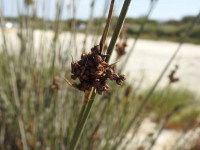
The flowers are small, hermaphroditic, and gathered in inflorescences called anthela, a particular form of panicle in which the lateral branches are more developed than the main ones. At the axil of the anthela there is often a bract that can resemble a leaf or appear cylindrical and rigid, sometimes with a spiniform apex, so much so as to seem an extension of the stem itself. Each flower is composed of 6 membranous tepals, 6 stamens, and a superior ovary uni- or trilocular with 3 carpels. The fruits are capsules containing numerous seeds (in the genus Juncus) or few seeds (in the genus Luzula).
From a reproductive point of view, Juncaceae are predominantly wind-pollinated (anemophilous pollination), although in some cases insects are involved (entomophilous pollination).
Distribution and diversity
The family Juncaceae is distributed mainly in temperate and cold regions worldwide, with a particular preference for wet and marshy environments. It includes about 8 genera and about 400 species globally. In Italy, there are about 40 spontaneous species mainly belonging to the genera Juncus and Luzula. These wet environments include marsh areas, riverbanks, wet meadows, and other areas with high soil moisture.
Main genera and representative species
The most important genera of the family Juncaceae are:
- Juncus: characterized by rush-like leaves, without cilia, with trilocular capsules containing numerous seeds. Among the best-known Italian species are Juncus effusus, common in reed beds and used for weaving and braiding, and Juncus maritimus, typical of coastal areas, used to produce ropes.
- Luzula: has leaves with a flat blade or rarely rush-like, always ciliate at least at the base. The capsules are unilocular and contain 3 seeds. The presence of marginal cilia is a distinctive character compared to Juncus.
Other less widespread genera include Distichia, Marsippospermum, Oreojuncus, Oxychloe, Patosia, and Rostkovia, but in Italy they are rare or absent.
Etymology
The name of the family derives from the type genus Juncus, a Latin name that indicated plants similar to rush, probably connected to the Latin verb “jungere” (to join, to bind), referring to the traditional use of these plants for making bindings, ropes, and braids.
Curiosities and uses
Juncaceae have a long tradition of use especially in artisanal activities related to weaving and the production of useful objects. For example, Juncus effusus is known to be used in the making of baskets or for chair seating, thanks to its resistant and flexible fiber. Juncus maritimus has historically been used for the manufacture of ropes, due to the robustness of its fibers.
Besides practical uses, some species of Juncaceae are employed as ornamental plants for borders of water mirrors, ponds, and small lakes, appreciated for their natural appearance and their ability to grow in wet environments, contributing to the ecological balance of such habitats.
Sources
- Wikipedia
Species of the family
1 species catalogued
Explore
Other botanical families