Botanical species
Frankenia laevis
L.
Sea-Heath
Description
Morphological description
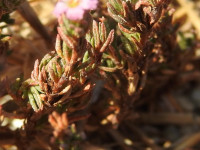
Perennial plant belonging to the family Frankeniaceae, it has a typically creeping and prostrate-ascending habit, with woody stems that adhere to the ground and ascending herbaceous branches. The stems are generally glabrous or may be slightly pubescent. The overall length of the plant is modest, with stems extending over the sandy or rocky substrate typical of coastal environments.
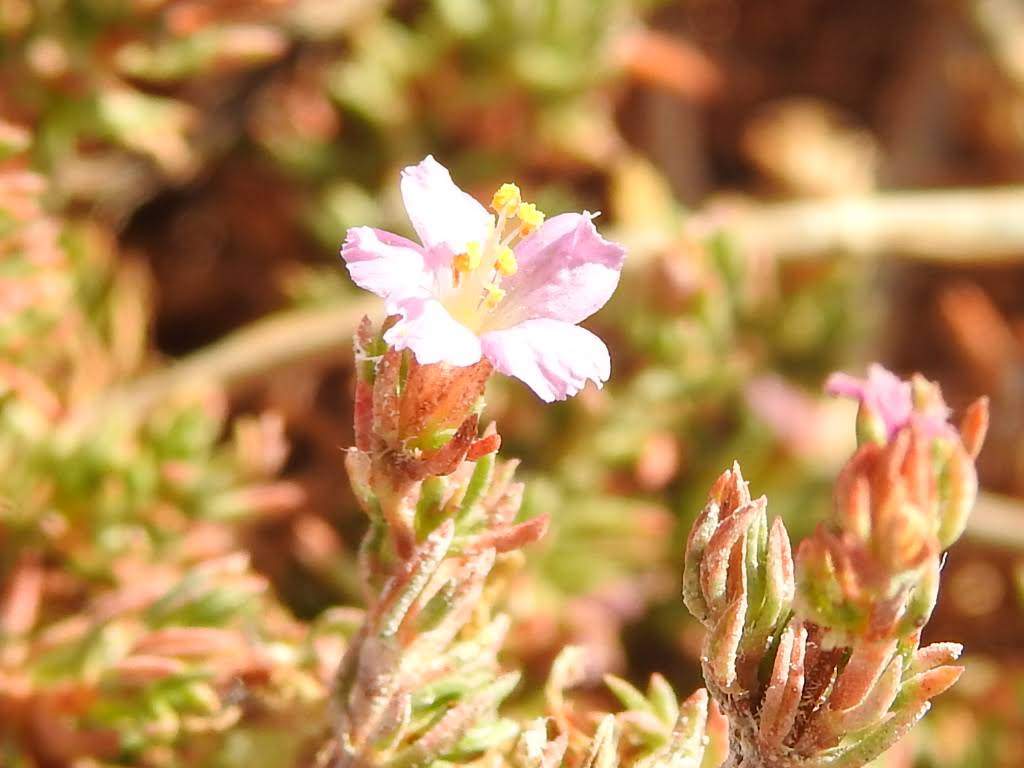
The leaves are fleshy, succulent in texture, arranged in pseudo-whorls or in small axillary clusters. The leaf blade is cylindrical in shape, thanks to a revolute margin that gives a tubular section and a length varying from about 3 to 7 mm and about 1 mm in width. The leaves are glaucous, often with a surface characterized by whitish encrustations, probably salt crystals or secretions typical of brackish environments.
The flowers are solitary or gathered in small few-flowered clusters, inserted among the leaves along the branches. The calyx, often reddish in color, measures from 2 to 3-5 mm in length and has a pentamerous structure. The petals are five, measuring between 5 and 6 mm, with a characteristic coloration: the base of the petal is yellow, while the limb is stained carmine red; occasionally flowers with pink or white petals may appear. This color contrast gives the flowers a vivid lilac-pink hue, making them easily recognizable during the flowering period.
The fruit and root system are little described in the available sources, but it can be deduced that, as in many psammophilous plants, the root system is well developed to anchor the plant in the sandy substrate and absorb water in often arid and brackish environments.
Habitat and distribution
This is a species typical of marine coastal environments with sandy or rocky substrate, particularly adapted to psammophilous and brackish conditions. In Italy it is mainly present in coastal regions, with greater distribution in Mediterranean areas such as Tuscany and Sardinia, where it has been precisely documented.
The plant generally grows at low altitudes, from the beach line up to a few meters in elevation, in environments exposed to sea breeze and high salinity, often in association with other species adapted to marine conditions. It prefers sunny exposures and is able to tolerate summer drought thanks to its leaf succulence.
Flowering period
Flowering typically extends from spring to early summer, particularly between April and June. Possible geographic variations are not detailed, but it can be hypothesized that in the southernmost Mediterranean regions the period may start slightly earlier, in relation to the milder climate.
Ecology and pollination
The flowers, characterized by vivid colors and marked contrasts, are probably visited by pollinating insects such as bees and butterflies, attracted by the coloration and the isolated or small group arrangement. The flower structure with well-distinct petals and a resistant calyx suggests an entomophilous reproductive strategy (pollination by insects).
Seed dispersal, although little documented, may occur by wind or water, considering the coastal habitat and proximity to the sea. The ability to adapt to brackish and sandy conditions makes this species a key element in dune ecosystems and transition zones between land and sea.
Curiosities and traditional uses
There are no specific data available on medicinal, food, or folkloric uses for this species. However, the common name "woody frankenia" refers to the woody texture of the stem and its belonging to the family Frankeniaceae, a group of plants often associated with brackish and coastal habitats.
Etymology
The genus name, Frankenia, is dedicated to the German botanist Johan Frankenius (or Franke), while the specific epithet "laevis" derives from Latin and means "smooth," probably referring to the surface of the stems or leaves. The Italian common name "erba franca legnosa" emphasizes the stem's woody texture and the plant's character as a robust herb adapted to coastal environments.
Sources
- Prof. P.V. Arrigoni, "Flora analitica della Toscana", "Flora dell'Isola di Sardegna"
- Tela Botanica / H. Coste, "Flore descriptive et illustrée de la France"
Characteristics
Where I found it (10 sightings)
Classification
- Kingdom
- Plantae
- Family
- Frankeniaceae
- Full name
- Frankenia laevis L.
- Life form
- Camefite suffruticose
Similar species
Search for species with similar characteristicsNoticed an error in the identification? Write to me
Explore
Other species of Frankeniaceae