Botanical family
Frankeniaceae
Description
Botanical characteristics
The plants of the family Frankeniaceae are generally herbaceous or suffrutescent, adapted to arid and saline environments, typical of desert or coastal areas. The typical habit includes fairly compact forms, with generally reduced and often scaly leaves, arranged oppositely on the branches. This characteristic is functional to reducing water loss, an adaptation to conditions of water stress.
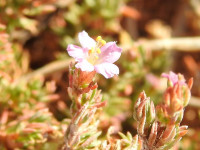
The flowers are hermaphroditic, actinomorphic (radially symmetrical), usually pentamerous and arranged in five whorls. They have sepals and petals in numbers of five (although they can vary from 4 to 6). The stamens are mostly six, with possible variations from 4 to a higher number. The carpels are generally four (sometimes two), forming a superior and unilocular ovary. The fruit is a loculicidal capsule, which opens along the walls of the locule to release the seeds.
These anatomical and morphological characters distinguish the family Frankeniaceae from other families of herbaceous plants and suffrutescent plants, especially for the combination of pentamerous flowers with a unilocular ovary and the presence of reduced and scaly leaves.
Distribution and diversity
The family Frankeniaceae is represented by a single genus, Frankenia, which includes several species of angiosperms. These plants are distributed mainly in arid and saline regions worldwide, with a particular presence in Mediterranean, desert, and coastal areas.
Their presence is mainly reported in habitats characterized by high soil salinity, such as coastal salt marshes or desert environments, where few other species manage to survive. This gives the family an important ecological role in brackish and arid ecosystems.
Main genera and representative species
Frankeniaceae is a monotypic family, that is, composed of a single genus: Frankenia. This includes numerous species spread across various regions of the world.
In Italy and the Mediterranean basin, some species of Frankenia are present, distinguished by their adaptability to saline and arid environments. These species contribute to the biodiversity of Italian coastal and brackish areas, performing essential ecological functions, such as soil stabilization and the creation of habitats for other life forms.
Etymology
The name of the family derives from the genus Frankenia, which in turn takes its name from the Swedish botanist Johan Frankenius. This type of denomination is common in botany, where family names are based on the type genus, in this case Frankenia.
Sources
- Wikipedia
Species of the family
1 species catalogued
Explore
Other botanical families