Botanical species
Aristolochia lutea
Desf.
Yellow Birthwort
Description
Morphological description
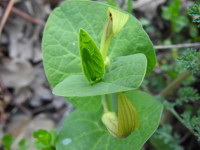
Perennial herbaceous plant generally between 10 and 60 cm tall, equipped with a globose, irregular, and superficial rhizome that allows it to survive and regenerate annually. The stem is annual, erect, striated, and branched especially at the base; its surface is finely hairy (minutely pubescent or puberulous), sometimes tomentose, giving the plant a velvety appearance. The habit is erect but with ascending branches.
The leaves are large, ovate in shape with entire margin and reniform base, and can reach a width of 9-10 cm. They have a petiole ranging from 1 to 3 cm and present fine hair on both surfaces. The texture is evergreen, a characteristic that allows the plant to maintain foliage throughout the year.
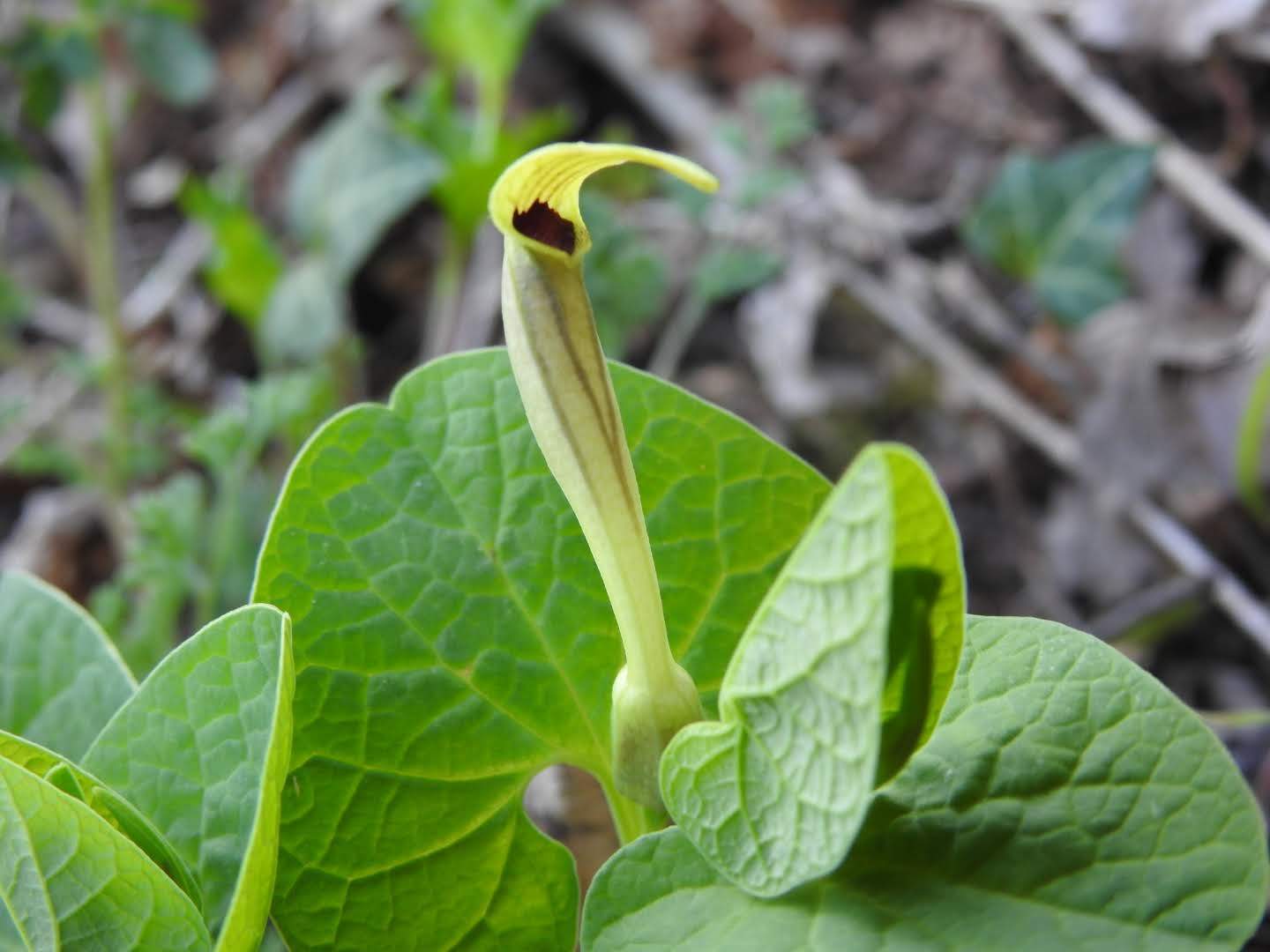
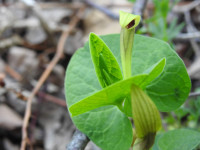
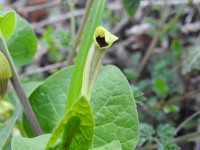
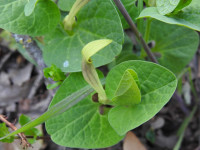
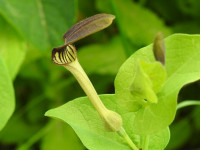
The flowers are solitary, hermaphroditic, zygomorphic in shape, and develop in axillary clusters at the leaf axils. They are rather large, up to 7.5 cm long, and are characterized by a perianth of yellow or yellow-greenish color, spotted with brown-purple at the throat. The flower tube is straight, progressively dilated upwards and then narrowed at the throat; it measures from 1.5 to 4.5 cm in length and from 1 to 3 mm in width at the base. The corolla limb is shorter or subequal to the tube and narrower, with a ligule about one third the length of the tube. The flower peduncles are pubescent and vary from 1 to 20 mm in length.
The fruit is a cerarium, that is, a capsule with incomplete dehiscence, pendulous and pear-shaped, with an umbilicate apex. It derives from a syncarpous gynoecium formed by 6 fused carpels containing triangular seeds. The chromosome number of the species is 2n=8.
Habitat and distribution
This species is typical of Mediterranean regions, with a range centered on the coasts of this basin but extending northwards and eastwards, in areas where grapevine has historically been cultivated. In Italy it mainly grows in deciduous broadleaf forests and in moist, shaded grassy environments with fresh soil. The preferred substrate is therefore forest soil, with exposure tending to be shaded or semi-shaded.
The superficial rhizome allows it to adapt to soils with some moisture and to colonize grassy forest spaces. The altitude of its growth is not specified precisely, but being a Mediterranean species it is generally found at low or hilly elevations.
Flowering period
Flowering mainly occurs between February and July, with possible variation depending on geographic location and climatic conditions. In general, the spring and early summer period is when the maximum flowering activity can be observed.
Ecology and pollination
The plant employs an entomophilous pollination strategy, i.e., mediated by insects. The intense scent of the flowers attracts pollinating insects, which, once inside the floral tube, are trapped by a barrier of waxy hairs that prevents them from exiting until the flower withers. This trap ensures that the insects are covered with pollen and thus promotes cross-fertilization.
Seed dispersal, deriving from a fruit with incomplete capsule dehiscence (cerarium), probably occurs by falling, but no specific data are available on the precise mode of dispersal.
Curiosities and traditional uses
The genus name Aristolochia derives from Greek and means "excellent for childbirth": these plants were historically used to stimulate uterine contractions during labor. The specific epithet lutea, meaning "yellow," refers to the typical color of the flower.
Despite its historical use in traditional medicine, especially in Asia, the plant is highly toxic, particularly nephrotoxic, and therefore its use in herbal or medicinal contexts is strongly discouraged. Toxicity is a common characteristic of many species in the genus Aristolochia, and the use of extracts or derivatives can be dangerous to health.
The flower, besides its intense fragrance, has a structure that functions as a trap for pollinating insects, a highly refined evolutionary strategy to ensure reproduction.
Etymology
The scientific name Aristolochia lutea combines the Greek terms "aristos" (excellent) and "locheia" (childbirth), alluding to the ancient use of the plant in obstetric practices. The term "lutea" indicates the yellow color of the flowers, which represents one of the most evident and distinctive characteristics of the species.
The Italian common name "Aristolochia gialla" derives precisely from this floral coloration, easily recognizable and significant for the identification of the plant.
Sources
- Acta Plantarum - Flora delle regioni italiane (scheda di Roberta Alberti)
Characteristics
Scheda botanica
| Famiglia | Aristolochiaceae |
|---|---|
| Fioritura | febbraio – luglio |
| Forma biologica | Bulbous |
| Habitat | with yellow flowers, with green flowers |
Domande frequenti
- Quando fiorisce Yellow Birthwort?
- Yellow Birthwort fiorisce febbraio – luglio.
- Che tipo di pianta è Yellow Birthwort?
- Yellow Birthwort è una Geophytes (Bulbous) secondo la classificazione di Raunkiaer.
- A quale famiglia appartiene Yellow Birthwort?
- Yellow Birthwort appartiene alla famiglia botanica Aristolochiaceae.
Where I found it (7 sightings)
Classification
- Kingdom
- Plantae
- Family
- Aristolochiaceae
- Full name
- Aristolochia lutea Desf.
- Synonyms
- Aristolochia longa auct. Fl. Ital.
- Life form
- Geophytes bulbous
Similar species
Search for species with similar characteristicsFurther reading
Noticed an error in the identification? Write to me
Other species of the same family
Aristolochiaceae
Explore
Other species of Aristolochiaceae