Botanical species
Aristolochia clematitis
L.
Birthwort
Description
Morphological description
Perennial herbaceous plant with a creeping and branched rhizome, from which aerial stems develop every year. The height generally varies between 20 and 100 cm. The stems are erect, herbaceous, simple or branched mainly at the base, sometimes sinuous and with a slightly woody base. They appear glabrous or with slight pubescence, with an angled cross-section.
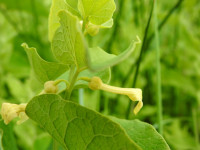
The leaves are alternate, with a blade ovate-cordate or deltate to reniform in shape, varying in size from 2-10 cm in length and 3-15 cm in width, with a finely dentate or crenate-dentate margin. The leaf base has a deep basal sinus that gives the typical heart-shaped form. The apex is obtuse or slightly rounded. The leaves have a petiole about one-third to half the length of the blade, glabrous and often 1.3-7 cm long.
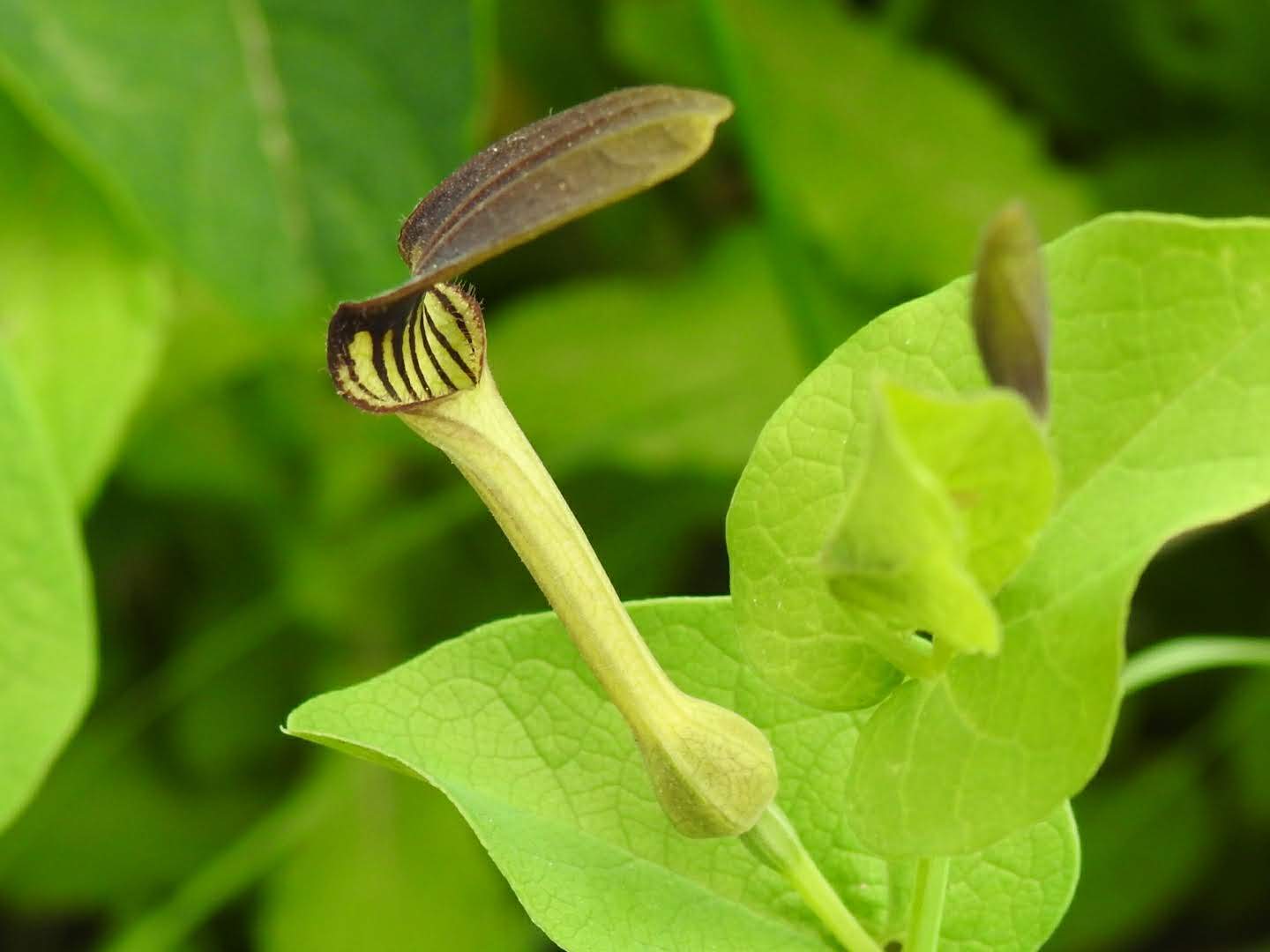
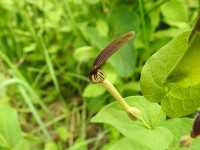
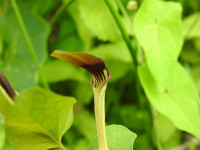
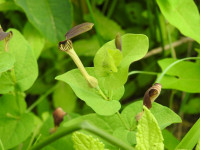
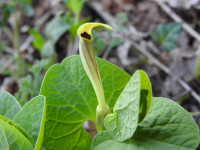
The flowers, which develop in clusters of 2 to many in the axils of the upper leaves, are medium-sized (2-3 cm), with a very characteristic shape similar to a “pipe”. The perianth has a cylindrical tube, curved upwards, and a funnel-shaped limb, golden yellow in color with brownish shades or brown stripes. The outer surface can be glabrous or slightly pubescent. The flower peduncle is about one-quarter to half the length of the leaf petiole, ranging from 0.2 to 4 cm. The flowers are zygomorphic and equipped with a “trap” mechanism for pollinating insects, with waxy coatings and internal hair barriers that temporarily trap insects to ensure fertilization.
The fruit is a pendulous capsule, ovate to cylindrical in shape, rather large compared to the plant, about 2-3 cm in diameter and length. The capsule has six valves and opens from the base upwards (basipetal dehiscence). The seeds are flattened, triangular in shape and about 1 × 1.2 cm, with a slightly rough surface.
The root system is characterized by a superficial, robust, and creeping rhizome, which allows the plant to survive from year to year and to colonize the surrounding environment.
Habitat and distribution
The species is widely distributed in Italian regions, with a range extending throughout the Mediterranean basin but also towards the temperate regions of central and eastern Europe. In Italy, it commonly grows along ditch margins, abandoned fields, uncultivated lands, vineyards, and on predominantly calcareous substrates. It can be found from sea level up to about 1000 meters altitude.
It prefers sunny or semi-shaded exposures, in open or semi-open environments, where the soil is well-drained, often calcareous or neutral. It is a rhizomatous geophyte species, capable of adapting to disturbed or anthropized habitats, with a certain rusticity.
Flowering period
Flowering mainly occurs in April and May, with slight variations depending on latitude and altitude. The flowers develop in correspondence with the upper leaves, in numerous clusters, characterizing the plant during spring.
Ecology and pollination
The plant attracts pollinating insects through an ingenious trap mechanism. The flowers emit a characteristic odor and have an internal surface coated with slippery waxy layers and hairs oriented to trap insects that enter, preventing them from leaving immediately. These insects, trapped and covered in pollen, are released only when the flower wilts, thus promoting effective cross-pollination. This strategy is typical of the Aristolochiaceae family and is fundamental for the species’ reproduction.
Seed dispersal occurs through the dehiscence of the pendulous capsules, with the seeds falling directly onto the soil near the parent plant, facilitating local colonization.
Curiosities and traditional uses
The genus name derives from Greek: “áristos” means “excellent, best” and “lochèia” refers to childbirth, indicating the ancient use of the plant in folk medicine as a remedy to facilitate labor and regulate the menstrual cycle.
Historically, the plant was used for its purgative, diuretic, astringent, and vulnerary properties. It was employed to treat rheumatism, gout, fevers, and even reptile bites, often based on popular beliefs and the doctrine of signatures, due to the flower’s shape resembling the uterus or a snake.
However, the species is toxic: the rhizome and leaves contain aristolochic acid, a highly harmful compound that can cause severe kidney damage and increase the risk of urinary tract cancers. For this reason, the pharmacological or dietary use of this plant is discouraged and banned in many countries, such as Germany, where products containing Aristolochia have been removed from the market.
From an ecological point of view, the golden yellow flowers and their peculiar odor are an evolutionary trap for pollinating insects, which, temporarily trapped in the corolla, promote fertilization.
Etymology
The scientific name derives from Greek and literally means “excellent childbirth”, referring to the traditional use of the plant as a labor stimulant. The specific epithet “clematitis” refers to plants of the genus Clematis, with which Aristolochia clematitis often leans on or grows nearby.
The Italian common name “aristolochia clematide” recalls the similarity of the leaves to those of some Clematis and highlights the peculiarity of the plant within its habitat.
Sources
- Prof. S. Pignatti, "Flora d'Italia"
- Acta Plantarum - Flora delle regioni italiane (scheda di Mirna Medri)
- World Flora Online (WFO)
Characteristics
Where I found it (5 sightings)
Classification
- Kingdom
- Plantae
- Family
- Aristolochiaceae
- Full name
- Aristolochia clematitis L.
- Life form
- Geofite radicigemmate
Similar species
Search for species with similar characteristicsFurther reading
Noticed an error in the identification? Write to me
Other species of the same family
Aristolochiaceae
Explore
Other species of Aristolochiaceae