Botanical species
Reseda alba
L.
White Mignonette
Description
Morphological description
Annual or perennial herbaceous plant, generally bushy and characterized by an erect habit that can reach a height ranging from 10 to 80 centimeters. The stem is robust, simple and often takes on a glaucous coloration, with a slightly waxy surface that gives a greenish-blue patina. In warmer and drier areas, the stem can lignify at the base, taking on a suffruticose appearance.
The leaves are arranged imparipinnately and have a pinnatisect structure, deeply incised with 5-15 pairs of narrow and linear lateral segments, ranging from 1 to 3-4 millimeters wide. The leaves are glabrous with entire or slightly undulate margins, while the base is decurrent along the stem. The texture is herbaceous, and the glaucescence may vary among populations.
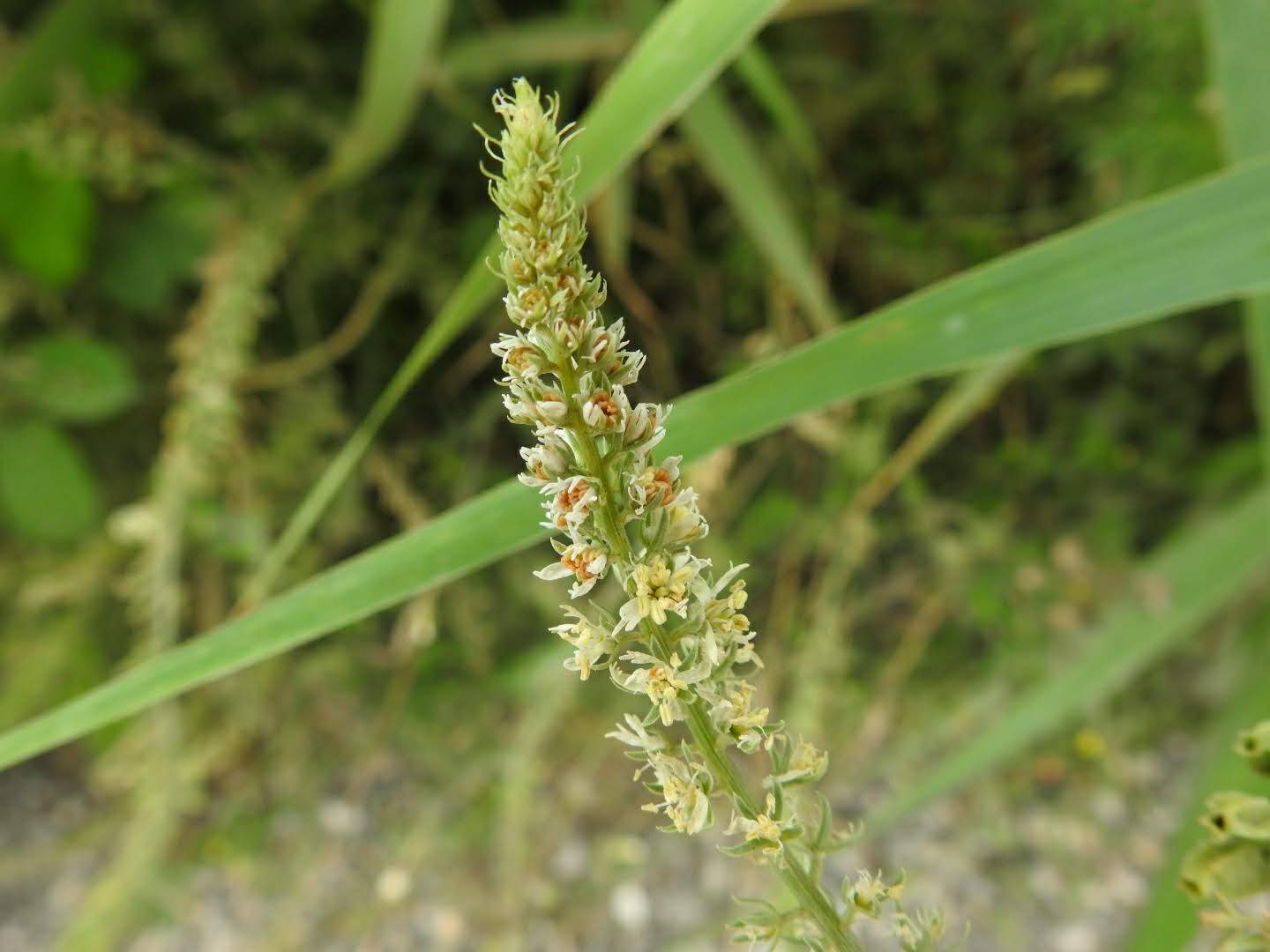
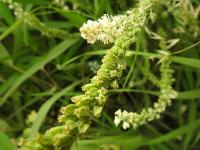
The flowers are gathered in long and dense racemes located at the apex of the stems, with pedicels 3-5 mm long. Each flower is pentamerous or rarely hexamerous, composed of 5 (or 6) lanceolate sepals, 2-4 mm long, persistent and white or whitish in color. The petals, longer than the sepals (3-7 mm), are white and in their apical half divide into three parallel linear lobes, giving the flowers a fine and delicate appearance. There are 10-16 stamens with glabrous and persistent filaments.
The fruit is a tetragonal capsule, obovoid-oblong, up to 1-1.5 cm long, with papillose or glabrous ribs and a quadridentate apex. The capsule is erect, more or less patent and contains reniform seeds, finely papillose and opaque.
The root system is not described in detail in the sources, but as typical of species adapted to arid habitats, it is presumed robust and capable of anchoring the plant on poor and gravelly substrates.
Habitat and distribution
Steno-Mediterranean species, Reseda alba is widespread along the coasts and inland areas of the Mediterranean basin, with a range that includes the Italian Peninsula (up to Romagna, Umbria and Maremma), Sardinia, Sicily, Corsica and the minor islands. In Italy it is also reported in Friuli and Veneto, although some populations may have disappeared.
It prefers open and sunny environments such as uncultivated areas, walls, gravel and rocks, with a particular preference for sandy substrates and dry climates. It grows from sea level up to 1000 meters altitude, adapting well to poor and dry soil conditions.
Flowering period
Flowering extends from January to December, indicating the plant's ability to bloom for most of the year, with possible variability depending on local climatic conditions. In some areas with mild winters, flowering can be earlier and prolonged.
Ecology and pollination
The plant presents a scapose floral system, with an elongated floral axis often leafless. The flowers, grouped in dense racemes, emit an unpleasant odor that can attract specific insects. Pollination is entomogamous, with pollinating insects visiting the flowers to collect pollen and nectar.
Seed dispersal occurs through the capsules which, once mature, open releasing the seeds onto the surrounding ground. The type of dispersal is not described as anemochorous or zoochorous, but it is presumed to be mainly barochorous (by falling) with possible secondary contribution by animals.
Curiosities and traditional uses
The genus name derives from the Latin “resedare,” meaning “to calm,” referring to the medicinal properties attributed to the plant since ancient times. In the ancient world, Reseda was used not only for therapeutic purposes but also in magical and propitiatory rites. Pliny the Elder reported that Reseda was employed to treat inflammations, accompanying the use with ritual formulas that involved spitting while reciting words of power.
From a medicinal point of view, White Mignonette is recognized as an officinal species with diuretic, calming, antirheumatic and anticatarrhal properties. However, such uses must be considered with caution and do not replace official medical therapies.
No significant alimurgical or food uses are reported, nor particular ornamental applications, although the plant is sometimes cultivated for its delicate appearance and prolonged flowering.
Etymology
The scientific name “Reseda” derives from the Latin “resedare,” meaning “to calm” or “to appease,” reflecting the calming properties attributed to the plant. The specific epithet “alba” refers to the white color of the flowers, which is the most evident characteristic of this species.
The Italian common name “White Mignonette” is a direct translation referring to the color of the flowers, distinguishing this species from others in the genus, often characterized by different colors.
Sources
- Prof. P.V. Arrigoni, "Flora analitica della Toscana", "Flora dell'Isola di Sardegna"
- Acta Plantarum - Flora delle regioni italiane (scheda di Marinella Zepigi)
- World Flora Online (WFO)
Characteristics
Scheda botanica
| Famiglia | Resedaceae |
|---|---|
| Fioritura | tutto l'anno |
| Forma biologica | Scapose |
| Habitat | with white flowers, Perennial plant, annual plant |
Domande frequenti
- Quando fiorisce White Mignonette?
- White Mignonette fiorisce tutto l'anno.
- Che tipo di pianta è White Mignonette?
- White Mignonette è una Therophytes (Scapose) secondo la classificazione di Raunkiaer.
- A quale famiglia appartiene White Mignonette?
- White Mignonette appartiene alla famiglia botanica Resedaceae.
Where I found it (4 sightings)
Classification
- Kingdom
- Plantae
- Family
- Resedaceae
- Full name
- Reseda alba L.
- Life form
- Therophytes scapose
Similar species
Search for species with similar characteristicsNoticed an error in the identification? Write to me
Explore
Other species of Resedaceae