Botanical species
Pistacia lentiscus
L.
Mastic Tree
Description
Morphological description
Pistacia lentiscus is a perennial evergreen plant belonging to the family Anacardiaceae, with a predominantly shrubby habit, although it can rarely take on a tree form, reaching a height of 1-3 meters as a bushy shrub, and up to 6-8 meters as a small tree. The crown is generally dense and globose, characterized by dense branching with branches that tend to assume a horizontal habit. The bark of young branches is ash-colored with a scaly tendency, while that of the adult trunk becomes reddish-brown; the wood is pinkish.
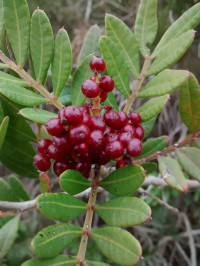
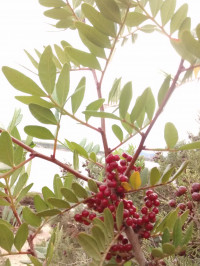
The leaves are alternate, paripinnate, with 6-10 segments (rarely from 4 up to 15), lanceolate-elliptic, varying in size between 7-30 mm in length, leathery in texture and glabrous surface. The upper side is dark green and shiny, while the underside is lighter and matte; the leaf segments have entire margins and obtuse apices equipped with a small mucro. The rachis is slightly winged.
The flowers are unisexual and pentamerous, petal-less, gathered in short dense cylindrical panicles, located in the axils of the leaves on the previous year's twigs. Male flowers are characterized by the presence of 4-5 stamens vividly bright red with a rudimentary pistil, while female flowers are green with a superior ovary. The color of the flowers varies from yellow to reddish-brown.
The fruit is a subspherical or lenticular drupe, 4-5 mm in diameter, fleshy, initially reddish then becoming black at maturity. Each fruit contains a single seed. The root system is typical of Mediterranean xerophilous species, with deep roots that favor survival in arid environments and poor soils.
The entire plant has a marked resinous, characteristic and aromatic odor, due to the presence of resins and essential oils.
Habitat and distribution
Pistacia lentiscus is a typical species of the evergreen Mediterranean maquis, widespread throughout the European, Asian, and North African Mediterranean basin, extending to the Macaronesian islands (Canary Islands). In Italy it is mainly present in coastal regions and the major islands, with significant populations in Sardinia, Sicily, and along the Tyrrhenian and Adriatic coasts.
It prefers marine and coastal environments but adapts up to 600 meters of altitude. It grows on siliceous soils, often poor and well-drained, but is very versatile and resistant also on more difficult, rocky, and arid substrates. It is a heliophilous, thermophilous, and xerophilous plant, capable of withstanding long summer droughts and high temperatures typical of the Mediterranean climate.
It is not a primary colonizing species but plays an important role in the degradation phases of the Mediterranean maquis, especially following repeated fires, where it can become dominant.
Flowering period
Flowering mainly occurs between March and May, with slight local variations related to climate and altitude. Flowers appear on the previous year's twigs, forming dense and cylindrical panicles. Fruiting follows between October and November, when the drupes mature, changing from red to black.
Ecology and pollination
Pistacia lentiscus is a dioecious species, with unisexual female and male flowers on separate plants. Pollination is mainly anemophilous, but also pollinating insects, attracted by the conspicuous red stamens of the male flowers, contribute to pollen transport. Flowering attracts various species of pollinating insects, favoring good fertilization.
Seed dispersal mainly occurs through birds that feed on the mature drupes, thus contributing to the spread of the species. The fleshy and colorful drupes are an effective lure for wildlife.
Curiosities and traditional uses
Pistacia lentiscus has had multiple uses in the past, both practical and medicinal, as well as significant ecological value.
-
Ethnobotany and medicinal uses: The resin extracted by incisions on the trunk and branches, called mastic of Chios, is traditionally used in folk medicine for its anti-inflammatory, antiseptic, and balsamic properties. Chewing mastic helps combat gingivitis, periodontitis, and bad breath. The essential oil extracted from the fruits has anti-inflammatory, sedative, and balsamic properties, useful for rheumatism and inflamed mucous membranes, while the tannic leaves were used in leather tanning.
-
Food uses: Although not a fruit-bearing plant, the seeds can be used to obtain an oil used in cosmetics and for the production of soaps with balsamic and antiseptic properties.
-
Practical and ornamental uses: The hard and reddish wood is appreciated for inlay work and small turnings. It is widely used as fuel for wood ovens, thanks to its ability to quickly reach high temperatures and maintain combustion for a long time.
-
Ecological and landscape role: It is a fundamental species in restoring vegetation cover on denuded and degraded soils, often employed in environmental reclamation projects and for green furnishings of marginal areas, slopes, and rocky environments. Its rusticity and resistance to pruning also make it suitable for ornamental hedges and Mediterranean or rocky gardens.
-
Impact on spontaneous flora: Its cut green leaves are highly demanded by the floral market for mixed floral arrangements, although indiscriminate harvesting is causing damage to wild populations in some Mediterranean areas.
Etymology
The genus name Pistacia derives from the Greek "pistákion," which in turn connects to the Persian "pistáh," a term that can mean "rich in flour" or "pistachio." The specific epithet lentiscus is of Latin origin and already indicated this species in ancient times.
The Italian common name "lentisco" derives directly from the Latin lentiscus, thus maintaining a historical and cultural continuity in the naming of the plant.
Sources
- Prof. S. Pignatti, Flora d'Italia
- Acta Plantarum - Flora delle regioni italiane (scheda di Daniela Longo)
- Tela Botanica / H. Coste, Flore descriptive et illustrée de la France
Characteristics
Where I found it (1 sightings)
Classification
- Kingdom
- Plantae
- Family
- Anacardiaceae
- Full name
- Pistacia lentiscus L.
- Life form
- Fanerofite cespugliose
Similar species
Search for species with similar characteristicsFurther reading
Noticed an error in the identification? Write to me
Explore
Other species of Anacardiaceae